Two buildings with 22 and 39 floors above ground;
Commercial, office, and cultural facilities to be placed in both buildings,
Observatory to be built on the rooftop
Bus terminal to be located underground,
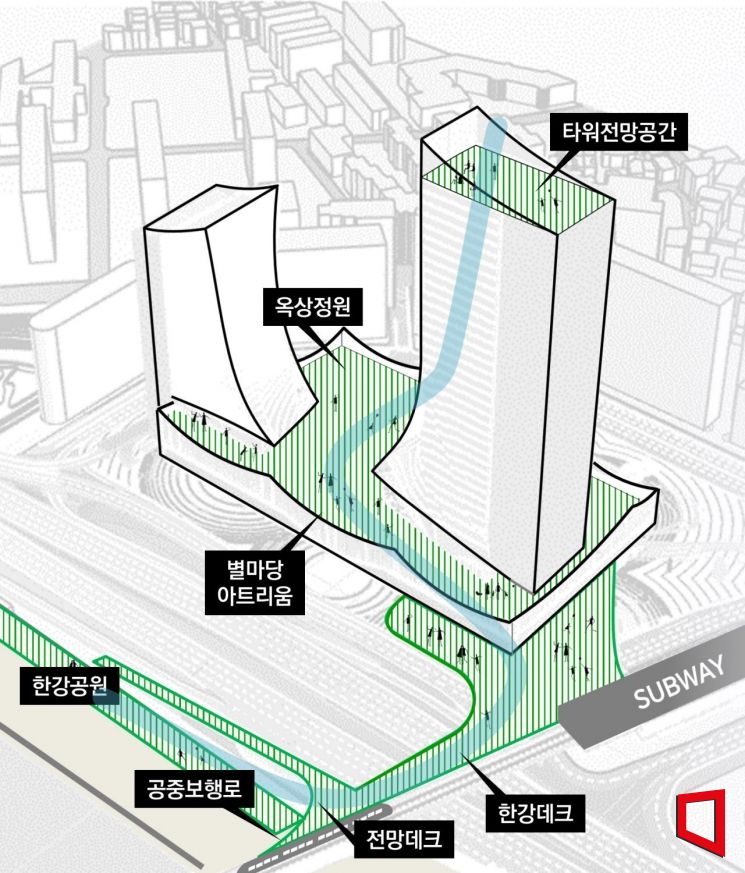
Pedestrian deck connecting to the Han River to be installed
Plan finalized 16 years after designation as preliminary negotiation site in 2009
Temporary terminal to be set up underground at Guui Park,
Redevelopment to be completed by 2026
Temporary terminal reduced to two underground floors
due to residents' opposition
The East Seoul Terminal will be transformed into a massive, multi-purpose complex with up to 39 floors. The passenger terminal and transfer center will be located underground, while commercial, office, and cultural facilities will be placed above ground. An observatory overlooking the Han River will be built on the rooftop. During the construction period, a temporary terminal will be set up underground at Guui Park, and after its use as a temporary terminal, it will be remodeled and provided as a community facility for residents.
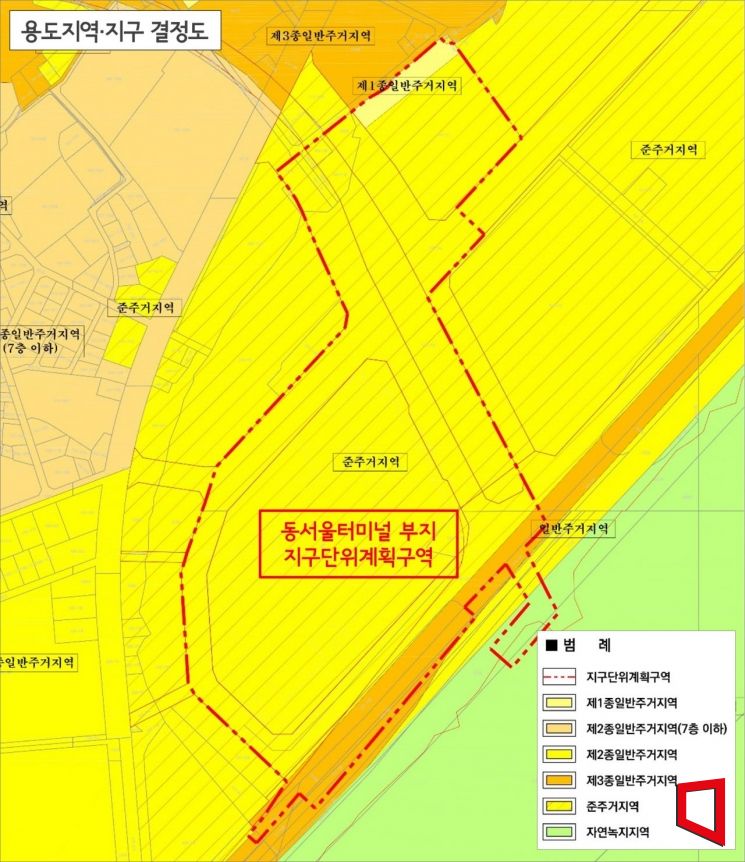
On May 29, the Seoul Metropolitan Government announced that the 9th Urban and Architectural Joint Committee had approved, with modifications, the "Designation and Planning Decision (Draft) for the District Unit Planning Zone of 546-1 Guui-dong (East Seoul Terminal site)."
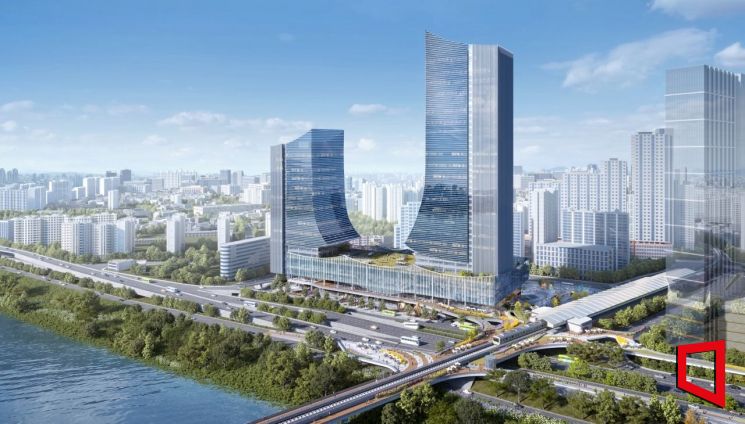
Two buildings with 22 and 39 floors above ground... Terminal and transfer center to be placed underground
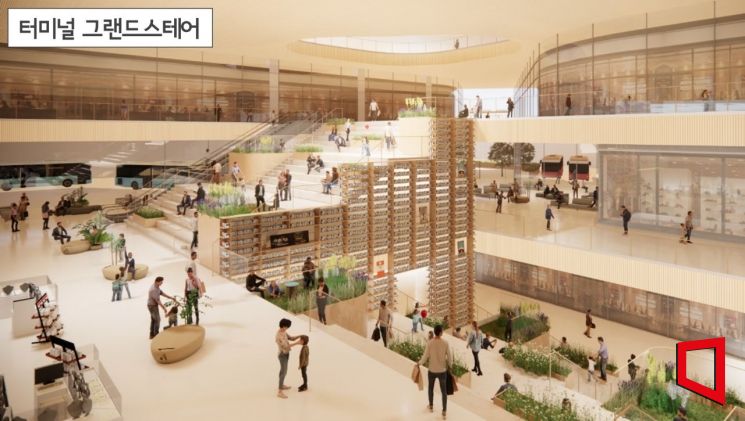
The East Seoul Terminal modernization project will construct two multi-purpose buildings with 7 underground and up to 39 above-ground floors (total floor area of 363,000 square meters), one with 22 floors and the other with 39 floors above ground. The passenger terminal and transfer center will be located underground. The lower above-ground floors will house retail and cultural facilities, while the upper floors will be used for offices. An observatory will be installed on the rooftop, offering views of the Han River and Seoul, for all visitors and citizens to enjoy. The project developer is Shinsegae Dongseoul PFV (including Shinsegae Property).
The East Seoul Terminal opened in 1987 and is the busiest intercity bus terminal in the country. It operates over 110 routes connecting inland regions such as Gangwon-do, Chungcheong-do, and Gyeongsangbuk-do. The aging facilities have raised safety concerns, and crowds and buses have caused traffic congestion in the surrounding area.
In 2009, the city introduced a preliminary negotiation system and selected the area around East Seoul Terminal as a negotiation target. The project was delayed due to changes in the developer, such as the transfer of ownership from HJ Heavy Industries (formerly Hanjin Heavy Industries) to Shinsegae Property in June 2019. After the terminal acquisition, a proposal for a full-scale review was submitted, and following negotiations and coordination meetings from August 2022, the business negotiations were completed in December 2023. In April last year, the city initiated the draft for the designation and planning decision of the district unit planning zone, and after public inspection, consultations with relevant departments, and review of residents' opinions, the plan passed the review in just over a year.
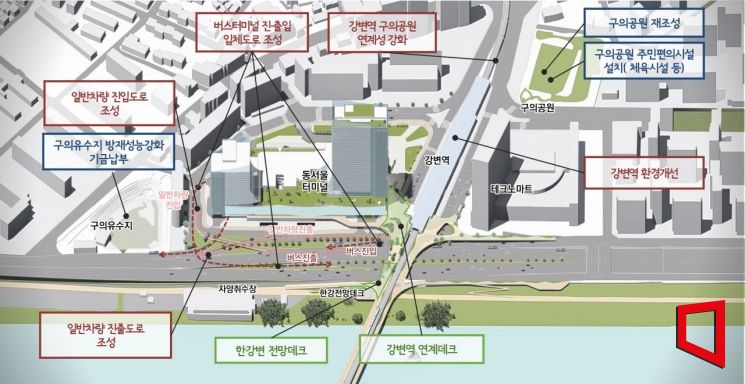
The public contribution secured through preliminary negotiations with the developer, Shinsegae Dongseoul PFV, amounts to a total of 138.14 billion won. Using this public contribution, a direct ramp will be newly constructed to directly connect East Seoul Terminal with the Gangbyeonbuk-ro expressway. Once the direct ramp connecting Gangbyeonbuk-ro and East Seoul Terminal is installed, traffic congestion and pollution caused by buses will be reduced. The public contribution will also be used to install a pedestrian deck connecting the terminal, the above-ground area, and the Han River. Additional public contribution funds will be invested in remodeling the exterior of Gangbyeon Station on Subway Line 2, creating a plaza under the overpass, and establishing community facilities above and below ground at Guui Park, as well as upgrading the flood control performance of the Guui water storage site.
Temporary terminal to be set up underground at Guui Park... Residents also express opposition
During the modernization construction period, the underground space of Guui Park will be used as a temporary terminal. The city plans to complete the "Guui Park Redevelopment" project by next year so that the surface remains a park while the underground is used as a temporary terminal. After its use as a temporary terminal, the underground space will be remodeled and provided as a community facility for residents. Unlike other municipalities, the temporary terminal will be operated as an indoor building with a waiting area and ticketing space. The above-ground green space will be increased by 1.7 times compared to the current size, and sports and cultural facilities will be established underground.
After the district unit plan, including the Guui Park redevelopment proposal, was made public in June last year, residents of Gwangjin-gu strongly opposed the plan, which delayed the construction schedule. Residents have demanded that, instead of Guui Park, another location within East Seoul Terminal or another area near Gwangjang-dong be used as the temporary station. The city and Gwangjin-gu have held meetings and operated a resident communication council to consult with residents. Initially, the city planned to use up to three underground floors of Guui Park for the temporary terminal, but in consideration of residents' opinions, this was reduced to two underground floors.
An official from the Seoul Metropolitan Government said, "After the public notice, there were concerns from residents about the risks of underground construction, and to reduce traffic, we reflected their opinions by limiting the temporary terminal function to two underground floors. We reviewed 10 other sites besides Guui Park, but this was the best option, so we are continuing discussions with residents. The redevelopment of Guui Park is expected to take about 15 months."
The revised and approved district unit plan for the East Seoul Terminal modernization project is expected to be officially announced in June. After completing individual permits and administrative procedures, such as the traffic impact assessment, architectural review, and building permits, construction could begin as early as the second half of 2026. The goal is to complete the project by 2031.
Lim Changsu, Director of Future Space Planning at the Seoul Metropolitan Government, stated, "We will transform the aging East Seoul Terminal into an innovative space where passengers, offices, retail, and culture can all be enjoyed in one place, and redevelop the nearby park to be citizen-centered, creating a new landmark complex transportation hub in the northeastern region. We will work closely with citizens, local governments, and developers so that this can serve as a driving force for urban development through connections with the Han River and the local community."
© The Asia Business Daily(www.asiae.co.kr). All rights reserved.
![Clutching a Stolen Dior Bag, Saying "I Hate Being Poor but Real"... The Grotesque Con of a "Human Knockoff" [Slate]](https://cwcontent.asiae.co.kr/asiaresize/183/2026021902243444107_1771435474.jpg)

















