"Chinese AI Advances Regardless of Access to American Chips"
Jensen Huang, CEO of Nvidia, criticized the semiconductor export control regulations imposed on China by the Donald Trump administration, stating that China's artificial intelligence (AI) sector continues to develop even without American-made chips.
On May 28 (local time), during a conference call following Nvidia's first-quarter earnings announcement, Huang said, "Regulations are actually strengthening Chinese semiconductor companies," expressing this viewpoint.
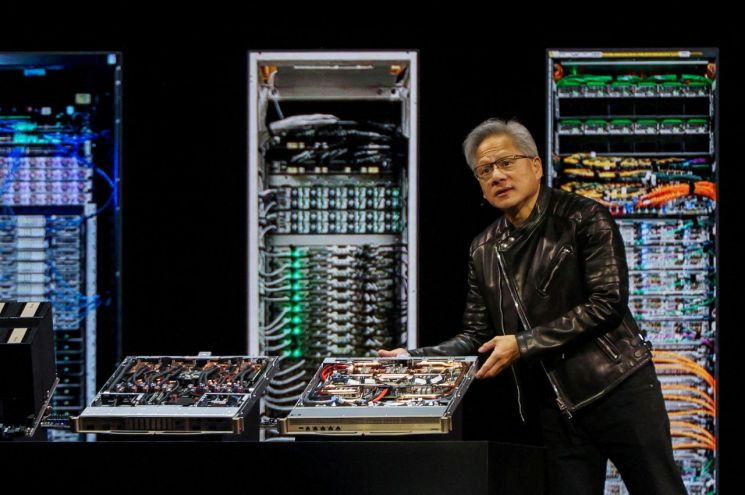
He warned, "American leadership is at risk," and pointed out, "U.S. policy is based on the assumption that China cannot develop AI on its own, but this assumption is clearly wrong." He also emphasized that American platforms should form the foundation of AI.
Nvidia previously released the H20 chip for the Chinese market, with its performance downgraded to comply with U.S. semiconductor export regulations. However, last month, the Donald Trump administration further tightened semiconductor export controls on China and notified Nvidia of new export restrictions on the H20 chip as well. Huang stated, "We cannot further lower the performance of the H20 to comply with the regulations."
When asked whether Nvidia would release a new chip for China, he replied, "President Trump has a plan. I trust that plan," and added, "Nvidia is working to develop products for the Chinese market, but there is nothing to announce at this time."
The impact of the Trump administration's semiconductor export control policy on China has also appeared in Nvidia's earnings. Nvidia announced that it expects $45 billion in revenue for the next quarter (May to July), which falls short of the $45.9 billion forecast by market research firm LSEG. Nvidia stated that if there had been no recent export restrictions on H20 chips to the Chinese market, its revenue outlook for the next quarter would have been about $8 billion higher.
CFO Colette Kress said, "Gross profit margin has declined due to export restrictions to China," and added, "Without such impacts, gross profit margin would have exceeded expectations." She further stated, "The bigger issue is that the size of the market Nvidia cannot access is growing," and added, "The Chinese market will grow to $50 billion, and we have lost a $50 billion opportunity."
Kress also remarked, "The new (semiconductor export) regulations are having a tangible impact on Nvidia and are likely to benefit overseas competitors." She also pointed out that no grace period was provided for inventory disposal.
Although Nvidia's exports to China have been blocked, the company is diversifying its global sales. By accompanying President Trump on his Middle East tour, Nvidia has signed a supply contract for its latest AI chips with a Saudi Arabian company and will participate in building data centers in the United Arab Emirates. Huang said he plans to visit Europe next week and emphasized, "Every country needs sovereign AI."
© The Asia Business Daily(www.asiae.co.kr). All rights reserved.
![Clutching a Stolen Dior Bag, Saying "I Hate Being Poor but Real"... The Grotesque Con of a "Human Knockoff" [Slate]](https://cwcontent.asiae.co.kr/asiaresize/183/2026021902243444107_1771435474.jpg)















