The Capital Area's First Extreme Weather-Themed "Climate Change Safe Park" to Be Established This Year
"Ensuring Everyone Can Enjoy Nature Close to Home"
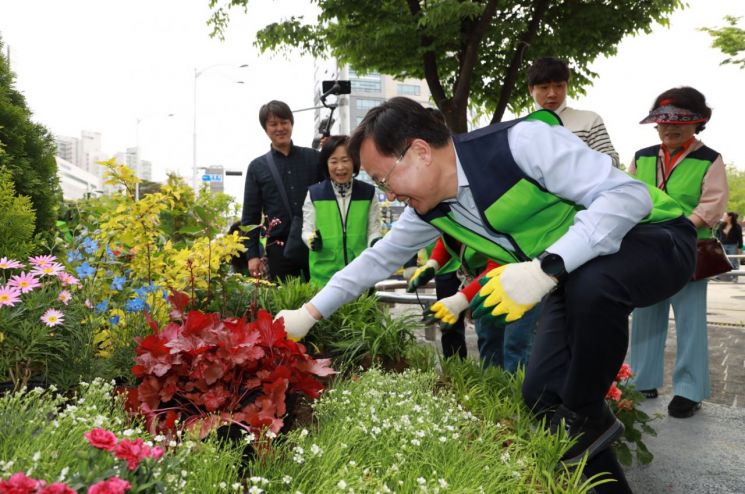
Geumcheon District in Seoul (District Mayor Yoo Seonghoon) is actively working to create more green spaces in the city center. Green spaces serve as urban refuges, help lower temperatures during heat waves, block fine dust, and act as carbon sinks.
Previously, Yoo Seonghoon, the mayor of Geumcheon District, made continuous efforts to expand the area of neighborhood parks since the 7th popularly elected administration. The walkable neighborhood park area increased significantly from 563,751 square meters to 766,386.8 square meters, and the per capita park area also rose from 2.32 square meters to 3.15 square meters. However, according to the National Statistical Portal (KOSIS), as of 2023, the green space ratio in Geumcheon District is only 22.25% (an area of 2,895,630 square meters), ranking among the bottom five out of Seoul’s 25 districts.
In response, the district is promoting garden and park development to improve the bleak environment and provide residents with spaces to connect with nature, thereby strengthening Geumcheon’s image as a place where people want to walk and stay. With the goal of becoming a “Green City Geumcheon,” the district is implementing various initiatives: creating parks to respond to the climate crisis, expanding key hub parks, increasing everyday parks, building parks considerate of urban minorities, and offering resident participation programs.
The Capital Area’s First Extreme Weather-Themed Climate Change Safe Park
Geumcheon District is introducing climate-adaptive designs in its parks to help address environmental issues. This year, for the first time in the capital area, a “Climate Change Safe Park” themed around extreme weather will be established in Siheung-dong. The existing San Gisuk Park in Siheung-dong will be revamped to incorporate climate-adaptive design that enables the park to contribute to solving environmental problems. The existing waterfall will be utilized to create a nature-friendly cooling shelter. The park is being designed as a healing space in nature for residents, equipped with carbon reduction and heat island mitigation functions. A climate crisis clock, displaying the time remaining until the Earth’s average temperature rises by 1.5 degrees Celsius above pre-industrial levels, will be installed to raise awareness of the urgency of climate change.
Earlier, the district also created a “Climate Response Urban Forest” along the Anyangcheon Stream. A total of 1,469 trees of species highly effective at reducing fine dust, such as Skyrocket Juniper, Emerald Green, and Blue Angel, were planted. This urban forest enhances the absorption and blocking of harmful ultrafine dust generated by railroads and highways, thereby protecting residents’ health and improving the living environment.
Expansion of Key Hub Parks
Geumcheon District is expanding large parks that reflect local characteristics, such as Omi Ecological Park, the G-Valley Garden Factory in the Seoul Digital Industrial Complex, and the Namseoul Hope Forest. These parks are being developed as multi-purpose spaces for walking, relaxation, and ecological education, serving as central spaces for the community.
In November last year, “Omi Ecological Park,” covering an area 2.7 times the size of a soccer field (about 18,500 square meters), was built in the Siheung Valley at the foot of Hoam Mountain. The name reflects the aspiration to enhance the charm of the garden through the five scents of forest, flowers, earth, people, and water that can be experienced in Siheung Valley. After design and about a year of construction, the park now features the “Baekin Baekhyanggiwon” (Garden of a Hundred People and a Hundred Scents), a 100-meter-long “Yellow Earth Barefoot Trail,” the “Mureogwi Rest Area” where two streams converge, a rose garden symbolizing the love of Venus, a garden healing center, and a fitness facility. The 4-kilometer “Garden Path” within the park also connects to the Seoul Dulle-gil trail, offering expansion potential.
The district plans to create the “G-Valley Garden Factory” in the Gasan-dong area. G-Valley, the only national industrial complex in Seoul, is an industrial and business area with a low green space ratio. The district aims to improve the bleak environment through greenery, while establishing a sustainable and resilient green corridor to enhance the competitiveness of the industrial complex. In particular, by securing open spaces in knowledge industry centers and linking them with gardens, the district plans to create spaces for workers to rest and walk.
There are also plans to establish the “Namseoul Hope Forest” by 2028. On December 24 last year, the district signed an agreement with Yoido Full Gospel Church, the landowner, to create the Namseoul Hope Forest on 250,000 square meters of land, equivalent to 34 soccer fields. The plan is to develop a forest recreation area with a forest campground, forest bathing area, and barrier-free forest trails for residents to enjoy relaxation. As this area is included in Section 12 of the Seoul Dulle-gil trail, it is expected that residents will be able to conveniently use the forest recreation space once it is completed.
Everyday Parks
Geumcheon District is striving to create green spaces that residents can easily access in their daily lives. In front of Geumcheon-gu Office Station, the “Farewell and Welcome Garden” has been established for residents who start and end their day commuting through the station. A “Welcome Garden” was created to greet commuters, based on the district’s symbols and city brand colors. Additionally, the “Fog Garden” was built in the multipurpose plaza of Doksan 3-dong, the “Cozy Garden” in the village park of Doksan 2-dong, and the “Food Garden” (urban farm) inside the Geumcheon-gu Office building.
At Anyangcheon Stream, residents can enjoy seasonal roses from spring until the first frost. Starting with the Geumcheon Hannae Rose Garden in 2019, the riverside flower path was expanded over about five years, resulting in the phased completion of a “Rose Garden” with a total length of 2 kilometers and an area of 5.8 hectares. Currently, 151,724 roses of 68 varieties are planted, creating a spectacular display of colorful blooms.
Parks for Urban Minorities and Expansion of Resident Participation Programs
Geumcheon District also pays close attention to urban minorities such as young children, seniors, and people with disabilities. Parks are being designed to be easily accessible for these groups. Barrier-free spaces are being expanded through wheelchair-accessible entrances and rest areas, with the goal of creating parks that are safe and convenient for everyone.
In fact, last year, a circular, barrier-free route totaling 2.18 kilometers was completed at Geumcheon Sports Park, including a barrier-free forest trail, the Gamrocheon Starlight Bridge, and an observatory. The barrier-free forest trail was built with a width of over 2 meters and a slope of 8.3% so that people with disabilities and the elderly can enjoy the forest scenery and relax. This allows more residents to conveniently stroll through the park and enjoy rest and leisure, establishing Geumcheon Sports Park as a representative park of the district.
In addition, a barrier-free wooden deck walking trail was opened at Hoam Neulsoll-gil. Meaning “the path where pine breezes always blow,” Hoam Neulsoll-gil is adjacent to the Gwanaksan section of the Seoul Dulle-gil trail and offers a tranquil atmosphere throughout the year. A 0.41-kilometer barrier-free wooden deck trail was also built in Triangle Park, which has a slope. Previously, access was difficult for people with limited mobility, but now they can comfortably use the park.
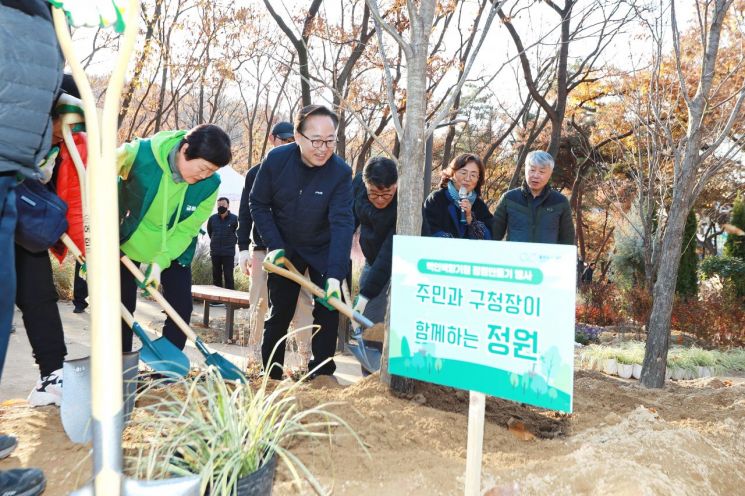
Furthermore, the district is expanding programs that allow residents to directly participate in park creation and maintenance. Through gardening education, volunteer activities, and community garden operations, these programs foster affection for parks and strengthen community spirit.
Yoo Seonghoon, mayor of Geumcheon District, stated, “We will expand green spaces and parks within the city so that all residents can enjoy nature nearby, and increase green infrastructure to transform Geumcheon into a ‘green city.’ We will also strive to achieve multiple effects, including carbon neutrality, response to the climate crisis, and securing resident rest areas.”
© The Asia Business Daily(www.asiae.co.kr). All rights reserved.


















