City buses in Changwon Special City, South Gyeongsang Province, have come to a halt once again. From early in the morning, Changwon citizens faced chaos on their way to work and school.
After the second and third rounds of mediation between management and labor of Changwon city buses, held at the South Gyeongsang Regional Labor Relations Commission, ended in a final breakdown, nine city bus companies in Changwon suspended operations starting from the first bus on May 28.
 On the first day of the strike by nine city bus companies in Changwon in 2025, Changwon citizens are using emergency transportation. Photo by Se Ryeong Lee
Previously, the labor and management of the nine city bus companies had held five rounds of negotiations and two preliminary mediations since December 20, 2024, in preparation for the 2025 wage and collective bargaining agreements.
The second round of mediation began at 2 p.m. on May 27, but even after extending the third round until 3 a.m., labor and management ultimately failed to reach an agreement.
A total of 669 buses joined the strike, accounting for 95% of all city buses in Changwon.
The city of Changwon deployed 170 chartered buses, 10 government-owned buses, and 330 leased buses in preparation for the strike. However, citizens were left waiting indefinitely for buses whose arrival times were uncertain.
Citizens who were ill or had mobility issues struggled to board and disembark from the chartered buses, which have relatively higher floors.
Some passengers were unable to signal for their stop properly because there were no bells inside the buses.
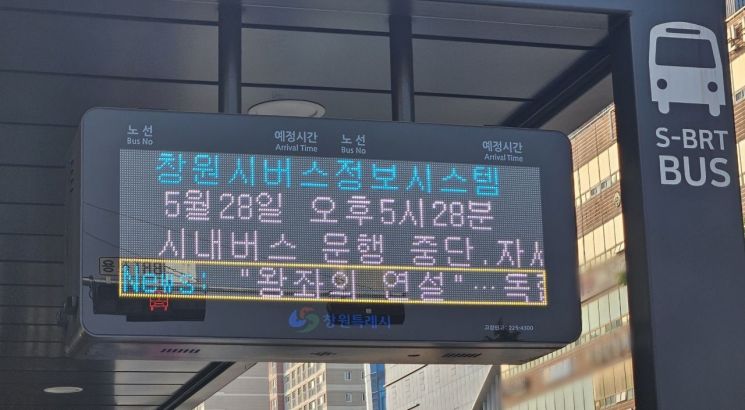 A message notifying the suspension of city bus operations is displayed on the Changwon City Bus Information System screen. Photo by Lee Seryeong
One citizen complained, "Why should we suffer when labor and management are fighting? I don't know when the bus will come, and I'm nervous because I'm not sure if the driver knows the route well."
Another citizen said, "I wonder if it is right to continue the semi-public bus system. Even if an agreement is reached, it seems like only the taxes we have to pay will increase, so we will suffer inconvenience due to the strike and also have to pay more, which is frustrating."
Yet another citizen commented, "It took longer to get to work this morning than it would have by taking the bus. Just in case, I think I'll have to leave even earlier tomorrow than usual."
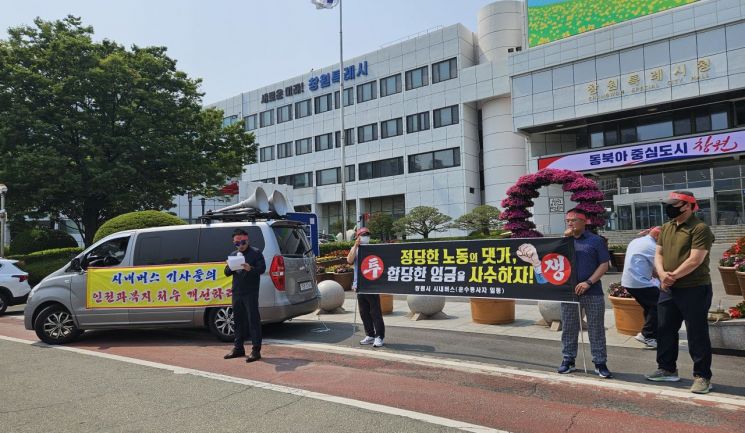 Bus drivers working in Changwon city are urging for better treatment in front of Changwon City Hall. Photo by Se Ryeong Lee
Previously, labor and management have been at an impasse over several issues: reflecting regular bonuses in ordinary wages following the Supreme Court's full bench ruling on December 19, 2024, increasing wages by 8.2%, and extending the retirement age from 63 to 65.
The management side argues that the ordinary wage issue will increase labor costs and proposes to minimize wage increases by restructuring the wage system. However, the labor side insists that ordinary wage matters and wage negotiations should be handled separately.
Changwon City, which has adopted the semi-public bus system, also expressed concerns, stating, "With the city bus industry operating at a deficit, the increasing labor costs will directly translate into a heavier financial burden for the city."
The city explained that while improving working conditions for employees is necessary to create a stable operating environment?consistent with the purpose of the semi-public system, which involves the municipality partially managing private bus companies, covering deficits to guarantee reasonable profits, and alleviating concerns about job insecurity or unpaid wages for bus drivers?the union's demands are excessive.
 Citizens are waiting for the bus at the bus stop in front of Changwon City Hall. Photo by Lee Seryeong
According to the city, financial support for Changwon city buses increased by about 27 billion won, from 58.6 billion won in 2020 (before the semi-public system was implemented) to 85.6 billion won in 2024.
Of this increase, 19 billion won was for driver labor costs, accounting for 70% of the total increase.
The city explained that if the 33 billion won increase in labor costs due to ordinary wage and wage increases is fully reflected, the total financial support would reach 120 billion won, a 40% increase from last year, resulting in a heavier tax burden for citizens.
The city criticized, "Even though the management unusually took the initiative to propose measures to improve working conditions, the union still went on strike. Even in Seoul, where the union was negotiating most fiercely over ordinary wages, the union postponed the strike, but the Changwon bus union seems to have no regard for the inconvenience caused to citizens."
The city also stated, "The union has taken citizens hostage and shaken the foundations of the semi-public system. Demanding that all costs be covered by citizens' taxes while only insisting on the union's position does not gain public sympathy and is unacceptable to the city."
While labor and management have agreed to resume negotiations at 2 p.m. today, both the city and Changwon citizens are closely watching the progress. If this round of negotiations also breaks down, the strike is expected to continue.
© The Asia Business Daily(www.asiae.co.kr). All rights reserved.



















