Democratic Party's Presidential Election Pledges
Focus on Real Estate and Housing Policies
On May 28, experts generally assessed that the Democratic Party of Korea's 21st presidential election policy pledges, particularly in the area of real estate and housing policy, lacked any standout measures. Both inside and outside the campaign of Lee Jaemyung, the Democratic Party's presidential candidate, there has been no clear articulation of a real estate policy stance. This low-key strategy is attributed to the widespread perception that housing prices soared during the Democratic Party's previous administration. Regardless of the underlying motives or intentions, it is interpreted that the party believes its ineffective real estate policies significantly contributed to the loss of public support.
The real estate and housing policies announced on this day mainly involve strengthening existing policies or suggesting broad directions rather than presenting concrete roadmaps. Even for housing supply, a common topic in presidential pledges, the party only mentioned plans to expand supply without specifying concrete targets or methods. One expert, who wished to remain anonymous, stated, "In the case of housing supply, it takes years to plan, obtain permits, and complete construction before actual occupancy is possible," adding, "Given this, it would be reasonable to expect at least rhetorical pledges, but this time, the approach is rather unusual."
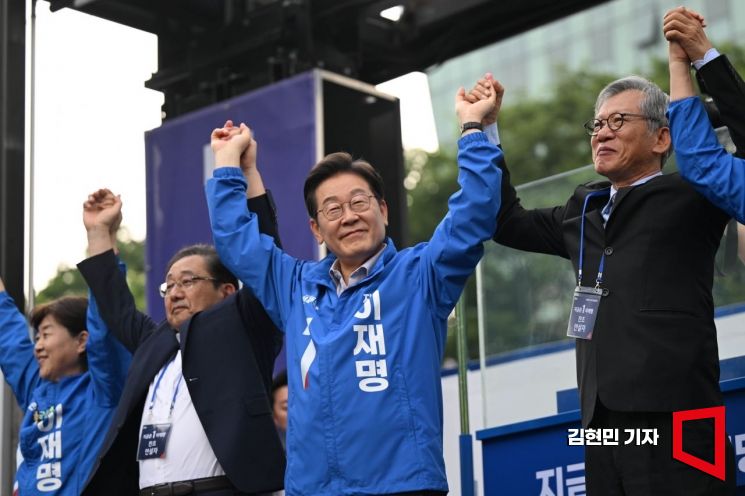 Lee Jae Myung, the Democratic Party presidential candidate, is greeting together with Professor Yoo Hong Jun and others at a campaign rally held in front of the main gate of Children's Grand Park in Gwangjin-gu, Seoul on May 28, 2025. Photo by Kim Hyun Min
The policy booklet states, under the section on stabilizing daily life, "We will focus on real estate supply policies for the middle class and working people." The most notable point is the statement, "We will shift the focus from suppressing price increases of ultra-high-priced apartments to housing supply policies for the middle and low-income classes." Park Wongap, Chief Real Estate Expert at KB Kookmin Bank, commented, "Given the deepening polarization of housing prices between the Seoul metropolitan area and the provinces, I expected the Democratic Party, if in power, to use measures such as loan regulations to suppress prices," adding, "It is somewhat surprising that they have openly declared not to impose additional regulations on 'ultra-high-priced apartments.'"
To address the issue of high pre-sale prices, the party pledged to introduce a fast-track approval system for housing supply. The idea is that if the time required to build new apartments is reduced, project costs will decrease, leading to lower pre-sale prices. However, although specific implementation plans were not mentioned, it is expected that simply revising or introducing new systems will not be easy. There are a wide variety of factors influencing pre-sale prices beyond project speed, and with the growing problem of unsold homes not just in the provinces but also in some areas of the Seoul metropolitan area, the effectiveness of such measures is expected to be limited.
To expand housing supply, the party proposed utilizing idle land owned by public institutions and companies, converting commercial land to residential use, and relaxing floor area and building coverage ratios during redevelopment projects. The pledge to extend the eligibility period for newlyweds to ten years when allocating public rental housing or assigning special supply quotas in both public and private sectors, as well as easing income requirements to expand the target group, is presented as part of measures to address low birth rates.
In the field of transportation, the party pledged to enact a Basic Transportation Act to guarantee the right to mobility. Although the need for such legislation has been recognized for decades by relevant government ministries and experts, based on overseas examples, it has yet to be enacted. The interests of various stakeholders, including consumers, providers, and service workers, are sharply divided, and existing laws already govern a wide range of transportation modes and systems, making this a challenging task. There are also opinions that recognizing mobility as a basic right would require enormous fiscal resources.
Additionally, the party specified that it would pursue the integration of the KTX and SRT high-speed rail systems to improve public convenience and enhance safety. The Democratic Party also proposed policies related to various modes of transportation, including the reintroduction of the safe freight rate system for cargo trucks, the introduction of a standard fare system for chartered bus transportation, and the recognition of taxis as quasi-public transportation.
© The Asia Business Daily(www.asiae.co.kr). All rights reserved.
![Clutching a Stolen Dior Bag, Saying "I Hate Being Poor but Real"... The Grotesque Con of a "Human Knockoff" [Slate]](https://cwcontent.asiae.co.kr/asiaresize/183/2026021902243444107_1771435474.jpg)
















