Violation of the Franchise Business Act... FTC Issues Corrective Order
Kakao Mobility: "Differentiating Fees Could Lead to Cherry-Picking Calls"
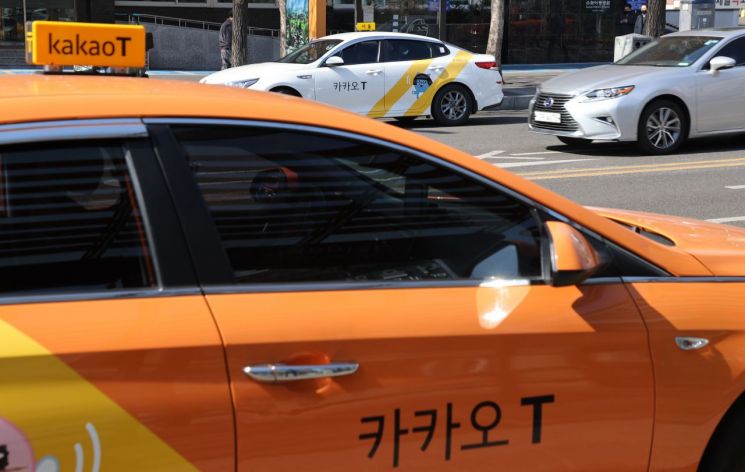
Kakao Mobility, the parent company of KM Solution, which operates the Kakao Taxi franchise, has announced plans to file an administrative lawsuit in direct response to the Fair Trade Commission's decision to impose a multi-billion won fine on KM Solution.
On May 28, the Fair Trade Commission (FTC) announced that it had imposed a corrective order and a fine of 3,882 million won on KM Solution, the operator of the Kakao T Blue franchise, for violating the Franchise Business Act. According to the FTC, since December 2019, KM Solution signed contracts with taxi franchise drivers to uniformly collect 20% of the total fare as a "franchise fee," applying this regardless of whether or not the platform was used.
The FTC specifically took issue with the fact that the 20% commission was charged even when franchise drivers picked up passengers on the street without using Kakao T, or picked up customers who hailed a taxi through other taxi apps. Although the contract stated "20% of the total fare received as compensation for providing transportation services," the fact that this "total fare" included business revenue outside the platform was not clearly disclosed.
The FTC determined that it was difficult to conclude that franchise drivers clearly understood this fee structure, and that charging for services not used could not be considered a normal business practice, thus acknowledging the illegality. The fine was calculated as 0.2% of the total franchise fees collected, which amounted to approximately 1.9411 trillion won. While the Franchise Business Act allows fines of up to 2.0%, the FTC explained that it judged the severity of the violation to be low.
In response, Kakao Mobility stated that it would challenge the FTC's decision through an administrative lawsuit.
Kakao Mobility explained, "The Kakao T franchise taxi service is a 'total package' that covers all aspects of operations, including call brokerage, dispatch, accounting, brand promotion, and vehicle management. Therefore, the same infrastructure is provided even when franchise drivers pick up passengers through street hailing or other app calls, and the fee structure is applied equally."
The company also emphasized, "If the fee were differentiated based on whether a call was made, side effects such as ride refusals or cherry-picking calls could occur. There is a consensus in the field that the fee should be applied equally regardless of the type of business operation." Kakao Mobility further explained, "At the time the franchise business was launched, it was not an environment where unreasonable conditions could be imposed on taxi drivers."
© The Asia Business Daily(www.asiae.co.kr). All rights reserved.
![Clutching a Stolen Dior Bag, Saying "I Hate Being Poor but Real"... The Grotesque Con of a "Human Knockoff" [Slate]](https://cwcontent.asiae.co.kr/asiaresize/183/2026021902243444107_1771435474.jpg)
















