Exploring Logistics Market Outlook and Corporate Response Strategies
Ocean Freight Rates May Surge in the Short Term
Gradual Stabilization Also Expected
Support for Maritime Transportation by Domestic Shipping Lines and SMEs
The Korea International Trade Association held the "Global Logistics Response Strategy Seminar in Response to Changes in U.S. Tariff Policies" on the 28th at the Trade Tower in Samseong-dong, Gangnam-gu, Seoul, with more than 200 representatives from import and export companies in attendance.
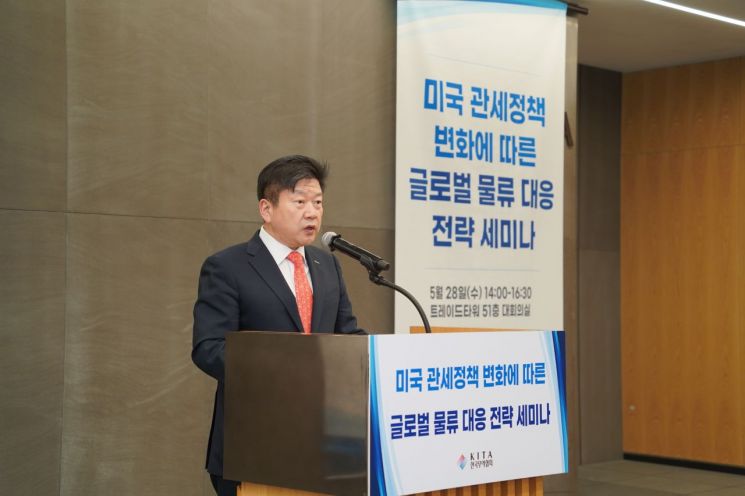 Jang Seokmin, Executive Director of the Korea International Trade Association, delivers the opening remarks at the "Global Logistics Response Strategy Seminar in Response to Changes in U.S. Tariff Policies" held on the 28th at the Trade Tower in Samseong-dong, Gangnam-gu. Photo by Korea International Trade Association
The seminar was organized to support the development of response strategies for import and export companies and to share market outlooks from supply chain and maritime and air logistics experts, at a time when global logistics uncertainty is increasing due to the U.S. deferral of tariffs on China and the imposition of port entry fees on Chinese vessels.
During the seminar, experts in international logistics and customs presented on topics including the current status and outlook of Korea-U.S. logistics supply chains, the maritime and air logistics market outlook for the second half of the year, and response strategies for import and export companies in light of changes in the trade environment.
Lee Sungwoo, Senior Research Fellow at the Korea Maritime Institute, explained the phenomenon of dualization in global supply chains caused by the tariff war. He emphasized that logistics networks linked to existing supply chains should focus on maximizing efficiency, while newly emerging North America-centered logistics networks should strengthen flexibility and localization as part of their response strategies.
Hwang Gyuyoung, Head of Ocean Freight Pricing Strategy at LX Pantos, predicted that ocean freight rates may surge sharply in the short term due to the U.S. deferral of tariffs on China and the early onset of the peak season, but are expected to gradually stabilize over time.
Jang Seokmin, Executive Director of the Korea International Trade Association, stated, "Recently, the deferral of tariffs between the U.S. and China has caused a sharp short-term surge in ocean freight rates, intensifying logistics difficulties for import and export companies. The Korea International Trade Association will do its utmost to ease the logistics burden on export shippers by supporting maritime transportation for small and medium-sized enterprises through collaboration with domestic shipping lines."
© The Asia Business Daily(www.asiae.co.kr). All rights reserved.
![Clutching a Stolen Dior Bag, Saying "I Hate Being Poor but Real"... The Grotesque Con of a "Human Knockoff" [Slate]](https://cwcontent.asiae.co.kr/asiaresize/183/2026021902243444107_1771435474.jpg)















