Korea Chamber of Commerce and Industry Holds 'Carbon Neutrality Policy Seminar'
Seeking Solutions by Referencing Japan's Carbon Neutrality Policy
There was an opinion that, in order to achieve carbon neutrality, policy should shift from regulation-centered approaches to those that leverage carbon neutrality as an opportunity for new growth.
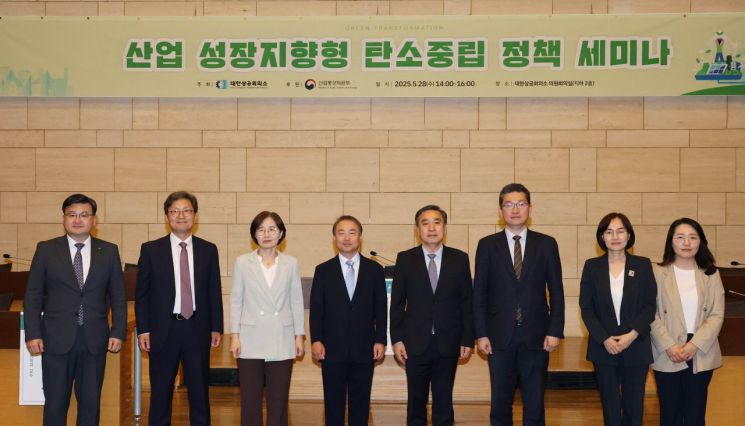 Seminar on Growth-Oriented Carbon Neutrality Policy: Cho Youngjun, Director of Sustainable Management at the Korea Chamber of Commerce and Industry (first from the left), and key participants are posing for a commemorative photo. Photo by Korea Chamber of Commerce and Industry
On May 28, the Korea Chamber of Commerce and Industry held a "Seminar on Growth-Oriented Carbon Neutrality Policy" at its headquarters in Jung-gu, Seoul, seeking solutions to turn carbon neutrality into an industrial growth opportunity by referencing Japan's carbon neutrality policy.
In 2023, Japan enacted the "Green Transformation (GX) Strategy" into law and established a public-private investment plan worth 150 trillion yen over the next 10 years, including the issuance of "GX Economic Transition Bonds." In particular, Japan is using incentives such as subsidies, tax benefits, and transition finance to encourage voluntary carbon reduction and technological transformation by companies, thereby utilizing carbon neutrality as a driver of growth.
In contrast, Korea maintains a regulation-focused policy framework centered on the Emissions Trading System (ETS), and the national greenhouse gas reduction target (NDC) is also linked to the ETS.
Experts unanimously stated that carbon neutrality can only be achieved if carbon neutrality policy is redesigned as a national growth strategy centered on incentives that encourage corporate participation. Professor Cho Hongjong of Dankook University emphasized, "The United States, through the Inflation Reduction Act (IRA), and Japan, through the GX Strategy, set economic growth and industrial competitiveness enhancement as their core objectives, but Korea lacks the necessary legal framework, fiscal investment, and market infrastructure to support this. Carbon neutrality policy must shift from goal-oriented to implementation-oriented."
There was also an opinion that, in order to support the growth of high-power-demand industries such as artificial intelligence (AI) and semiconductors, it is necessary to provide affordable and stable carbon-free electricity (CFE). Yang Uiseok, Secretary General of the CF Alliance, explained, "If we utilize a diverse mix of carbon-free power sources such as renewables, nuclear, and hydrogen, we can reduce costs and achieve carbon neutrality sooner than if we rely on a single energy source."
Lee Sangeun, Director of the Industrial Environment Division at the Ministry of Trade, Industry and Energy, stated, "Although companies are facing difficulties due to U.S.-imposed tariffs and competition from China, industrial GX is a path we must take. We need to move beyond unilateral reductions and transition to a national strategy where the public and private sectors work together to pursue growth and secure market leadership." He added, "The government will also work to specify measures such as governance, incentives, and roadmaps for promising sectors."
Cho Youngjun, Director of Sustainable Management at the Korea Chamber of Commerce and Industry, said, "In order to achieve low-carbon transformation while maintaining corporate competitiveness, it is necessary to establish a government support-centered carbon neutrality policy and enact an 'Industrial GX Promotion Act' to systematically support this effort."
© The Asia Business Daily(www.asiae.co.kr). All rights reserved.
![Clutching a Stolen Dior Bag, Saying "I Hate Being Poor but Real"... The Grotesque Con of a "Human Knockoff" [Slate]](https://cwcontent.asiae.co.kr/asiaresize/183/2026021902243444107_1771435474.jpg)















