Eight crew members who attempted to smuggle the largest amount of cocaine ever into South Korea via Okgyehang Port have been identified. Of these, four have been detained and referred for prosecution, while Interpol red notices are being processed for the remaining four, who disembarked from the vessel before it entered Okgyehang Port.
The Seoul Main Customs and the Donghae Regional Coast Guard announced the results of their joint investigation on the 28th.
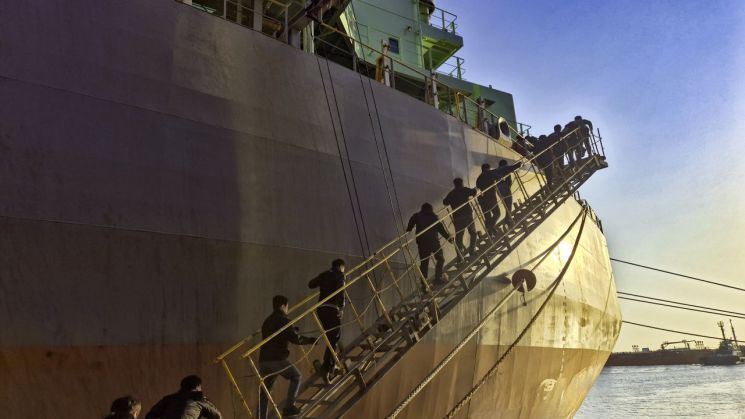 On the 2nd of last month, a joint inspection team from the Korea Customs Service and the Coast Guard boarded a vessel that had entered Okgyepo Port in Gangneung to crack down on drug smuggling. Approximately 2 tons of suspected cocaine were found in a concealed compartment inside the vessel. Courtesy of Korea Customs Service
The Korea Customs Service and the Coast Guard received intelligence from agencies such as the U.S. Federal Bureau of Investigation (FBI) and Homeland Security Investigations (HSI) that cocaine was concealed on the vessel L. Through joint investigation, they uncovered the hidden cocaine.
On the 2nd of last month, when the vessel L entered Okgyehang Port in Gangneung, the two agencies deployed two drug detection dogs and over 90 personnel to conduct a thorough inspection of the vessel.
During this process, 1,690 blocks of cocaine, each measuring 10 cm by 6 cm by 1.7 cm and weighing 1 kg each, were found in a concealed compartment within a bulkhead. The total weight was 1,690 kg, which is enough for 57 million people to use simultaneously. This is the largest single case of maritime drug smuggling ever attempted in South Korea.
Immediately after the cocaine was discovered, the two agencies formed a joint investigation team of 47 members, conducted a full-scale investigation of all 20 crew members of the vessel L, and used on-site forensics, fingerprint analysis of seized items, and digital forensics of mobile phones to identify eight crew members involved in the smuggling operation.
Of the eight identified crew members, four have been detained and referred for prosecution on charges of violating the Act on the Aggravated Punishment of Specific Crimes (Narcotics). The other four, who disembarked before entering Okgyehang Port and returned to the Philippines, are currently the subject of Interpol red notice requests.
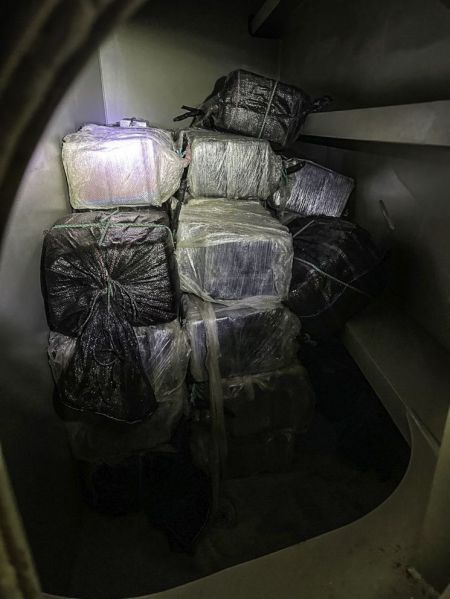 A large number of boxes containing drugs were seized in a sealed room on a foreign trade ship from Mexico that docked at Okgyehang Port in Gangneung City. Photo by Korea Customs Service
The investigation revealed that, in the early morning of February 8th, while en route from Peru to Panama, the vessel L rendezvoused with two boats carrying 10 to 15 members of a drug cartel (known as "ninjas") about 30 miles off the coast of Peru. They transferred 56 sacks containing a total of 1,690 blocks of cocaine onto the vessel L.
It was also confirmed that, while the vessel L was traveling from Panama to South Korea (Dangjin Port), attempts were made to deliver cocaine to East Asian drug traffickers using the so-called "drop and pick up" method. This involved dumping cocaine into the sea in waters near Japan, Jeju, and China, then retrieving it with other vessels. However, these attempts failed due to adverse weather conditions and other factors.
The joint investigation also revealed that the vessel L's plan to attempt another offshore transfer after departing from Okgyehang Port was thwarted by the Korea Customs Service and the Coast Guard.
Currently, the Korea Customs Service and the Coast Guard are continuing their international joint investigation by sharing information obtained during the investigation?including international drug cartel tracking data, GPS movement routes, fingerprint and DNA analysis?with agencies such as the U.S. Drug Enforcement Administration (DEA), the Philippine Drug Enforcement Agency (PDEA), and Interpol.
Shin Kyungjin, head of the joint investigation team (Superintendent), stated, "This case constitutes the largest drug crime in South Korea involving an international drug cartel," and explained, "Although there is no evidence so far that the vessel L attempted to bring cocaine directly into South Korea, it has been confirmed through the investigation that attempts were made to offload cocaine within South Korean territorial waters or nearby seas."
He added, "The Korea Customs Service and the Coast Guard will respond more forcefully to maritime drug crimes in cooperation with relevant domestic and international agencies."
© The Asia Business Daily(www.asiae.co.kr). All rights reserved.
![Clutching a Stolen Dior Bag, Saying "I Hate Being Poor but Real"... The Grotesque Con of a "Human Knockoff" [Slate]](https://cwcontent.asiae.co.kr/asiaresize/183/2026021902243444107_1771435474.jpg)
















