Up to 6 Million Jobs Could Disappear
If 30% Tariffs Remain
The New York Times (NYT) reported on May 27 (local time) that if the temporary truce in the US-China trade war is broken and the conflict resumes, up to 9 million jobs could be lost in China.
According to a report by Natixis, if US tariffs on China remain at the current level of 30%, exports to the US could be cut in half, resulting in the loss of up to 6 million manufacturing jobs. If the trade war resumes, the number of lost jobs could soar to 9 million. On May 10-11, while the US and China were engaged in a triple-digit tariff war, senior officials from both countries held talks in Geneva, Switzerland, and agreed to lower the tariffs imposed on each other by 115 percentage points each for 90 days.
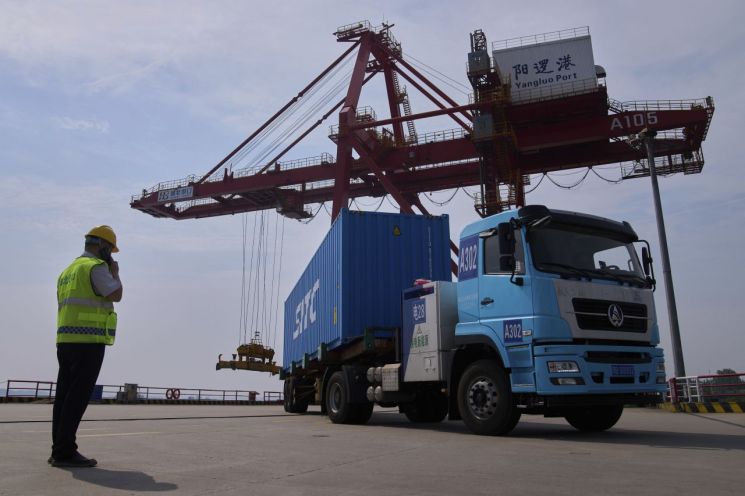
President Trump claimed during his first term in 2019 that his tariff policy had caused 5 million jobs to disappear in China. At the time, economists questioned how much actual damage the tariffs had caused, but his statement underscored the impact on jobs in China's export-dependent economy.
In particular, during a potential second Trump administration, the Chinese economy has become even more vulnerable in terms of employment due to factors such as the real estate downturn. Alicia Garcia-Herrero, Chief Economist for Asia-Pacific at Natixis, said, "The situation has definitely worsened," adding that the importance of preserving manufacturing jobs has grown because employment in other sectors in China has declined.
Since the COVID-19 pandemic, China's economic recovery has been sluggish, with growth slower than during Trump's first term. While the Chinese government is targeting economic growth of around 5% this year, many economists expect the actual growth rate to fall short of this goal. During Trump's first term, China's annual economic growth rate exceeded 6%.
The labor market situation is also different from before. In early 2018, China announced that the urban unemployment rate had fallen to its lowest level in 15 years and that a record number of new jobs had been created. In contrast, according to the National Bureau of Statistics of China, the urban unemployment rate for those aged 16-24 (excluding students) was 15.8% last month. Although this was a decrease from the previous month, with 12 million new college graduates expected this year, forecasts predict the unemployment rate will rise again. After the youth unemployment rate hit a record high of 21.3% in June 2023, China abruptly stopped releasing the data and began publishing a new youth unemployment rate that excludes middle and high school students as well as university students.
Existing workers are also facing instability. The number of regular jobs is decreasing, and, according to the NYT, industries such as food delivery and manufacturing are increasingly relying on ultra-short-term workers (gig workers).
Jane Hu, who worked as an office employee at a construction equipment company in Shanghai, told the NYT that she lost her job last month after China imposed a 125% retaliatory tariff on US imports. The company she worked for imported machinery from the US to China, and costs more than doubled. Already struggling due to the real estate downturn, the additional tariffs led to a 40% drop in sales. She said that companies are reluctant to hire married women without children like herself, and she has only been able to attend two job interviews.
In Guangzhou, the center of China's apparel industry, many companies closed and reduced hiring as overseas buyers' orders declined before the suspension of the tariff war. Han Dongfang, founder of China Labour Bulletin (CLB), told the NYT that factory owners are supposed to compensate workers when making layoffs, but because of the enormous costs, some factories close without notice and the owners disappear.
However, the US remains highly dependent on rare earth elements controlled by China. If imports of Chinese products are halted, this could lead to concerns over rising prices and trigger supply shortages.
If negotiations break down and the trade war drags on, some analysts believe China may have the upper hand in terms of endurance. Diana Choyleva, Chief Economist at Enodo Economics, a China-focused research firm, said, "China is better positioned to suppress discontent from labor market shocks, but the US will find it difficult to deal with public anger over empty store shelves."
© The Asia Business Daily(www.asiae.co.kr). All rights reserved.

















