Debt Amounts Between 40 and 60 Million Won Most Common
84% of Respondents Have Experienced "Debt Rolling"
Last year, 7 out of 10 young people who applied for personal rehabilitation cited "living expenses" as the main reason for taking out their first loan.
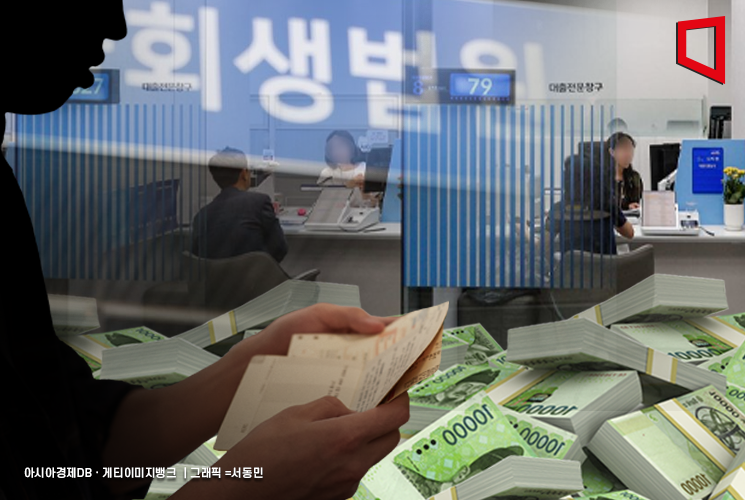
According to a survey conducted by the Seoul Financial Welfare Counseling Center within the Seoul Welfare Foundation on May 28, among 1,374 individuals aged 29 or younger who applied for personal rehabilitation last year and completed the "Youth Financial Guide" program, the largest proportion of young applicants (31%) had debts between 40 million and 60 million won. The Youth Financial Guide is a program designed to prevent dropouts from the personal rehabilitation process by providing income and expenditure management, guidance on rehabilitation procedures, and methods for completing repayments after approval.
This was followed by debts between 60 million and 80 million won (22%), less than 40 million won (19%), more than 100 million won (15%), and between 80 million and 100 million won (13%).
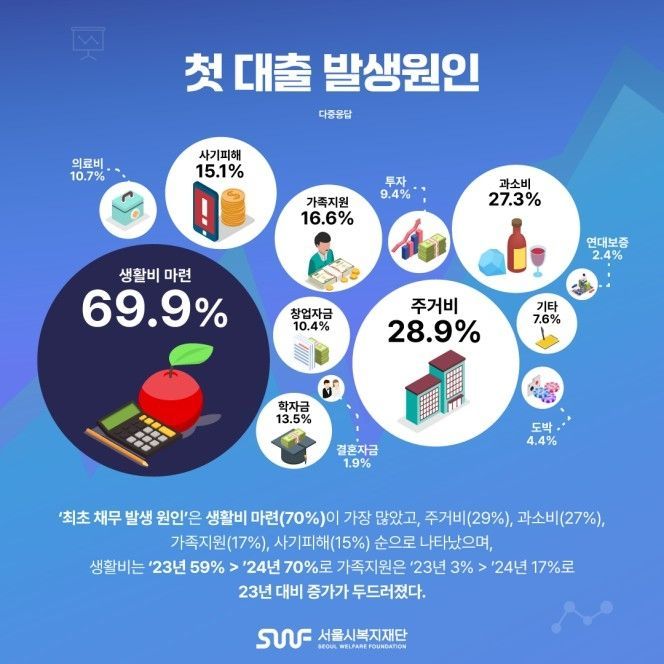
The main causes of initial debt (multiple responses allowed) were living expenses (70%), followed by housing costs (29%), overspending (27%), family support (17%), and fraud (15%). A foundation official explained, "Compared to last year, the number of respondents who incurred debt due to living expenses or family support has increased."
Additionally, 84% of young people who applied for personal rehabilitation responded that they had engaged in "debt rolling" (taking out new loans to repay old ones). The reasons for their debts increasing to unmanageable levels included repayment of other debts (65%), increased debt due to high interest rates (38%), and income gaps such as unemployment or job changes (31%).
It was also found that 93% of young people who applied for personal rehabilitation experienced "emotional difficulties" over the past year. In particular, 34% of respondents, or about 3 out of 10, reported experiencing "suicidal impulses." Furthermore, 63% of respondents said they had "no one to turn to for help in difficult situations," indicating that many are experiencing social isolation due to debt.
To support young people facing financial and economic difficulties and help them regain independence, the Seoul Metropolitan Government operates the Youth Companion Center within the Seoul Financial Welfare Counseling Center. Anyone aged 39 or younger can use the center's services.
Jung Eunjeong, head of the Seoul Financial Welfare Counseling Center, said, "Most young people undergoing personal rehabilitation lack social safety nets such as family support, stable employment, or welfare benefits. The center will continue to strengthen various financial welfare services to help these young people resolve their debt problems, recover, and plan for a healthy future."
© The Asia Business Daily(www.asiae.co.kr). All rights reserved.
![Clutching a Stolen Dior Bag, Saying "I Hate Being Poor but Real"... The Grotesque Con of a "Human Knockoff" [Slate]](https://cwcontent.asiae.co.kr/asiaresize/183/2026021902243444107_1771435474.jpg)
















