Tens of Millions of Won Needed Just for ESS Installation
Over 10 Years Required to Recoup Investment Costs
The initiative to promote the adoption of Energy Storage Systems (ESS) among private sector entities, led by local governments, is facing difficulties from the outset. The core of the ESS project is to allow businesses to store electricity during off-peak hours when rates are low and use it whenever needed. However, the project is struggling because the difference in electricity rates between time periods is minimal, and the amount of financial support offered by local governments is far too small, resulting in a lack of interest from businesses. This has made it inevitable that the government’s plan to distribute self-generation ESS, centered on local governments nationwide to stabilize the power grid, will face setbacks. Since the spread of ESS also affects the expansion of renewable energy, there are calls to increase the support budget and widen the gap between electricity rates by time period.
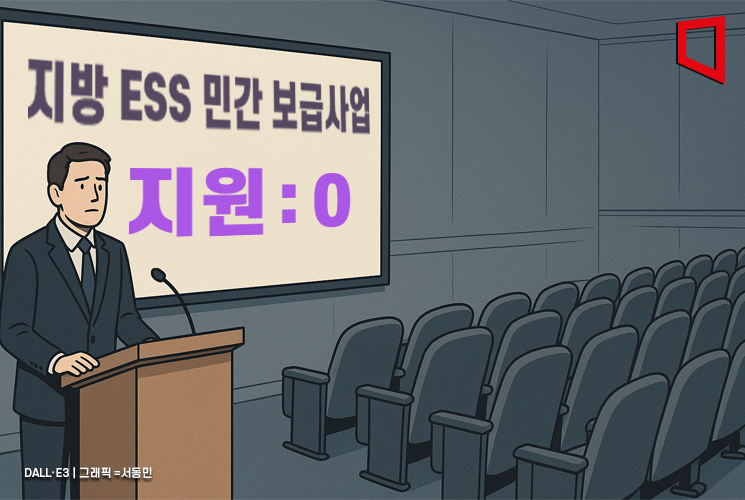
According to the city of Gwangju on the 29th, the municipality announced a public offering to support 10% of construction costs for the installation of two new 400kWh ESS units in the region, but received no applications by the end of last month. Gwangju is the first local government in the country to launch an ESS support project. The intended recipients of the support were owners of self-generation electrical facilities. These facilities are installed at business sites by electricity users to directly consume the electricity they generate, and are considered a representative form of distributed power sources.
There are a considerable number of eligible recipients within Gwangju. According to the Korea Electrical Engineers Association, there are currently 8,950 self-generation facilities in the area. However, industry sources explain that the lack of profitability is causing potential applicants to turn away from the project.
The city planned to support 10% of construction costs, capping the subsidy at 50 million KRW per site and 100 million KRW in total. However, considering the current differences in seasonal and time-of-use electricity rates, it is estimated that it would take more than 10 years to recover a 500 million KRW investment. An industry official stated, "It usually costs several hundred million KRW to install an ESS, so a 10% subsidy is not enough to incentivize installation," and added, "It is difficult for the private sector to participate under conditions where the business is not profitable."
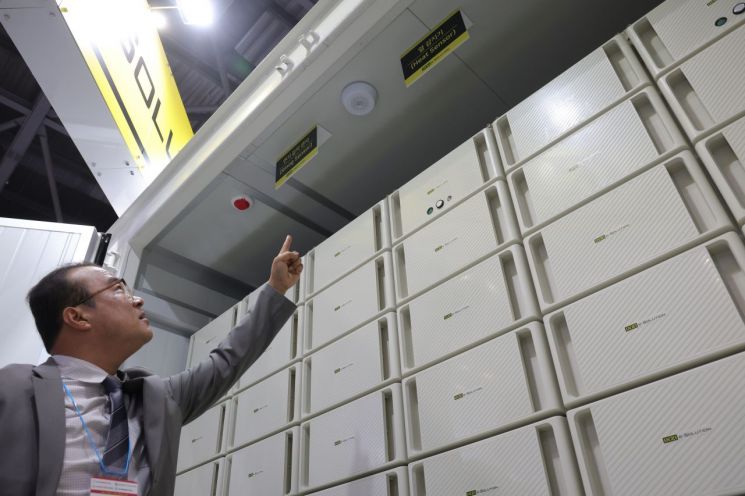 At the 2024 World Solar Energy Expo and the 2024 World Battery & Charging Infrastructure Expo, an exhibitor is pointing to the smoke and heat detection sensors of a high-safety Energy Storage System (ESS). Photo by Yonhap News
This project drew attention because it was the first support initiative at the local government level. However, with the public offering ending in failure, the project’s original purpose?to stabilize the power grid by storing surplus electricity during off-peak hours and using it at lower cost during periods of high demand?has been undermined. In particular, substations in the Honam region have reached capacity and have been designated as grid management substations. In this region, the construction of new power plants is effectively restricted until the end of 2031, making the introduction of ESS even more urgent.
The sluggish adoption of ESS is also expected to impact the expansion of renewable energy. The government has set a goal in its 11th Basic Plan for Long-term Electricity Supply and Demand to increase the share of renewable energy generation from 8.3% in 2023 to 29.2% by 2038. Achieving this will require the addition of about 91GW of solar and wind power generation facilities, a capacity equivalent to approximately 90 of the latest nuclear power plants.
Recently, Gwangju lowered the supported capacity to 300kWh to reduce the investment burden and issued a new call for applications. Experts advise that rather than increasing the scale of local government subsidies, the gap in electricity rates should be widened to create business incentives.
Son Yanghoon, professor of economics at Incheon National University, pointed out, "The high price of ESS makes it difficult to generate returns on investment," and added, "Since the government or local governments cannot provide unlimited subsidies, electricity rates need to become much more flexible than they are now."
© The Asia Business Daily(www.asiae.co.kr). All rights reserved.


















