Seoul-bound Buses Full from Ilsan, Haengsin-dong Residents Unable to Board
Increased Efficiency Through Flexible Operations Without Adding More Buses, Including Deployment of Double-Decker and Chartered Buses
Goyang Special City in Gyeonggi Province (Mayor Lee Donghwan) has taken a proactive and flexible approach to protect citizens' transportation rights in response to severe congestion during morning commutes, which arose after the implementation of the ban on standing passengers on metropolitan buses, following the amendment of the Road Traffic Act Enforcement Decree (effective December 20, 2023).
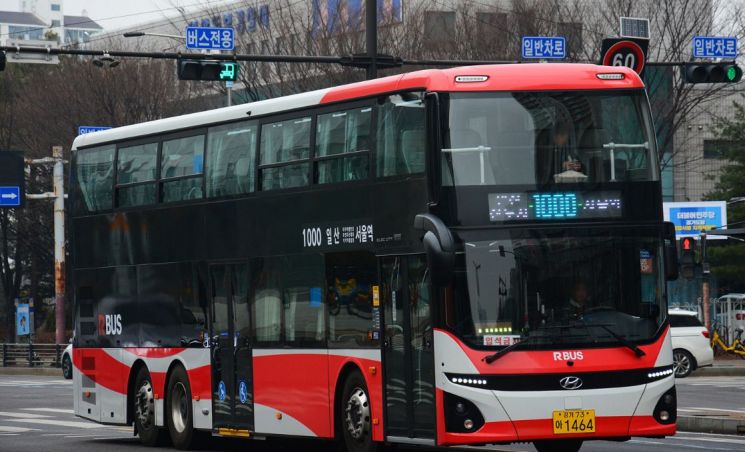
Although the ban on standing passengers on metropolitan buses was an unavoidable measure for citizen safety, in practice, it placed a significant burden on outer metropolitan cities such as Goyang.
In particular, Express Seat Bus No. 1000, a major route for commuters to Seoul, was already full in the upstream Ilsan section, causing serious inconvenience for residents of Haengsin-dong in Deogyang-gu, located downstream, who were repeatedly unable to board at their stops.
Additionally, long queues formed at bus stops for metropolitan buses, leading to frequent conflicts and emotional complaints among citizens during the busy morning commute.
Goyang Special City has continuously coordinated with the Ministry of Land, Infrastructure and Transport and the Metropolitan Transport Commission (MTC), using data on the number of passengers unable to board before and after the ban, and has implemented measures such as deploying two additional chartered buses, maintaining the nation’s only six mid-route bus dispatches, and introducing five double-decker electric buses.
In particular, the 'mid-route dispatch operation of quasi-public metropolitan buses' is the first and only system of its kind in the country. Even though this approach is difficult to implement under the existing quasi-public operation system, the city persistently persuaded the MTC (Metropolitan Transport Commission under the Ministry of Land, Infrastructure and Transport) to maintain the mid-route dispatch in order to guarantee the transportation rights of Deogyang-gu residents.
Furthermore, despite the reality of reduced service on privately operated routes due to a shortage of drivers, the city encouraged bus companies to normalize the number of buses in operation.
Following these measures, the issue of passengers being unable to board due to buses skipping stops was greatly alleviated, as buses could now be dispatched at major downstream stops on Jungang-ro, such as Goyang Police Station and Haengsin Elementary School.
Meanwhile, Goyang City, which is predominantly residential, experiences a significant difference in congestion between commuting hours and other times of the day.
While increasing the number of operating buses (commercial vehicles) is a fundamental solution to resolve congestion caused by the ban on standing passengers and the concentration of demand during commuting hours, in the case of Goyang, the number of passengers outside of commuting hours is significantly lower, making it financially unviable to simply increase the number of buses without considering the cost-to-revenue ratio. Therefore, indiscriminate increases in bus numbers are not a realistic solution.
Goyang Special City is considering ways to resolve citizen inconvenience and reduce the budget burden through flexible operations without increasing the number of buses.
Recently, to alleviate congestion during commuting hours in the Hyangdong area, the city implemented mid-route dispatch for Bus No. 730 (regular city bus), operating only during commuting hours between Hyangdong and DMC Station.
© The Asia Business Daily(www.asiae.co.kr). All rights reserved.
![Clutching a Stolen Dior Bag, Saying "I Hate Being Poor but Real"... The Grotesque Con of a "Human Knockoff" [Slate]](https://cwcontent.asiae.co.kr/asiaresize/183/2026021902243444107_1771435474.jpg)















