Shilla and Shinsegae Duty Free Apply for Rent Adjustment in Court
Adjustment Hearing Set for June 2
Operators Cite Excessive Burden Amid Sluggish Business
International Cases of Temporary Relief...
Calls for "Flexible Management" Emerge
With Hotel Shilla and Shinsegae Duty Free appealing for relief due to sluggish business conditions and requesting a rent reduction from Incheon International Airport Corporation, attention is focused on whether the courts and relevant authorities will accept their request. Some in the industry are pointing to international examples where duty-free operators received rent reductions after COVID-19, arguing that a temporary reduction is necessary to give these businesses some breathing room.
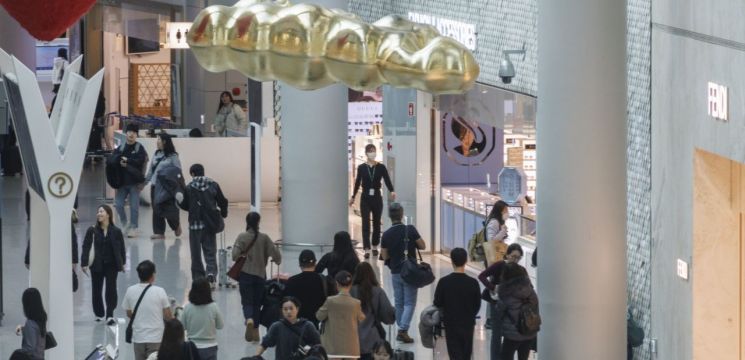
According to industry sources on May 27, Shinsegae Duty Free filed an application for rent adjustment with the Incheon District Court on April 29, and Shilla Duty Free, operated by Hotel Shilla, did the same on May 8. Both companies requested a 40% reduction in rent for cosmetics, perfume, liquor, and tobacco stores located in the duty-free zones of Incheon Airport's Terminal 1 and Terminal 2. The hearing for this adjustment is scheduled for June 2.
Currently, rent for duty-free shops at Incheon Airport is calculated by multiplying the fee per passenger, as estimated by the bidder, by the number of airport users. The calculation method was changed in 2023 from a fixed rent payment system. It is reported that Shilla and Shinsegae Duty Free each bid about 10,000 won per passenger in the duty-free license auction that year. This figure is about 80% of the pre-COVID-19 average spending per customer, reflecting expectations that demand for overseas travel would recover after the pandemic transitioned to an endemic phase.
In fact, last year, the number of outbound passengers using Incheon Airport reached 35.31 million, recovering to the 2019 pre-pandemic level of 35.56 million. However, duty-free sales at Incheon Airport totaled 2.0181 trillion won, a 27.8% decrease compared to 2.7958 trillion won in 2019.
An industry official pointed out, "As exchange rates rise, domestic travelers feel more burdened using duty-free shops, and the time required for departure procedures has increased compared to the past, reducing the opportunity for duty-free shopping. Most importantly, the number of Chinese group tourists, who account for a large portion of sales, has decreased compared to before, and their spending has also dropped significantly."
On the other hand, despite declining sales, Shilla and Shinsegae Duty Free are reportedly paying about 30 billion won per month in rent, calculated based on the monthly passenger count of around 3 million at Incheon Airport. Annually, this amounts to approximately 360 billion won for each company. In 2023, Shilla paid 11% of its annual sales (3.2819 trillion won) and Shinsegae paid 18% of its annual sales (2.006 trillion won) as rent. Shilla Duty Free posted an operating loss of 69.7 billion won last year, turning to a deficit, while Shinsegae Duty Free also swung to a loss of 35.9 billion won. In the first quarter of this year, the two companies recorded losses of 5 billion won and 2.3 billion won, respectively. As a result, there is talk that these operators who won the Incheon Airport duty-free license have fallen victim to the "winner's curse."
Experts argue that relevant authorities should show flexibility on the rent issue so that Incheon Airport, as the landlord, and the duty-free industry can build a long-term partnership. Hong Kyuseon, a professor in the Department of Tourism at Dong Seoul University, emphasized during a National Assembly seminar in March titled "Diagnosing the Crisis and Seeking Solutions in the Aviation and Tourism Industries: Focusing on the K-Duty-Free Industry" that international cases of temporary rent reductions at airports should be considered as alternatives. He cited Singapore Changi Airport's 35% rent reduction for duty-free operators after COVID-19 and Shanghai Pudong Airport's 75% reduction in minimum guaranteed payments as representative examples.
Professor Hong stated, "Incheon Airport is the gateway to our country and a symbolic space for the tourism industry. Considering the need to maintain employment for industry workers, the domestic duty-free industry, and the competitiveness of Incheon Airport facilities, relevant authorities, including the main ministry, must find a way to temporarily ease the rent burden."
Meanwhile, Incheon International Airport Corporation commented, "We are reviewing the adjustment applications submitted by the duty-free industry, but currently, there are no plans to reduce rent."
© The Asia Business Daily(www.asiae.co.kr). All rights reserved.

















