Requirements Eased, but Only Six Visas Issued in Six Months
Lack of Inter-Ministerial Cooperation... Recommendations Not Leading to Issuance
"To Form a Startup Cluster, Scale Must Be Increased First"
The "Startup Korea Special Visa (D-8-4S)", introduced to attract overseas tech talent to Korea, has proven to be largely ineffective even after six months since its implementation. Although the visa was established to promote the recruitment of global talent by removing the quantitative screening requirements of the existing Technology Startup Visa (D-8-4) and introducing a private evaluation-based system, the actual number of visas issued has remained in the single digits.
According to the Ministry of Justice as of the end of April, only six foreign entrepreneurs are currently residing in Korea under the Startup Korea Special Visa. In December of last year, at the initial stage of implementation, ten cases were reviewed through recommendations from the Ministry of SMEs and Startups, and six visas were issued. However, not a single visa has been issued so far this year.
The Startup Korea Special Visa is a system jointly established by the Ministry of SMEs and Startups and the Ministry of Justice in November of last year. While the existing Technology Startup Visa required applicants to obtain OASIS (Outstanding Startup Immigration System) points or have experience in a government startup support program, the Special Visa does not require such quantitative criteria. Instead, the Ministry of SMEs and Startups recommends candidates based on evaluations of business feasibility and innovation by a private evaluation committee, after which the Ministry of Justice makes the final decision on issuance.
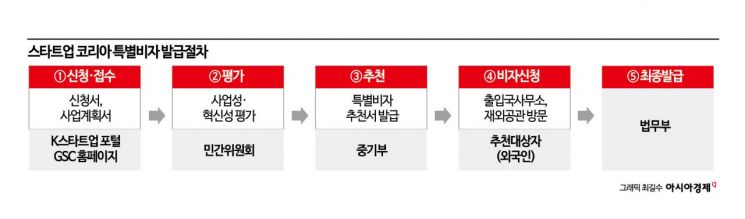
The Ministry of SMEs and Startups claims that it has held several private evaluation committee meetings and proceeded with some recommendation procedures this year as well, but there have been no cases where this has led to the Ministry of Justice issuing a visa. In response, the Ministry of Justice explained, "There have been no official recommendations from the Ministry of SMEs and Startups since the end of last year." For the visa system to function effectively, the recommendation process by the Ministry of SMEs and Startups and the issuance process by the Ministry of Justice must be closely coordinated. However, the current situation suggests a lack of communication and division of roles between the two ministries.
Industry experts point out that, regardless of the system's intended purpose, foreign entrepreneurs still face significant entry barriers. Foreigners wishing to start a business in Korea must go through various administrative procedures, such as establishing a corporation, reporting foreign exchange transactions, and registering their place of stay. In addition, language barriers and limited access to information make it practically difficult for them to settle. A startup industry insider commented, "A visa alone is not enough for entrepreneurs to settle. Comprehensive support across all stages, including housing, taxation, and administration, must be provided."
When compared to overseas cases, the limitations of the Korean system become even clearer. Since 2015, Japan has operated a "Startup Visa" system that allows foreign entrepreneurs a certain period to prepare their business, and then, once they meet the requirements for office leasing and capital, they can convert to a long-term stay "Business Management Visa." As of May last year, 716 foreign entrepreneurs were residing in Japan under this system.
In contrast, in the past 13 years, fewer than 300 foreigners have participated in Korean government startup support programs. Park Daehee, head of the Daejeon Center for Creative Economy and Innovation, stated at a recent policy forum, "It takes more than four months just to obtain a single Technology Startup Visa," and emphasized, "To build a global startup ecosystem, not only the visa system but also perceptions and the overall system must be improved."
© The Asia Business Daily(www.asiae.co.kr). All rights reserved.
![Clutching a Stolen Dior Bag, Saying "I Hate Being Poor but Real"... The Grotesque Con of a "Human Knockoff" [Slate]](https://cwcontent.asiae.co.kr/asiaresize/183/2026021902243444107_1771435474.jpg)











