Originally a Sloped and Deeply Eroded Valley
First Discovery of a Retaining Wall Built with Roof Tiles, Not Stone
"Confirmation of a Highly Hierarchical Area in the Baekje Royal Palace"
It has been revealed that the highest and widest flat terrace at Busosanseong Fortress in Buyeo was artificially constructed.
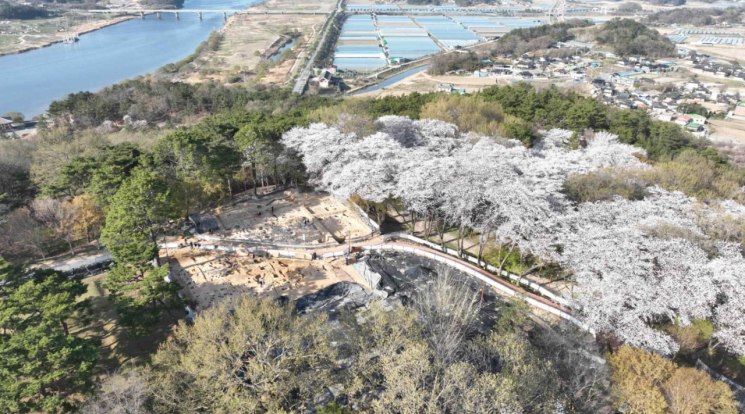
The National Research Institute of Cultural Heritage and the National Buyeo Institute of Cultural Heritage announced on May 27 that, through excavation on the eastern side of the military granary site (gunchangji?a storage area for military provisions) from the Joseon Dynasty at Busosanseong Fortress, they confirmed that this land was originally a sloped and deeply eroded valley. The method used to create the flat terrace followed the traditional land formation techniques seen at Mongchontoseong and Pungnaptoseong from the Hanseong period of Baekje. The valley, which was 3 to 4 meters deep, was filled with soil, and an embankment (made of earth) was constructed first to prevent soil slippage.
On the flat terrace, which is composed of three stepped levels, there were sites for buildings with embedded pillars (gullipju geonmul?structures built by setting pillars into the ground), buildings with wajeok foundations (wajeok gidan?foundations edged with stacked roof tiles), and storage facilities. A notable feature is the east-west retaining wall dividing the first and second terraces, which was built by stacking roof tiles to a height of about 0.6 meters. The institute explained, "This is the first time in Korea that a retaining wall made of roof tiles, rather than stone, has been identified," adding, "The remaining length is 26 meters, but it may be found to extend further west toward the military granary site."
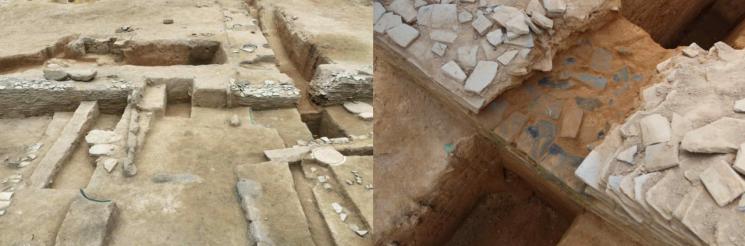
On the first terrace, sites of Baekje-era buildings with embedded pillars, buildings with wajeok foundations, storage facilities, and buildings dating from Unified Silla to the Joseon Dynasty were identified. On the second terrace, two buildings with wajeok foundations were discovered. One of these measured approximately 14.6 meters east to west and 11.5 meters north to south. Circular foundation stones were used for the outer pillars of the building, while square foundation stones were used for the inner structure. Between the foundation stones, roof tiles were used to create a gomagi facility, which is a finishing structure installed beneath the lower horizontal beam (ha-inbang) connecting the pillars.
The institute stated, "Through the embanked terrace and the wajeok foundation building sites, it has been confirmed that the area around Busosanseong Fortress was not merely a defensive space, but a highly hierarchical area of the Baekje royal palace," adding, "We will continue research to further understand the royal palace and city of Baekje during the Sabi period."
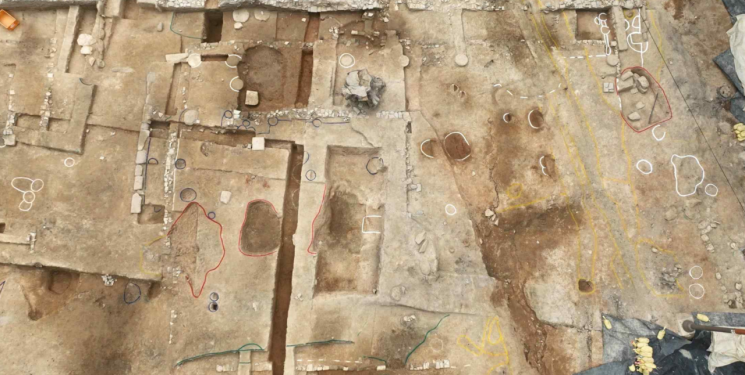
Busosanseong Fortress is located north of the Gwanbuk-ri site, which is known as the royal palace site from the Baekje Sabi period. Since 1981, the Cultural Heritage Administration has conducted seventeen excavations up to this year, identifying the walls and structures of Baekje, as well as facilities such as building sites and wells.
© The Asia Business Daily(www.asiae.co.kr). All rights reserved.



















