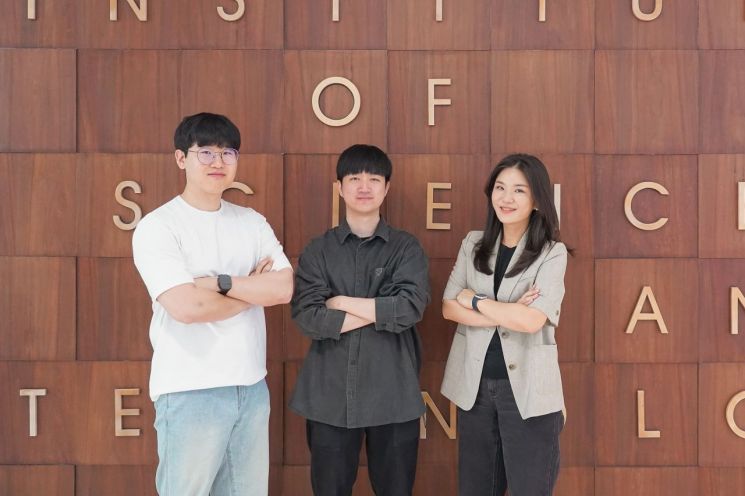
 (From left) Yoon Junyeon, PhD candidate in Materials Science and Engineering at GIST; Hwang Junho, PhD candidate; Eunji Lee, Professor.
Gwangju Institute of Science and Technology (GIST) announced on May 26 that the research team led by Professor Eunji Lee from the Department of Materials Science and Engineering has observed and quantitatively analyzed, in real time, the entire process by which crystalline block copolymers self-assemble and evolve into nanoparticles in solution.
This study is recognized as the world's first experimental validation of the core hypothesis of the "scaling theory," which had previously existed only in theory. It is considered to have established a scientific foundation for the precise design of nanomaterials.
The scaling theory posits that crystalline block copolymers fold themselves to avoid contact with the solvent and assemble into the most energetically stable form. A key aspect of this theory is the preference for lower curvature (less bent structures).
The research team captured in real time a clear evolutionary pathway in which polymer nanostructures progress from spherical micelles to cylindrical micelles, to toroidal (doughnut-shaped) structures, and finally to vesicles with a bilayer structure.
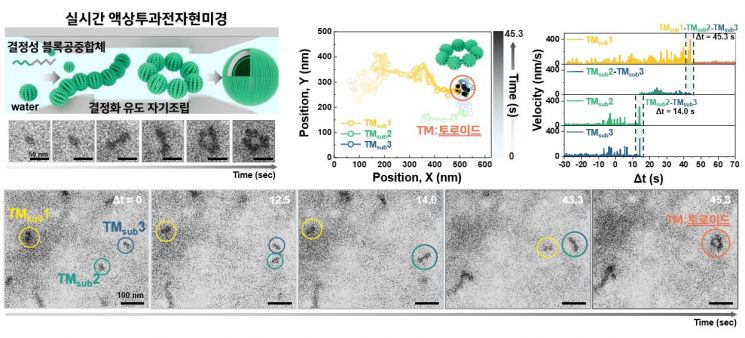 Elucidation of the Crystallization-Induced Self-Assembly Process of Amphiphilic Block Copolymers Using In Situ Liquid-Phase Transmission Electron Microscopy.
In nature, the ability to self-assemble complex structures plays a crucial role in the development of high-performance nanomaterials. Among these, "polymer crystallization" refers to the phenomenon in which polymer chains fold and arrange themselves in an orderly manner, playing an important role in forming complex structures where order and disorder coexist.
The related technique, "crystallization-induced self-assembly," is a principle in which the crystallization of polymers drives structure formation. This allows for both the regularity of molecular arrangement and the stability of particle structures, drawing attention in various fields such as optoelectronics and biomaterials.
However, due to the complexity arising from the simultaneous occurrence of crystallization and phase separation between blocks, it has so far been difficult to experimentally elucidate the specific mechanisms of structural transitions.
The research team used PEO-b-PCL, a representative biodegradable and biocompatible polymer, to observe in real time the self-assembly process according to molecular weight and block composition ratio using LP-TEM. PEO-b-PCL is a polymer combining hydrophilic PEO, which dissolves well in water, and hydrophobic, crystalline PCL. It is environmentally friendly and used for various applications such as drug delivery.
As a result, the team clearly captured the phenomenon in which spherical nanoparticles, which are not observed in non-crystalline polymers, evolved into cylindrical or toroidal (doughnut-shaped) forms through lateral association. This is due to the preference of the crystalline core block for lower curvature, or flatter interfaces, in order to lower the system's energy. This is a very significant discovery, as it experimentally validates a key assumption of the "scaling theory," which had previously existed only in theory.
Another important aspect of this study is that it not only visualized the morphology of nanostructures but also quantitatively analyzed time-resolved video data to obtain numerical data on particle trajectories and assembly rates.
Hwang Junho, PhD candidate (first author), stated, "This study is the first to precisely elucidate the molecular-level principles and dynamics of polymer self-assembly," adding, "It could serve as a foundation for the precise design of nanostructures required for advanced technologies such as organic electronics, biosensors, and drug delivery systems in the future."
Professor Eunji Lee commented, "This research is academically significant in that it tracked the formation and evolution of polymer nanostructures in real time and quantitatively analyzed them. In particular, by experimentally demonstrating how the complex phenomenon of crystallization-induced self-assembly influences the evolution of nanostructures, we have suggested new directions for the design of functional nanomaterials."
This research was conducted under the supervision of Professor Eunji Lee (corresponding author) from the Department of Materials Science and Engineering at GIST, with Hwang Junho (first author) and Yoon Junyeon (co-author), both PhD candidates, carrying out the study. Professor Seo Myeongeun from the Department of Chemistry at KAIST and Professor Joseph P. Patterson from the Department of Chemistry at the University of California, Irvine (UC Irvine), participated as co-authors.
© The Asia Business Daily(www.asiae.co.kr). All rights reserved.
![Clutching a Stolen Dior Bag, Saying "I Hate Being Poor but Real"... The Grotesque Con of a "Human Knockoff" [Slate]](https://cwcontent.asiae.co.kr/asiaresize/183/2026021902243444107_1771435474.jpg)
















