Three Endemic Korean Species?Shiri, Korean Chub, and Spotted Sleeper?Found in Cheonggyecheon 20 Years After Restoration
It has been confirmed that three species of freshwater fish native to Korea?Shiri, Korean chub, and spotted sleeper?inhabit Cheonggyecheon, which was restored 20 years ago.
The National Science Museum announced on May 26 that, to mark the 20th anniversary of the restoration of Cheonggyecheon, Korea's representative urban stream, it conducted a survey of freshwater fish inhabiting Cheonggyecheon and discovered Shiri, a species that only lives in clean and healthy river rapids of Grade 2 water quality or higher.
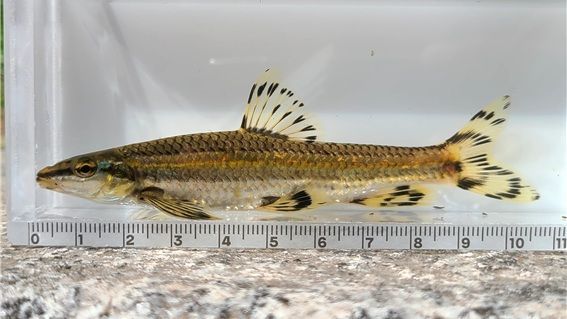 The Korean endemic freshwater fish "Shiri," measuring about 10 to 15 cm in length, inhabits Cheonggyecheon. Provided by the National Museum of Korea
This survey was conducted at six sites, from Cheonggye Plaza and the area near Mojongyo, where Cheonggyecheon begins, to the confluence with Jungnangcheon. The same locations as those from 20 years ago were selected in order to objectively compare and analyze changes in the fish fauna over the past two decades.
Surveys of freshwater fish in Cheonggyecheon were conducted intensively from 2003, prior to restoration, through the five years following restoration. However, no detailed monitoring has been carried out since 2019.
To address this, the National Science Museum signed a memorandum of understanding (MOU) with the Seoul Facilities Corporation, which manages Cheonggyecheon, in February to identify the current status and changes in freshwater fish inhabiting Cheonggyecheon for the 20th anniversary of its restoration.
During the first joint academic survey conducted from April 29 to 30, a total of 1,238 individuals belonging to 20 species and 1 variety (Israeli carp) from 7 families and 4 orders were identified. The order Cypriniformes accounted for the largest number, with 13 species and 1 variety, followed by Perciformes with 5 species.
The most abundant species was Zacco platypus, making up about 53.7% of the total individuals, followed by Korean chub (14.7%) and Chinese minnow (7.5%).
Three species endemic to Korea were identified: Shiri, Korean chub, and spotted sleeper. One exotic species, Israeli carp, was found. No ornamental or ecosystem-disrupting species were detected.
Regarding species distribution by section, Zacco platypus, a swimming species preferring flowing water, was most common from the upper to mid-lower reaches. In contrast, at the confluence with Jungnangcheon, the lowest section, Crucian carp, a species that prefers slow-moving or stagnant water, was frequently observed.
Looking at changes in the fish fauna of Cheonggyecheon over the past 20 years, only four species?Crucian carp, Korean crucian carp, mud loach, and Chinese bleak?were found in 2003 before restoration, indicating that species tolerant of poor water quality dominated. In the latest survey, however, a greater diversity of species was found, including Korean chub, Zacco platypus, striped shiner, slender gudgeon, sandfish, and Chinese medaka, all of which inhabit different microhabitats and indicate improved water quality and increased biodiversity.
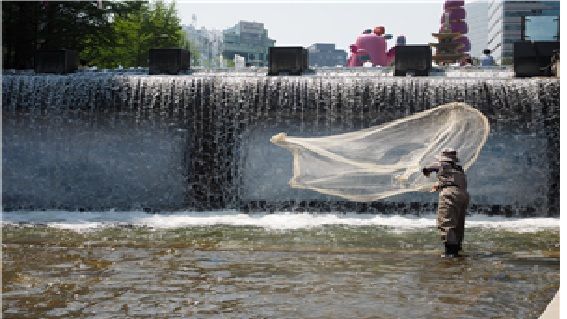 The site of the academic survey on freshwater fish in Cheonggyecheon. Provided by the National Museum of Korea.
In particular, Shiri collected from the rapids near Gwansugyo in the upper section is a species endemic to the Korean Peninsula and only found there worldwide. It inhabits clear, fast-flowing rapids and serves as an ecological indicator species for the health of river ecosystems.
Going forward, additional seasonal surveys will be conducted for precise monitoring of freshwater fish inhabiting Cheonggyecheon, including Shiri, and the results will be provided to the Seoul Metropolitan Government to support sustainable use and management of Cheonggyecheon.
During the survey, informational banners and signs were posted to inform citizens that the investigation was for academic purposes. All fish captured in the field were released back to their original locations after identification to protect the natural environment.
This academic survey of Cheonggyecheon was produced as a two-part series on the "TV Saengmul Dogam" YouTube channel (849,000 subscribers), operated by Kim Junyoung, a biology YouTuber who is working in partnership with the National Science Museum to promote scientific culture.
Kwon Seokmin, Director of the National Science Museum, stated, "In celebration of the 20th anniversary of Cheonggyecheon’s restoration, we will continue our efforts to vividly inform citizens about the freshwater fish and changes in the stream ecosystem." He added, "We are planning to provide opportunities for communication and empathy with citizens by running freshwater fish exploration programs for the public and organizing an exhibition in the second half of the year, so that Cheonggyecheon can serve as a space where people can experience, explore, and find healing in nature within the city."
© The Asia Business Daily(www.asiae.co.kr). All rights reserved.


















