Samsung Episholdings and Celltrion to Lead Global Expansion
Investment Activation and Acceleration of Bio New Drug Development Expected
This fall, with the launch of Samsung Episholdings (incorporating Samsung Bioepis), the domestic bio-pharmaceutical industry will be reorganized into a true "two-top" system centered around Samsung Episholdings and Celltrion. Both companies, which are pursuing a two-track strategy of biosimilar (biopharmaceutical copy drug) and new drug development, are also expected to accelerate their global expansion.
According to industry and securities sources on the 26th, the expected market capitalization of Samsung Episholdings, which will be newly established through the spin-off of Samsung Biologics, is projected to exceed approximately 25 trillion won. Currently, Samsung Biologics' market capitalization stands at 72.3128 trillion won, and the spin-off will be divided at a ratio of about 65 to 35 based on the respective net asset values. When calculated arithmetically, this results in the aforementioned market capitalization. With this spin-off, the value of the new drug pipeline is expected to be reassessed, leading to an increase in corporate value.
This scale is approaching that of Celltrion, a pioneer in the domestic bio industry, which has a market capitalization of about 34 trillion won. As a result, the two companies are expected to firmly secure the top two positions in the domestic bio industry. Last year, Celltrion achieved record sales of 3.5573 trillion won and an operating profit of 492 billion won. Samsung Bioepis is rapidly improving its performance. Five years ago, in 2020, its sales were 777.4 billion won and operating profit was 145 billion won; last year, just four years later, sales reached 1.5377 trillion won and operating profit 435.4 billion won, more than doubling over this period.
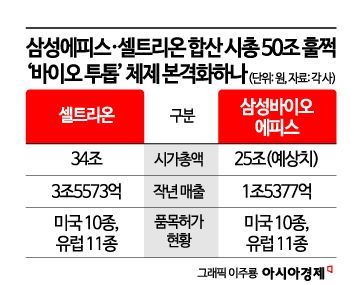
In the biosimilar sector, Samsung Episholdings and Celltrion possess world-class competitiveness. Both Samsung Bioepis and Celltrion have obtained the largest number of antibody biosimilar approvals in the United States (10 types) and Europe (11 types), respectively. Samsung Bioepis is developing several undisclosed biosimilar pipelines, including the Keytruda biosimilar 'SB27'. Celltrion is currently developing biosimilars such as Keytruda and Darzalex, as well as seven undisclosed pipelines, with plans to complete a total biosimilar portfolio of 22 products by 2030.
The pace of new drug development based on the two-track strategy is also expected to accelerate. Both companies are expanding their business areas into advanced new drug development, leveraging the antibody technology they have built up through biosimilars. In January of this year, Celltrion, at the main stage of the JP Morgan Healthcare Conference in the United States, for the first time unveiled detailed development schedules for 13 new drug pipelines based on new technologies such as antibody-drug conjugates (ADC) and multi-antibodies. The company plans to develop nine ADC new drugs and four multi-target antibody new drugs by 2028, with the first product to be commercialized in 2029. Celltrion also announced its vision to generate 40% of its total sales from new drugs by 2030.
Samsung Bioepis also plans to actively engage in the development of innovative new drugs such as antibody-drug conjugates (ADC) and gene therapies. In particular, in the ADC field, the company is conducting joint research with domestic firm IntoCell and plans to enter clinical trials within this year. In addition, Samsung Bioepis is pursuing strategic investments in promising domestic and overseas bio startups by utilizing the 'Samsung Life Science Fund', which was jointly established with Samsung C&T and Samsung Biologics. Through this, the company aims to rapidly acquire new drug development capabilities externally and, in the mid- to long-term, strengthen its own new drug pipeline.
The new drug competition between the two bio leaders is expected to have several positive ripple effects across the entire domestic pharmaceutical and bio industry. It is anticipated that this will stimulate the inflow of venture capital into the bio sector and further expand the positive effects of encouraging latecomer companies to create new business models. Lee Seungkyu, Vice President of the Korea Bio Association, stated, "Both companies have proven global competitiveness in biosimilar development and mass production, and I believe they can transfer this to the new drug development stage. With their financial strength, increased investment in domestic and overseas startups, as well as M&A activity, could become a catalyst for the domestic pharmaceutical and bio industry to take a significant leap forward."
© The Asia Business Daily(www.asiae.co.kr). All rights reserved.
![Clutching a Stolen Dior Bag, Saying "I Hate Being Poor but Real"... The Grotesque Con of a "Human Knockoff" [Slate]](https://cwcontent.asiae.co.kr/asiaresize/183/2026021902243444107_1771435474.jpg)















