Six Rare Migratory Bird Species, Including the Great Knot, Visit Namchang Fields in Onyang-eup
First Observation of Great Knot, Red Knot, and Citrine Wagtail in Ulsan
The city of Ulsan announced that from May 2 to May 6, 2025, six species of rare migratory birds, including the internationally protected Great Knot, visited Namchang fields in Onyang-eup, Ulju-gun.
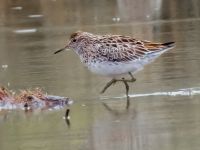 Quail as well. Provided by Woojin Jo (Wolgye Elementary School Grade 5)
The birds observed during this period were: Great Knot, Red Knot, Citrine Wagtail, Marsh Sandpiper, Grey-headed Lapwing, and Crimson Sunbird.
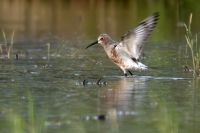 Red Knot Flapping Wings. Photo by Hyunpyo Cho (New Correspondent)
Among them, five Great Knots, one Red Knot, one Marsh Sandpiper, and one Citrine Wagtail were discovered by Hyunpyo Cho (bird correspondent) and his son Woojin Jo (Wolgye Elementary School, Grade 5). From May 2, they documented the birds foraging in Namchang fields through photographs and videos.
Notably, the Great Knot and Red Knot were observed in Ulsan for the first time. Both species are classified as Vulnerable (VU) on the IUCN Red List, meaning they are at risk of extinction.
The Great Knot, belonging to the Scolopacidae family, has a reddish-brown upper body with a particularly strong red coloration on the head. It is characterized by a V-shaped pattern on its flanks.
Rather than mudflats, it mainly forages in flooded rice paddies and wetlands. The Red Knot, observed alongside, has a vivid reddish-brown color from head to belly. While similar to the Common Redshank, it is distinguished by its longer, downward-curved bill.
Additionally, the Citrine Wagtail, which was first reported in Korea when a male was seen in Jeju Island on April 25, 1999 and has since been rarely observed nationwide, was also recorded in Ulsan for the first time.
The Citrine Wagtail, a member of the Motacillidae family, resembles the Yellow Wagtail but has a yellow chest and black legs. In particular, the male has a deep yellow color from the head to the lower belly and a black band from the nape to the sides of the neck. The female does not have the black band on the nape.
Another migratory bird observed on this occasion, the Marsh Sandpiper, was recorded for the second time since its previous sighting at the Seosaeng coast in August 2020 (as reported on Naturing).
This bird actively searches for food in flooded rice paddies, wetlands, and mudflats. In Korea, only a small number pass through during the spring and autumn.
It has a thin, long, straight bill. The upper body is grayish-brown with black markings and white-edged feathers, which distinguishes it from other birds.
In addition, bird enthusiast Kim Taehun captured images of two Grey-headed Lapwings foraging in Namchang fields during the same period, continuing from last year.
This species is a rare migratory bird in Korea. Its head and neck are bluish-gray with a black marking on the chest. The bill is yellow with a black tip. It mainly feeds on insects and earthworms in rice paddies and river wetlands.
Also, a male Crimson Sunbird, observed again this year following last year, was recorded in photos and videos by citizen biologist and photographer Ki Deuk Yoon.
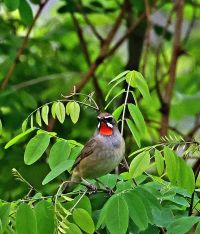 Crimson Sunbird. Provided by Ki Deuk Yoon (Citizen Biologist, Photographer)
Seungmin Hong, CEO of Jjaekjjaek Rest Area, emphasized, "Namchang fields, as farmland adjacent to the coast, serve as a crucial stopover and refueling site for birds, making it an area of high ecological value. It is important to maintain the current environment so that birds remember it as a place rich in food and safety."
An official from Ulsan city stated, "We will work closely with citizens, bird correspondents, and citizen biologists to thoroughly document that Ulsan's Seosaeng coast and Namchang fields are key stopover or breeding sites for summer and migratory birds," adding, "Through continuous monitoring, we will strive to protect habitats and promote education and birdwatching tourism."
© The Asia Business Daily(www.asiae.co.kr). All rights reserved.
![Clutching a Stolen Dior Bag, Saying "I Hate Being Poor but Real"... The Grotesque Con of a "Human Knockoff" [Slate]](https://cwcontent.asiae.co.kr/asiaresize/183/2026021902243444107_1771435474.jpg)














