The Donald Trump administration has reportedly made an official request for South Korea to resolve several "non-tariff barrier" issues during the recent director-level customs and technical meeting between South Korea and the United States held in Washington DC.
The United States has specified its demands regarding a 25% "reciprocal tariff" on South Korea, as well as tariff reductions on specific items such as steel, automobiles, and semiconductors. It is expected that negotiations between South Korea and the United States will intensify going forward.
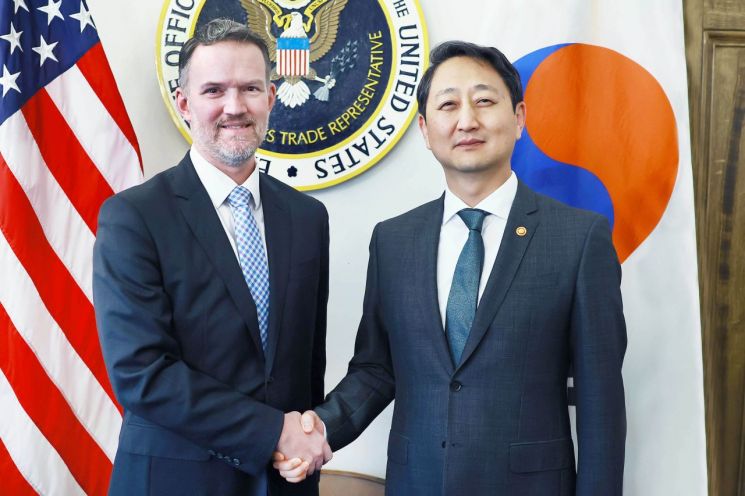 Minister Andeok Geun of the Ministry of Trade, Industry and Energy is shaking hands with Katherine Tai, United States Trade Representative, and taking a commemorative photo in the meeting room of the USTR in Washington DC, USA, on the 24th of last month (local time). Photo by Yonhap News
According to government sources on the 25th, during the South Korea-US consultations held from the 20th to the 22nd, the United States raised several "non-tariff barrier" issues included in the National Trade Estimate (NTE) Report. In particular, the US mentioned restrictions on the import of beef under 30 months of age, emissions regulations on imported vehicles, restrictions on Google’s export of detailed maps, and drug pricing policies.
The most sensitive issues are the easing of import restrictions on beef and rice. The United States expressed dissatisfaction with the restriction to cattle under 30 months of age, which was agreed upon as a "transitional measure" during the 2008 agreement to open the South Korean beef market. Regarding rice, President Trump himself has expressed dissatisfaction with South Korea's imposition of a basic tariff of 513%.
The South Korean negotiating team reportedly explained to the US side that expanding imports of beef and rice would require a national consensus process in accordance with the Trade Procedure Act. The South Korean delegation approached the negotiations with the policy of reaching a final agreement after the new government is inaugurated following the June 3 presidential election.
The government plans to hold an interagency meeting early this week to share the results of the consultations and analyze the priorities among the US demands before passing them on to the next administration. South Korea is emphasizing trade balance through increased imports from the United States and strategic industrial cooperation centered on shipbuilding, with the goal of achieving a 25% reciprocal tariff and tariff exemptions on specific items.
However, because most of the US demands involve sensitive issues with complex domestic interests, the next administration, which will be inaugurated after the presidential election on June 3, will have to conduct negotiations on a tight schedule before the July 8 deadline.
© The Asia Business Daily(www.asiae.co.kr). All rights reserved.
![Clutching a Stolen Dior Bag, Saying "I Hate Being Poor but Real"... The Grotesque Con of a "Human Knockoff" [Slate]](https://cwcontent.asiae.co.kr/asiaresize/183/2026021902243444107_1771435474.jpg)















