Japanese Prime Minister Shigeru Ishiba announced on May 25 that he intends to continue discussions on the U.S.-Japan tariff negotiations with the upcoming Group of Seven (G7) summit in Canada in mid-June in mind.
According to Kyodo News and Jiji Press, Prime Minister Ishiba told reporters in Maizuru, Kyoto, where he was visiting for an inspection event of a Maritime Self-Defense Force escort ship, "We will proceed with discussions with the G7 summit in mind."
Regarding cooperation in the shipbuilding sector, which has been mentioned as a potential card in the U.S.-Japan tariff negotiations, he explained, "Japan has a significant technological advantage in icebreakers," and added, "Including the Arctic route, icebreakers could become a key point of cooperation."
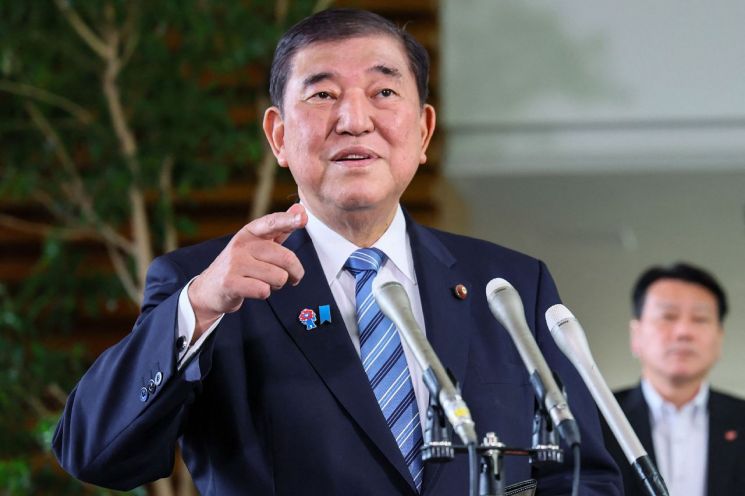 Japanese Prime Minister Shigeru Ishiba is explaining the details to the press after a phone call with U.S. President Donald Trump at the Prime Minister's Official Residence in Tokyo on the 23rd. Photo by AFP Yonhap News
Earlier, on May 23, Prime Minister Ishiba and President Donald Trump exchanged their intentions to hold a face-to-face meeting during a phone call regarding the G7 summit. On the same day (local time), the U.S. and Japanese governments held the third round of tariff negotiations in Washington, D.C., discussing the expansion of bilateral trade, non-tariff measures, and cooperation on economic security.
Ryosei Akazawa, Japan's Minister for Economic Revitalization and the head representative for the negotiations, told reporters immediately after the third round that the two sides agreed to continue close consultations among ministers, aiming to find common ground at the U.S.-Japan summit to be held on the occasion of the G7 summit.
He said, "It would be very good if some agreement could be reached at the summit," but also emphasized, "Japan has national interests that must be protected, so simply reaching a quick agreement is not necessarily desirable," and added, "When negotiations are conducted with a set deadline, the side that is conscious of the deadline generally loses."
During the second round of tariff negotiations, the U.S. side indicated that the 25% tariffs on steel and aluminum and the 25% tariff on automobiles were not subject to negotiation, that the 24% reciprocal tariff?of which the 10% applied equally to all countries?could not be reconsidered, and that only the additional 14% imposed on Japan could be adjusted. However, Japan has continued to demand a review of all tariffs, including the tariffs on automobiles.
© The Asia Business Daily(www.asiae.co.kr). All rights reserved.
![Clutching a Stolen Dior Bag, Saying "I Hate Being Poor but Real"... The Grotesque Con of a "Human Knockoff" [Slate]](https://cwcontent.asiae.co.kr/asiaresize/183/2026021902243444107_1771435474.jpg)















