Compared to the 20th Election, an Increase of 194,179
Women Account for 50.5%, Voters in Their 50s Make Up 19.6%
Teens at 2%, 20s at 13% Are the Smallest Groups
The number of eligible voters for the 21st presidential election, scheduled for June 3, has been tallied at 44,391,871. There are more female voters than male voters, and the largest age group is those in their 50s.
On the 23rd, the Ministry of the Interior and Safety confirmed and announced the number of eligible voters as of the 22nd, the official date for finalizing the voter list.
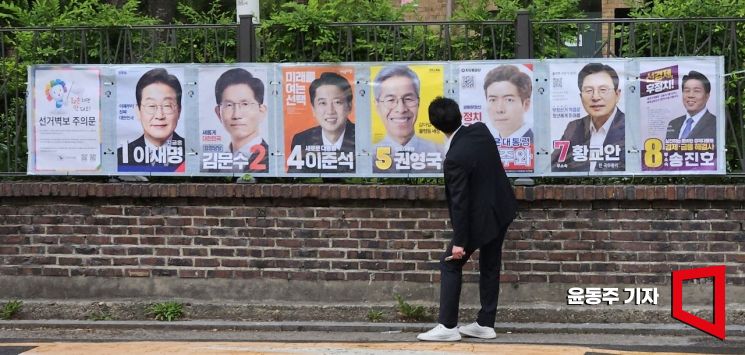 On the 15th, officials from the Seoul Metropolitan Election Commission are posting election posters of candidates for the 21st presidential election on a wall near the Artist's House in Jongno-gu, Seoul. 2025.05.15 Photo by Yoon Dongjoo
Of the total, 44,133,617 are domestic voters. There are 258,254 overseas voters, which includes those who have reported absentee voting from abroad and overseas voters. This figure represents an increase of 194,179 compared to the 20th presidential election in 2022, and an increase of 111,860 compared to the 22nd National Assembly election in 2024.
By gender, there are 21,977,489 male voters (49.5%) and 22,414,382 female voters (50.5%), meaning there are 436,893 more female voters than male voters.
By age group, those in their 50s make up the largest portion with 8,683,369 voters (19.6%). Excluding those aged 18-19 (900,325 voters, 2.0%), the 20s age group has the fewest voters with 5,832,127 (13.1%). Those in their 60s (7,847,466 voters, 17.7%) and those aged 70 and above (6,854,304 voters, 15.4%) together account for 33.1% of the total. This is 5.1 percentage points higher than the combined total of voters in their 20s (5,832,127, 13.1%) and 30s (6,634,533, 14.9%), which together make up 28.0%.
By region, Gyeonggi Province has the largest number of voters with 11,711,253 (26.4%), followed by Seoul with 8,284,591 (18.7%) and Busan with 2,864,071 (6.5%). Sejong has the fewest voters with 307,028 (0.7%).
Eligible voters can check their voter registration number and polling station location through the websites of city, county, or district offices, or via notification letters sent by mail. Early voting will be available at polling stations nationwide on May 29 and 30, and voters can participate in the election at their designated polling stations on June 3.
© The Asia Business Daily(www.asiae.co.kr). All rights reserved.

















