Wi Seongrak: "Top-down Approach Has Failed to Resolve North Korean Nuclear Issue"
Emphasizes Need for Working-level Negotiations and Balanced Diplomacy with U.S., China, Japan, and Russia
Wi Seongrak, a Democratic Party lawmaker who serves as the foreign affairs and security advisor to Lee Jaemyung, the Democratic Party's presidential candidate, stated on the 23rd, "It has become clear that the 'summit-level negotiations' that were anticipated in 2018-2019 have proven ineffective in addressing the North Korean nuclear issue." He further pointed out, "It has even become more difficult because the United States and North Korea attempted the summit negotiations in the wrong way."
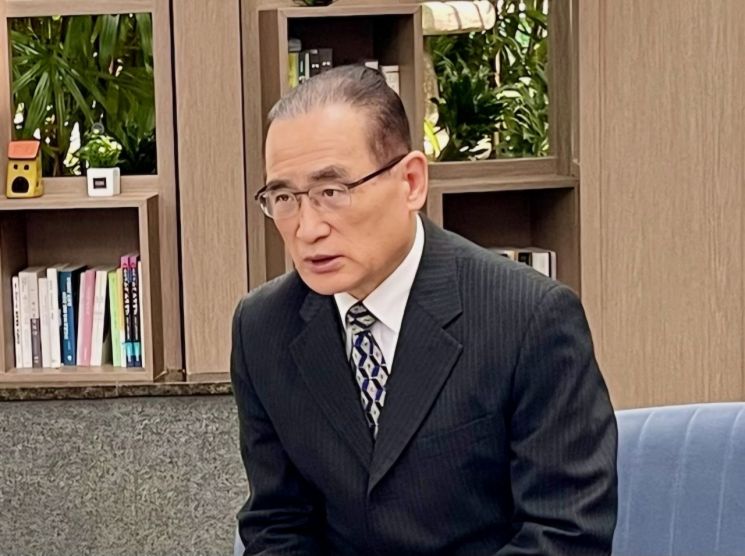
His remarks suggest that the 'top-down' approach, which was attempted during the U.S.-North Korea dialogue phase under the first Trump administration through direct talks between President Donald Trump and North Korean State Affairs Commission Chairman Kim Jong-un, is not effective in resolving the complex North Korean nuclear issue.
Attending the 'Grand Debate on Foreign Policy for the New Administration' held at the East Asia Institute (EAI) in Jongno-gu, Seoul, that morning, Wi said, "To resolve the North Korean nuclear issue, the United States and North Korea need to accumulate progress through working-level negotiations, and then the leaders should put the finishing touches. However, at that time, they did not think this way and tried to resolve everything through a summit, which made things much more difficult."
With the launch of a new administration scheduled for early next month, he also emphasized the necessity of managing relations not only with the United States but also with neighboring countries such as Japan, China, and Russia. This is also connected to a key point in Lee's campaign pledge to develop diplomatic relations with the four major powers based on national interest and pragmatism.
Wi noted, "South Korean diplomacy has achieved results in areas such as the South Korea-U.S. alliance and South Korea-Japan, South Korea-U.S.-Japan cooperation, but currently, both South Korea-China and South Korea-Japan relations are at their lowest point, and North Korea continues its nuclear missile threats." He expressed concern, stating, "With the imposition of martial law in our country, the values of liberal democracy that we have pursued have been significantly damaged." Regarding the direction of the new administration's foreign policy, he said, "Fundamentally, we need to base our approach on the South Korea-U.S., South Korea-Japan, and South Korea-U.S.-Japan cooperation, while also properly managing relations with China, Russia, and North Korea." He added, "By doing so, South Korea should contribute in its own way to creating a new order amid the current U.S.-China confrontation."
He specifically pointed out China and Russia, saying, "If we fail to properly manage relations with China and Russia and adversarial relations persist, it will be difficult to achieve our immediate goals of North Korean denuclearization and establishing peace on the Korean Peninsula." He continued, "China and Russia have now come to cooperate with North Korea on the nuclear issue," and stressed, "We must also avoid a situation where we (the Republic of Korea) are excluded from discussions on the Korean Peninsula issue."
Regarding persistent forecasts that a second Trump administration might consider redeploying U.S. forces in Korea to contain China, he said, "America's 'America First' policy is creating many challenges for its allies, and it will increasingly demand our participation in containing China." He added, "There is no perfect solution, but the top priority of the South Korea-U.S. alliance should be deterrence against North Korean provocations, and this should be the basis for our discussions." He further emphasized, "We must not lose the broader framework of alliance trust. Just as the U.S. and the Soviet Union managed to cooperate in certain areas even during the Cold War, even if the U.S. and China compete in other fields, we should play a constructive role in areas of cooperation on Korean Peninsula issues."
© The Asia Business Daily(www.asiae.co.kr). All rights reserved.
![Clutching a Stolen Dior Bag, Saying "I Hate Being Poor but Real"... The Grotesque Con of a "Human Knockoff" [Slate]](https://cwcontent.asiae.co.kr/asiaresize/183/2026021902243444107_1771435474.jpg)
















