Collaboration with Samsung Seoul Hospital, Naver Cloud, and Hits
Selected for the Ministry of Science and ICT's "AI Star Fellowship"
KAIST is developing artificial intelligence (AI) technologies and platforms capable of autonomously inferring and diagnosing diseases, as well as discovering new drugs.
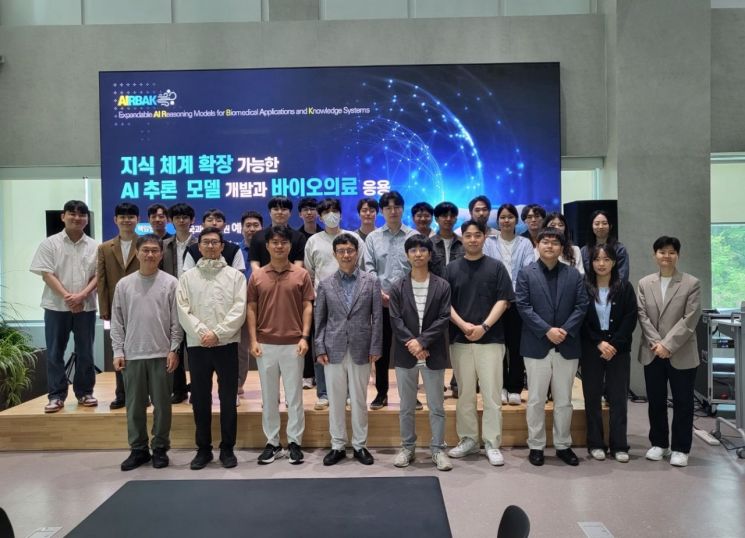 On the 20th, the KAIST research team held the first meeting announcing the start of the 'AI Star Fellow Project' at the AI Graduate School Yangjae Industry-Academic Campus, together with Samsung Seoul Hospital, Naver Cloud, and Hits. Photo by KAIST
On May 23, the KAIST Digital Biohealth AI Research Center announced that it has been selected for the Ministry of Science and ICT's "AI Star Fellowship," a program supporting top-tier early-career AI researchers. Starting this month and continuing until December 2030, the center will invest a total of 11.5 billion KRW to accelerate the development of AI technologies and platforms that can independently infer and diagnose diseases and identify novel drug candidates.
This project aims to foster an innovative AI research ecosystem centered on early-career researchers, and to develop inference-based AI agents that leverage specialized knowledge systems in the bio and medical fields.
The project will be led by Professor Ye Jongcheol from the KAIST AI Graduate School, with participation from early-career researchers such as Professors Choi Yoonjae, Lee Kimin, Ahn Seongsu, and Park Chanyoung, as well as mid-career researchers including Professors Joo Jaegul and Kim Wooyeon. Together, they will collaborate with various research labs within the university to conduct comprehensive research spanning from the theoretical foundations of AI inference to practical applications.
Specifically, the main objectives include: (1) building high-performance inference models that integrate diverse medical knowledge systems to enhance the precision and reliability of diagnosis and treatment; (2) developing a convergent inference platform that efficiently combines symbolic reasoning and neural network models; and (3) securing AI technologies for new drug development and biomarker discovery based on cell ontology.
In collaboration with industry and medical institutions such as Samsung Seoul Hospital, Naver Cloud, and Hits, the project also aims to achieve: (1) clinical diagnostic AI utilizing medical knowledge systems; (2) AI-based molecular target discovery for drug development; and (3) commercialization of an AI inference platform capable of knowledge expansion.
Ye Jongcheol, Director of the KAIST Digital Biohealth AI Research Center, stated, "After the completion of this project, we will do our utmost to ensure that the participating early-career researchers can achieve world-class research outcomes."
Meanwhile, the AI Star Fellowship is a newly established program in which postdoctoral researchers and faculty members within seven years of appointment can participate as project leaders (PLs) and take the initiative in leading research. The program is operated as a consortium of multiple university research labs and industry partners.
Through this initiative, KAIST plans to foster bio-medical convergence AI talent in partnership with Samsung Seoul Hospital, Naver Cloud, and Hits, while simultaneously promoting the commercialization of key technologies.
© The Asia Business Daily(www.asiae.co.kr). All rights reserved.
![Clutching a Stolen Dior Bag, Saying "I Hate Being Poor but Real"... The Grotesque Con of a "Human Knockoff" [Slate]](https://cwcontent.asiae.co.kr/asiaresize/183/2026021902243444107_1771435474.jpg)















