Jung Kisuk, Head of NHIS, Stresses Tobacco-Lung Cancer Link at Final Hearing Against Three Major Tobacco Companies
"Tobacco Companies Intentionally Concealed Harmful Effects"
At the final hearing of a tobacco lawsuit that has continued for 12 years, the National Health Insurance Service (NHIS) reiterated its argument that there is a causal relationship between the addictive nature of smoking and the onset of lung cancer. The NHIS pointed out that tobacco companies have intentionally concealed the harmful and addictive properties of smoking for decades, deceived consumers, and reaped enormous profits as a result.
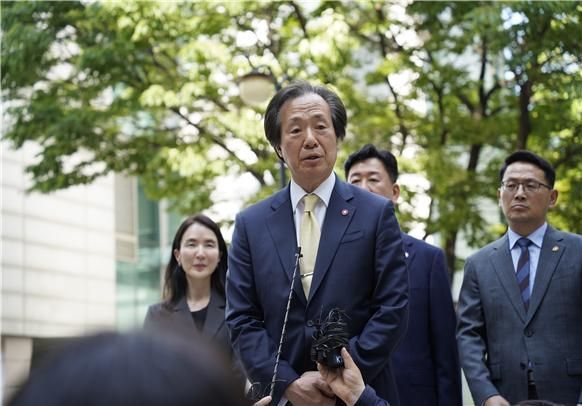 Jung Kisuk, chairman of the National Health Insurance Service, is responding to reporters' questions before attending the 12th appellate hearing of the National Health Insurance Service's damages lawsuit against tobacco companies, held on the 22nd at the Seoul High Court in Seocho-gu, Seoul. National Health Insurance Service
The Civil Division 6-1 of the Seoul High Court held the 12th appellate hearing on the 22nd for the NHIS’s 53.3 billion won damages lawsuit against KT&G, Korea Philip Morris, and BAT Korea.
Jung Kisuk, a respiratory medicine specialist and chairman of the NHIS, attended the hearing in person, as he did in previous sessions, stating, “It is distressing that even in 2025, we are still discussing the addictive nature of tobacco,” and argued, “Tobacco companies bear direct responsibility for the onset of lung cancer and other diseases.”
Chairman Jung referenced a recent study involving approximately 140,000 health screening participants, saying, “The research showed that tobacco contributed to the development of lung cancer in 98 out of 100 cases. Various academic societies composed of leading scholars have also stated that there is a causal relationship between smoking and cancer, and that tobacco is addictive, so tobacco companies must be held accountable.”
Addressing the court, he appealed, “The numerous medical opinions on the causal relationship between smoking and cancer, as well as the heartfelt pleas from people across all walks of life, can no longer be overlooked,” and urged, “The harsh reality faced by smoking victims in Korea, who have nowhere else to turn for relief, must be taken seriously.”
Chairman Jung remarked, “I have witnessed countless patients secretly smoking in hospital corridors even before surgery,” and pointed out, “Even though they only have one body, the fact that they continue to smoke before surgery is due to addiction.” He added, “This fight to protect the health of the public is by no means the NHIS’s alone. Broad public interest and support are desperately needed to hold tobacco companies fully accountable.”
During the hearing, the NHIS submitted 22 additional pieces of evidence to prove the causal link between smoking and cancer. These included opinion letters from the Korean Association for Lung Cancer and respiratory medicine specialists, opinion letters on tobacco addiction from the Korean Academy of Addiction Psychiatry and psychiatric specialists, an assessment of tobacco addiction by the Korean Association for Smoking Cessation, in-depth case analyses of smoking experiences for some of these, and internal research results from the NHIS.
Regarding the third key issue?NHIS’s direct right to claim damages?the NHIS argued, “The finances of the national health insurance system, which are primarily funded by citizens’ insurance premiums, are clearly worthy of legal protection. When diseases eligible for insurance benefits arise due to tobacco, and corresponding medical benefits are provided, resulting in actual financial loss to the plaintiff, this clearly constitutes an infringement of legal interests.”
In contrast, the defendant tobacco companies emphasized that smoking is ultimately a matter of individual free will. The tobacco companies’ attorney stated, “Smoking is a personal choice, and those who choose to smoke can still quit if they wish,” and argued, “It is not unreasonable for the Supreme Court to require consideration of individual factors, family history, and other influences to determine whether there are other contributing factors and whether smoking is a particularly strong causal agent.”
Previously, in April 2014, the NHIS filed a damages lawsuit for approximately 53.3 billion won against KT&G, Korea Philip Morris, BAT Korea, and other tobacco companies. The 53.3 billion won represents the medical benefits paid by the NHIS for 3,465 patients who, after smoking for more than 30 years or at least 20 pack-years, were diagnosed with lung or laryngeal cancer. In January 2020, after over six years of litigation, the court of first instance ruled against the NHIS, stating that it must be additionally proven that the claimants had no other risk factors for smoking-related diseases, such as the period and extent of smoking exposure, lifestyle habits, or family history.
© The Asia Business Daily(www.asiae.co.kr). All rights reserved.
![Clutching a Stolen Dior Bag, Saying "I Hate Being Poor but Real"... The Grotesque Con of a "Human Knockoff" [Slate]](https://cwcontent.asiae.co.kr/asiaresize/183/2026021902243444107_1771435474.jpg)
















