Gwangju City Analyzes Air Quality at Four Key Locations Including Pyeongdong
Sulfur Dioxide and Other Levels Rose After Noon on the 19th
Returned Below Legal Limits Within Hours
Fine Dust Exceeded Standards but Not at Dangerous Levels
Air Quality Inside Songjeong Station Also Safe Immediately After the Accident on the 17th
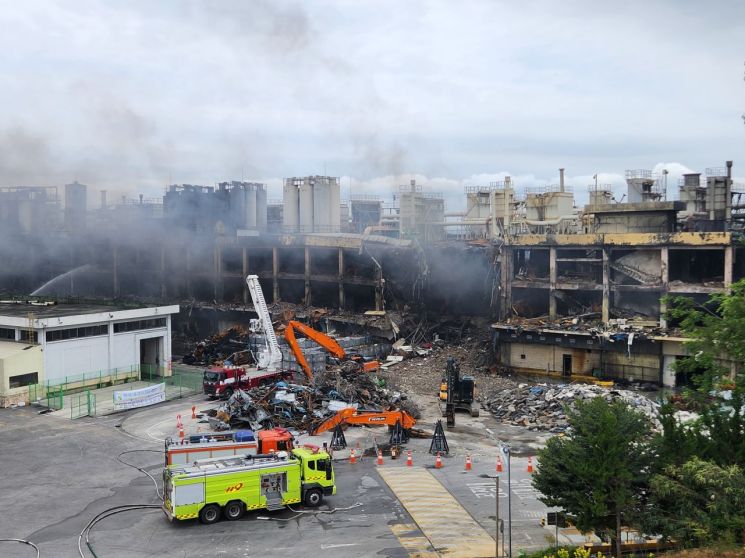 At around 11:40 a.m. on the 22nd, numerous firefighting equipment and police personnel arrived at the Kumho Tire Gwangju factory fire site to conduct an investigation into the cause of the accident. Photo by Shim Jinseok
On the morning of May 17, a major fire broke out at the Kumho Tire Gwangju factory, but it was analyzed that there was no significant change in the local air quality. On May 19, the second day after the accident, some items such as fine dust were temporarily detected at levels slightly above the standard, but it was found that these were not high enough to pose a threat to health.
The Gwangju Institute of Health and Environment on May 21 released the results of air pollution measurements (including six air quality standard pollutants: PM-2.5, PM-10, ozone, sulfur dioxide, nitrogen dioxide, and carbon monoxide) from four locations?Pyeongdong, Usandong, Oseondong, and Yuchondong?closest to the accident site among the total of 11 monitoring stations in the region, for the period from 9 p.m. on May 17 to 3 p.m. on May 21, following the Kumho Tire fire.
According to the data, 'sulfur dioxide', which is classified as the most direct indicator of air quality pollution after the fire, has a legal permissible standard of 'annual average 0.02ppm or less' and 'hourly average 0.15ppm or less'. However, in most of the surveyed areas, the levels ranged from 0.0026ppm to 0.0032ppm, showing no significant change.
On May 19, the second day after the accident, between noon and midnight, separate measurements taken by a mobile vehicle near the accident site showed sulfur dioxide levels peaking at 0.0269ppm. However, this was still well below the legal permissible limit. From 1 a.m. on May 20, the level dropped to 0.0082ppm, quickly returning to stability.
Ozone, which can cause bronchitis and other issues when exposed to high concentrations, has legal standards of '8-hour average 0.06ppm' and 'hourly average 0.1ppm or less'. It was analyzed that ozone levels remained stable after the accident.
Similar to sulfur dioxide, ozone levels in Usandong, Yuchondong, and across Gwangju exceeded 0.071ppm after 3 p.m. on May 19, slightly surpassing the legal 8-hour average limit of 0.06ppm. However, according to Gwangju city officials, this was scientifically insignificant.
Other items, such as nitrogen dioxide (annual average 0.03ppm or less, hourly average 0.10ppm or less) and carbon monoxide (8-hour average 9ppm or less, hourly average 25ppm or less), also showed virtually no change after the accident.
However, fine dust (PM-10) and ultrafine dust (PM-2.5) levels greatly exceeded the average from 2 p.m. on May 19.
Although these were also measured by a mobile vehicle rather than a fixed monitoring station, at around 7 p.m. that day, fine dust reached 227μg/m³ and ultrafine dust reached 142μg/m³. Considering that the standards are 81μg/m³ for fine dust (PM-10) and 36μg/m³ for ultrafine dust (PM-2.5), it can be seen that the levels rose considerably.
On May 19, as numerous firefighting equipment and personnel were deployed to extinguish the fire at the construction site, it is interpreted that scattered dust and other particulates temporarily spread in the surrounding area.
Additionally, the city of Gwangju conducted its own unofficial investigation into volatile organic compounds (VOCs) inside Gwangju Songjeong Station and other locations around noon on May 17, immediately after the accident, but all results were found to be below the standard limits.
An official from the Gwangju Institute of Health and Environment stated, "It is true that a large fire of this scale in the region raises significant concerns for health and safety. While it is difficult to make hasty predictions or forecasts, air quality tests conducted from multiple angles did not reveal any noticeable risk factors. However, since various variables may affect residents near the accident site, they should immediately contact a health center or hospital if they notice any abnormal physical symptoms."
© The Asia Business Daily(www.asiae.co.kr). All rights reserved.
![Clutching a Stolen Dior Bag, Saying "I Hate Being Poor but Real"... The Grotesque Con of a "Human Knockoff" [Slate]](https://cwcontent.asiae.co.kr/asiaresize/183/2026021902243444107_1771435474.jpg)















