Announcement of Spin-Off on the 22nd
Samsung Biologics and Episholdings to Adopt Horizontal Structure
New Drug Development and Bio Investment Expected to Gain Momentum
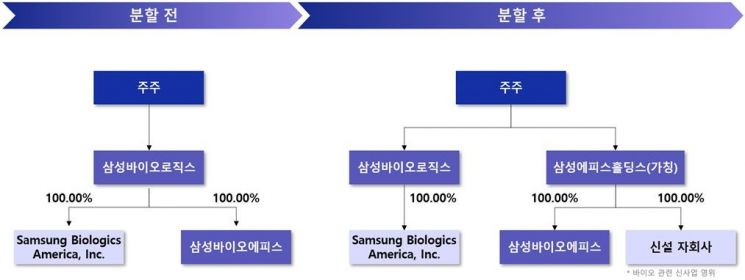 Samsung Biologics Governance Structure Before and After the Split. Data Provided by Samsung Biologics
The Samsung Group is undertaking a comprehensive overhaul of its governance structure for its bio business. The company plans to separate its new drug and biosimilar (biopharmaceutical generic) research and development (R&D) operations, which have so far been subordinate to its contract development and manufacturing organization (CDMO) business, and create a new, horizontally structured entity to further strengthen its new drug development division. This decision reflects Samsung Group’s determination to rapidly enhance the competitiveness of its bio division, which is seen as the next major growth engine following semiconductors.
On May 22, Samsung Biologics announced that it will establish ‘Samsung Episholdings’ through a simple physical division, thereby completely separating its CDMO business from its biosimilar business.
Separation of CDMO and New Drug Businesses... Samsung Biologics Gains Two Growth Engines
Samsung Episholdings will be established by splitting off the business division responsible for managing subsidiaries and new investments from Samsung Biologics. As a pure holding company, Samsung Episholdings will incorporate Samsung Bioepis, a biosimilar company, as a wholly owned subsidiary. In addition, a new subsidiary dedicated to pursuing bio-related new businesses will also be established, with Samsung Episholdings owning 100% of its shares. The inaugural CEO of Samsung Episholdings will be Kim Kyungah, who currently serves as CEO of Samsung Bioepis. Samsung Biologics will be reborn as a pure-play CDMO company.
The restructuring of Samsung Biologics’ governance is aimed at enhancing business specialization. The CDMO business acts as a partner that assists clients in the development and production of pharmaceuticals on a contract basis. However, from the client’s perspective, there have been concerns that development information could be leaked to the R&D subsidiary. Such concerns about technology and capital outflow have also hindered meaningful growth in the new drug development subsidiary. For this reason, except for China’s WuXi Biologics, none of the major global CDMO companies have a new drug development company as a subsidiary. The principle that ‘CDMO companies do not compete with their clients’ has been regarded as an unwritten rule within the industry. The physical division of Samsung Biologics can be seen as an extension of this trend.
The division will be finalized following a series of procedures, including the submission of a securities registration statement on July 29 and a shareholders’ meeting to approve the split on September 16. Samsung Episholdings is scheduled to be established on October 1, at which point Samsung Bioepis will be incorporated as a wholly owned subsidiary, completing the split. Subsequently, on October 29, the surviving company Samsung Biologics will undergo a change in listing status, and the newly established Samsung Episholdings will be relisted.
This corporate split will be carried out as a physical division, whereby shareholders will receive shares in both the existing and new entities in proportion to their current holdings. Existing shareholders of Samsung Biologics will receive shares in Samsung Biologics and Samsung Episholdings in a ratio of 0.6503913 to 0.3496087. The split ratio was determined based on the current book value of net assets.
Samsung Biologics’ Growing Presence... Swift and Specialized Decision-Making Expected
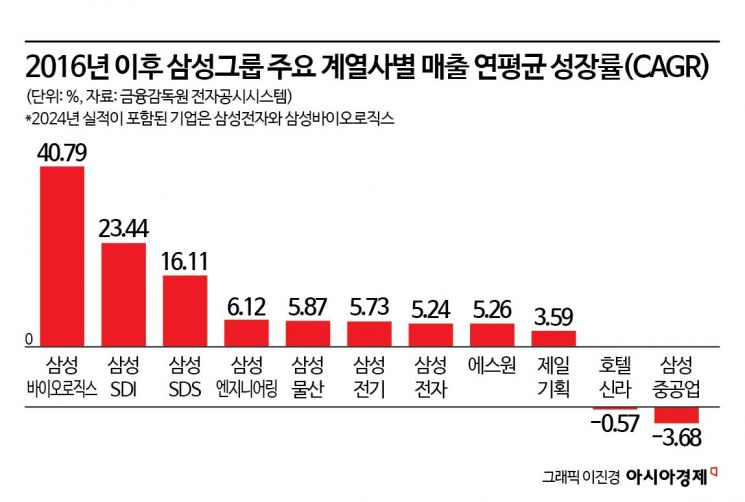
This governance restructuring is expected to firmly establish the presence of the bio business as a future growth engine at the group level. Since 2016, Samsung Biologics has recorded unparalleled growth within the group. A comparison of the performance of 11 major non-financial affiliates of Samsung Group from 2016 through last year shows that Samsung Biologics achieved a compound annual growth rate (CAGR, based on revenue) of 40.79% over the past eight years, the highest growth rate within the group.
This far outpaces the growth rates of Samsung SDI (23.44%) in second place, Samsung SDS (16.11%) in third, and even the group’s core, Samsung Electronics (5.24%). In a situation where the semiconductor business, once the group’s mainstay, is faltering, the organizational restructuring of the bio division carries even greater significance.
Through this split, Samsung Biologics and Samsung Episholdings will be able to make swift and specialized decisions tailored to the characteristics and strategies of their respective business divisions, thereby enabling faster and more flexible business execution. Samsung Biologics, now a pure-play CDMO company, plans to continue its growth strategy with the goal of becoming a ‘global top-tier CDMO’.
Yoo Seungho, Executive Vice President and Head of Business Support Center at Samsung Biologics, said during a conference call on the physical division held that morning, “By transforming into a pure-play CDMO company, Samsung Biologics will be able to completely eliminate any potential risks that may arise in future business operations. We also expect to enhance shareholder value through the expansion and acceleration of global partnerships, as well as a high-profit business structure.”
He added, “The newly established company will focus on discovering new growth engines as an investment holding company and will pursue aggressive growth through research and development and mergers and acquisitions (M&A). The biosimilar business will continue to launch new products and will seek to be re-evaluated as a top-tier biosimilar platform, thereby solidifying its position as a leading global biosimilar company. We believe that the ‘hidden value’ of the biosimilar business will play a significant role in enhancing shareholder value for the newly established company.”
Based on its ‘three-pronged growth strategy’ of expanding production capacity, diversifying its portfolio, and increasing its global footprint, Samsung Biologics plans to further strengthen its CDMO capabilities and increase investments in new business areas such as antibody-drug conjugates (ADC), adeno-associated viruses (AAV), and pre-filled syringes (PFS).
Samsung Episholdings has outlined a growth strategy to secure a portfolio of more than 20 biosimilar products to foster Samsung Bioepis as the ‘world’s number one biosimilar company.’ The company also plans to continue exploring next-generation technology areas for future growth, such as building new modality development platforms.
Upon listing, the company will also be able to actively expand its business through venture investments and M&A. For Samsung Bioepis, which is preparing to become a new drug developer, this means gaining multiple strategic tools.
John Rim, CEO of Samsung Biologics, stated, “We decided on this split so that both companies can proactively and swiftly respond to rapid changes in the global environment and secure unrivaled competitive advantages in their respective businesses through selection and concentration. This will serve as a springboard for both companies to accelerate growth and become global top-tier bio companies.”
© The Asia Business Daily(www.asiae.co.kr). All rights reserved.
![Clutching a Stolen Dior Bag, Saying "I Hate Being Poor but Real"... The Grotesque Con of a "Human Knockoff" [Slate]](https://cwcontent.asiae.co.kr/asiaresize/183/2026021902243444107_1771435474.jpg)

















