National Fire Agency Launches Central Fire Joint Investigation Team
Simulation Experiment on "Initial Ignition" Device Planned
Secondary Damages, Including Hazardous Substance Release, to Be Analyzed
An experiment simulating the circumstances at the time of the fire will be conducted to determine the cause of the large-scale fire that occurred at the Kumho Tire factory in Gwangju.
On May 22, the National Fire Agency announced the launch of a "Central Fire Joint Investigation Team" to identify the exact cause of the fire at the Gwangju tire factory that broke out on May 17 and to analyze the extent of the damage.
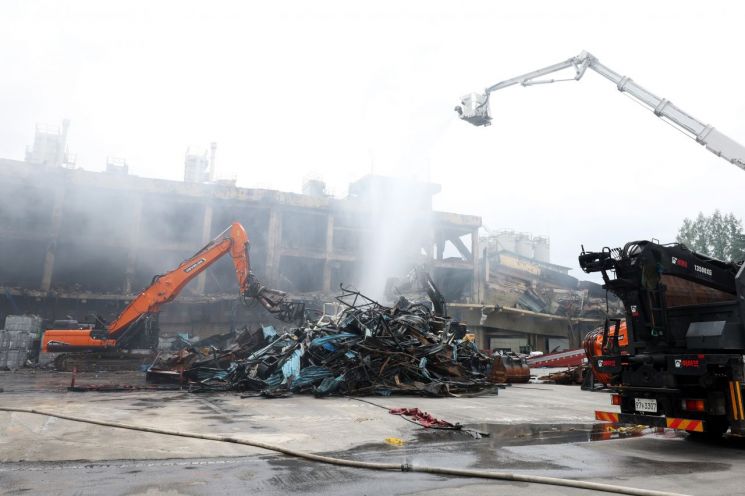
The joint investigation team will conduct a comprehensive investigation into the cause of ignition, the path of the damage, and structural vulnerabilities of the fire, based on on-site inspections and scientific analyses, over approximately one month until June 20.
The team consists of 16 members from eight organizations, including the National Fire Agency, the National Fire Research Institute, the Disaster Prevention Test and Research Institute, the Korea Electrical Safety Corporation, and the Gwangju Metropolitan Fire and Safety Headquarters. In addition, engineering PhDs and professors specializing in fire and safety from the private sector will participate as advisors.
For a specific device that has been suggested as a possible source of ignition, the National Fire Research Institute will lead a simulation experiment. It has been indicated that sparks from an industrial electric oven inside the factory were a major cause of the fire. The experiment will scientifically verify the possibility of ignition under conditions identical to those at the actual site. The results of this experiment will be reflected in the final investigation report.
Furthermore, the joint investigation team plans to examine the entire course of the fire through investigation items such as: analysis of the electrical and mechanical operating status at the time of the fire, identification of the path of fire spread and the extent of property damage, review of the possibility of arson or negligence in management, and assessment of the adequacy of the initial response system.
In addition, the team will analyze both human and material damages caused by the fire, as well as the possibility of secondary damage such as the release of hazardous substances, and will compile a report that can be used to inform future institutional improvements and technical countermeasures.
Park Geuno, Director of the 119 Response Bureau at the National Fire Agency, stated, "This investigation will not only determine the cause of the fire, but also serve as basic data for developing policies to prevent similar large-scale fires and to strengthen safety at manufacturing facilities. The results of the investigation will be widely shared with relevant ministries, local governments, and the private sector to serve as a foundation for establishing effective safety measures."
© The Asia Business Daily(www.asiae.co.kr). All rights reserved.
![Clutching a Stolen Dior Bag, Saying "I Hate Being Poor but Real"... The Grotesque Con of a "Human Knockoff" [Slate]](https://cwcontent.asiae.co.kr/asiaresize/183/2026021902243444107_1771435474.jpg)















