Ministry of Health and Welfare Holds Public Hearing on Institutionalizing Medical Support Work on the 21st
45 Specific Procedures Include Arterial Line Insertion and Anesthesia Monitoring
13 Tasks, Such as Tissue Collection and Tracheostomy Tube Insertion/Removal, Excluded
"Scope of Duties and Legal Responsibility Must Be Clearly Defined"
Starting next month, PA (Physician Assistant) nurses will be legally permitted to perform 45 medical procedures that were previously restricted to physicians, such as bone marrow aspiration, which involves inserting a needle into a patient's bone marrow to collect tissue. Medical associations are opposing the move, arguing that it undermines the foundation of the medical licensing system. Nurses are also voicing concerns, insisting that nurse-led training is essential for these tasks. As a result, the controversy is expected to continue.
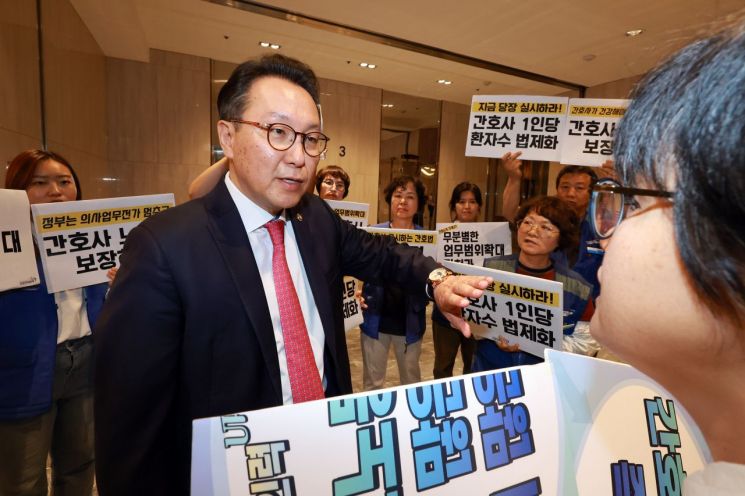 Park Minsu, the 2nd Vice Minister of Health and Welfare, is talking with members of the Medical Solidarity Headquarters of the Public Transport Union of the Korean Confederation of Trade Unions who were picketing while waiting for Vice Minister Park at the "Public Hearing on Institutionalization Measures for Medical Support Work Following the Enactment of the Nursing Act," held on the 21st at Peak and Park Convention in Yongsan-gu, Seoul. Photo by Yonhap News
On the 21st, the Ministry of Health and Welfare held a "Public Hearing on Institutionalization Measures for Medical Support Work Following the Enactment of the Nursing Act" at Peace and Park Convention in Yongsan-gu, Seoul, and unveiled the "Regulations on the Performance of Medical Support Work," which contains these provisions.
Medical support personnel, previously referred to as PA nurses, have been utilized as substitutes for residents in medical institutions facing physician shortages. However, due to the lack of specific regulations in the Medical Service Act, they have been working in an unstable legal status, essentially performing illegal tasks. Following last year's medical service disruptions caused by conflicts between doctors and the government, the Nursing Act was finally enacted to improve nurses' working conditions and enhance their expertise. The Act is scheduled to take effect on June 21.
PA nurses are defined as either advanced practice nurses qualified under the Nursing Act or dedicated nurses with at least three years of clinical experience who have completed the required training. However, those with at least one year of experience performing medical support tasks are also eligible, even if they have less than three years of clinical experience. Under the Nursing Act, these nurses will now be able to legally perform certain medical procedures traditionally carried out by residents and other physicians, provided they do so under the guidance and delegation of a physician.
The detailed list of PA nurse tasks released on this day consolidates and adjusts the previous pilot program, reducing the original 54 permitted tasks by excluding 13 and adding 10 new ones, resulting in a total of 45 approved procedures. These include: insertion, replacement, and removal of nasogastric and drainage tubes; drafting consent forms and diagnostic reports for surgeries, procedures, examinations, and treatments; invasive surgical support and assistance; removal and replacement of tracheostomy tubes; arterial blood sampling; skin suturing; bone marrow and ascites aspiration; assistance with chest tube insertion and thoracentesis; and preparation and operation of artificial heart-lung machines and cardiopulmonary support devices.
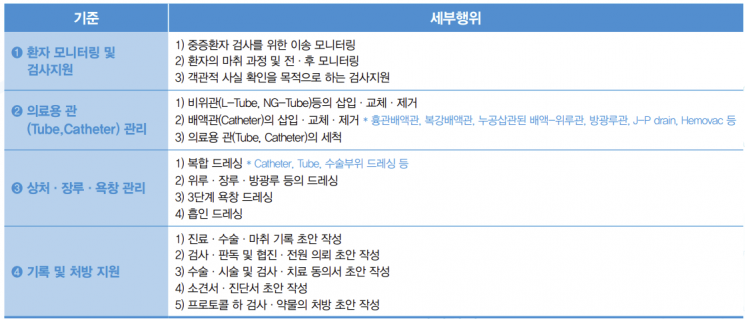
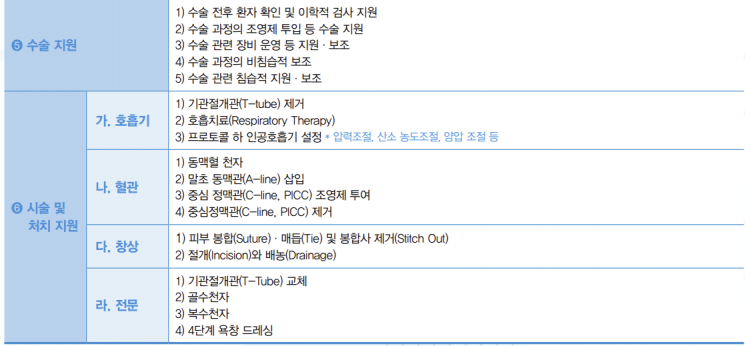
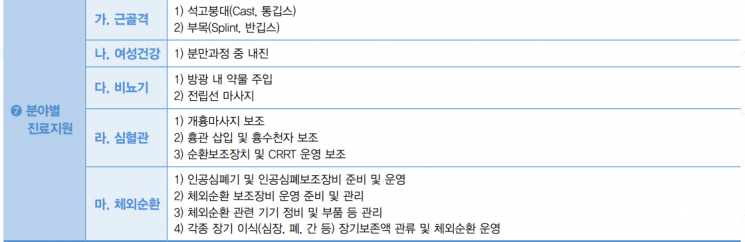
The range of medical institutions eligible to employ PA nurses has been expanded from only general hospitals with 100 or more beds, as in the pilot program, to hospital-level institutions with 30 or more beds. Institutions authorized to provide PA nurse training are limited to relevant associations and their branches, such as the Korean Nurses Association, the Korean Medical Association, and the Korean Hospital Association; general hospitals with 300 or more beds; public health and medical support centers; other advanced practice nurse training institutions; or organizations and groups recognized by the Minister of Health and Welfare.
After the publication of this task list, medical associations raised concerns that it could blur the distinctions between the roles of different healthcare professionals. They argue that procedures such as bone marrow aspiration and tracheostomy tube replacement are highly complex and that delegating them to nurses could jeopardize patient safety. There is also strong opposition to allowing PA nurses to take on the duties of "perfusionists," who traditionally receive extensive theoretical education and practical training in cardiovascular and thoracic surgery.
Kim Chunki, Policy Director of the Korean Medical Association and Professor of Cardiology at Ewha Womans University Seoul Hospital, who participated in the public hearing as a panelist, emphasized, "The key issue is legal liability for medical procedures. There needs to be a detailed discussion about whether the physician who delegated the task or the nurse who performed it should bear responsibility."
Park Dan, Acting Chairperson of the Korean Intern Resident Association, also participated as a panelist and argued, "If there is a shortage of physicians, the solution should not be to shift tasks and responsibilities to nurses, but to allocate more budget to hire additional doctors." Regarding the title for medical support personnel, he stated, "Since these personnel assist physicians, it would be appropriate to call them 'physician assistants.' If they are to perform physician tasks, only physicians should be responsible for their training."
Nurses also expressed dissatisfaction with the government plan. Kim Jeongmi, President of the Gyeonggi Province Nurses Association under the Korean Nurses Association, argued, "Given the nature of medical support work, training must be based on fundamental nursing knowledge and should help nurses understand the clinical context and patient crises." She insisted that the Korean Nurses Association should be entrusted by the Ministry of Health and Welfare to oversee the training curriculum. She also emphasized, "There must be official recognition of the qualifications for dedicated nurses, along with corresponding legal protections and compensation systems."
Park Hyerin, Director of Nursing Policy at the Ministry of Health and Welfare, stated, "The scope of tasks may be subject to change based on further feedback. Since it will be difficult to complete the enforcement regulations before the Nursing Act comes into effect, the existing pilot program will continue until then."
© The Asia Business Daily(www.asiae.co.kr). All rights reserved.



















