As Homeplus undergoes rehabilitation proceedings, there is growing attention on how the company’s share of compensation payments related to the past humidifier disinfectant incident will be handled. Homeplus sold its own brand (PB) product, the "humidifier cleaner," from 2005 to 2011, and is obligated to pay a share of the compensation under the "Special Act on Remedy for Damage Caused by Humidifier Disinfectants" (Humidifier Disinfectant Damage Remedy Act). The main issue is how this payment is classified under rehabilitation law. The repayment rate will vary depending on whether it is categorized as a rehabilitation claim, a public interest claim, or a priority claim equivalent to taxes. Here are six scenarios regarding the handling of these payments.
① In Principle, a "Rehabilitation Claim"
The payment Homeplus is responsible for is generally interpreted as a monetary claim based on liability for damages. Since the damage occurred in the past and the law requires the company to bear the payment in the form of compensation, it is regarded as a claim established before the commencement of rehabilitation proceedings. Therefore, this claim is classified as a "rehabilitation claim" under the "Debtor Rehabilitation and Bankruptcy Act" (Debtor Rehabilitation Act).
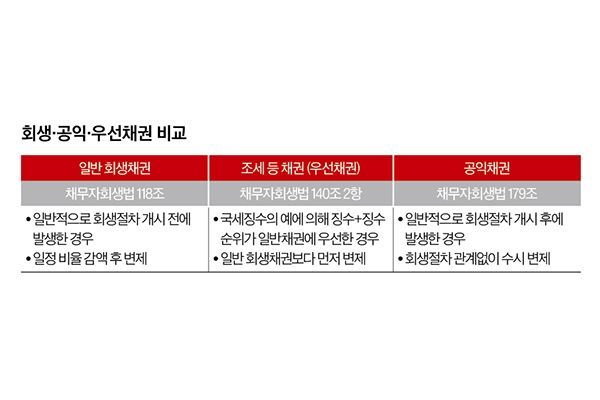
A rehabilitation claim refers to a claim that existed prior to the commencement of rehabilitation proceedings, and the same repayment rate as other general creditors is applied. In most rehabilitation plans, creditors such as financial institutions typically receive a repayment rate of around 50?60%. Therefore, the compensation fund for humidifier disinfectant victims may also be reduced within this range.
② Full Repayment for Public Interest Claims... Unlikely
If the payment is recognized as a public interest claim, it will be repaid in full at 100%. Public interest claims are not subject to reduction. These include costs incurred by the administrator after the commencement of rehabilitation or expenses essential to the progress of the rehabilitation proceedings. The Korea Environmental Industry and Technology Institute, as the creditor, is also reportedly arguing that the payment qualifies as a public interest claim.
However, most experts believe that the payment does not meet the requirements for a public interest claim (Article 179 of the Debtor Rehabilitation Act), as it arose before the commencement of rehabilitation proceedings and was not incurred by the administrator’s actions. A judge from a rehabilitation court explained, "Basically, public interest claims are debts that arise after the commencement of rehabilitation proceedings. Claims arising from past illegal acts, such as the compensation payment, are unlikely to meet these requirements."
③ "Priority Claim" Equivalent to Taxes
The Humidifier Disinfectant Damage Remedy Act stipulates that if a company fails to pay the compensation, collection may be enforced "in accordance with the procedures for national tax collection." Based on this, there is debate as to whether this claim can be recognized as a "claim equivalent to taxes" under Article 140 of the Debtor Rehabilitation Act.
To be recognized as a claim equivalent to taxes, two requirements must both be met: ▲collection must be possible according to national tax collection procedures, and ▲the claim must have priority over other claims. Article 35 of the Humidifier Disinfectant Damage Remedy Act states that if compensation and additional charges are not paid, collection will proceed as in cases of national tax delinquency, but there is no clear provision regarding priority of collection. Therefore, it appears unlikely that this claim will actually be recognized as a claim equivalent to taxes and thus subject to 100% repayment.
Another chief judge of a rehabilitation court commented, "If the Humidifier Disinfectant Damage Remedy Act had specified priority, it would have had significance as a special law, but it seems that rehabilitation proceedings were not considered when the law was enacted."
④ Possibility of Full Repayment Depending on the Rehabilitation Plan
However, the payment is not necessarily subject to reduction. Even as a rehabilitation claim, if the rehabilitation plan stipulates full repayment, 100% payment is possible. This is determined through negotiations between the debtor and creditors. As long as the principles of equality or fairness are not seriously undermined, the court can approve such a plan. Another judge from a rehabilitation court stated, "The court may guarantee the creditor’s bargaining power by classifying this payment claim separately."
⑤ Unconfirmed Claims, Amount to Be Determined Later
Currently, Homeplus is reportedly disputing both the amount and even the existence of the compensation claim. The Korea Environmental Industry and Technology Institute, which is in charge of the compensation program, has filed a claim for approximately 400 million KRW in indemnity and about 3 billion KRW in compensation, totaling 3.4 billion KRW. However, Homeplus is pursuing separate litigation regarding the existence and scope of the amount. In this case, the claim is classified as an "unconfirmed claim," and will need to be confirmed through subsequent examination and confirmation proceedings. In the rehabilitation plan, repayment is specified in accordance with the most similar type of claim.
⑥ In Principle, Claims Are Succeeded in M&A
What happens to the compensation claim if a merger and acquisition (M&A) takes place during rehabilitation proceedings? In principle, both rehabilitation claims and public interest claims are comprehensively succeeded. The acquiring company takes on the debt, and the details are specifically reflected in the rehabilitation plan and the acquisition agreement.
However, claims with a strong personal element may be excluded from succession. An insolvency expert stated, "Even for future claims, they are likely to be handled according to the general treatment of conditional claims, but due to the nature of the compensation payment, there is room for legal dispute."
Reporter: Ahn Jaemyung, Legal News
※This article is based on content supplied by Law Times.
© The Asia Business Daily(www.asiae.co.kr). All rights reserved.
![Clutching a Stolen Dior Bag, Saying "I Hate Being Poor but Real"... The Grotesque Con of a "Human Knockoff" [Slate]](https://cwcontent.asiae.co.kr/asiaresize/183/2026021902243444107_1771435474.jpg)
















