Establishing a Full-Cycle Ecosystem for Advanced Bio-Manufacturing with KRIBB and KAIST
Daejeon Designated as Regulatory Free Zone for "Space Technology Research and Utilization" Covering 5.15 Million Square Meters
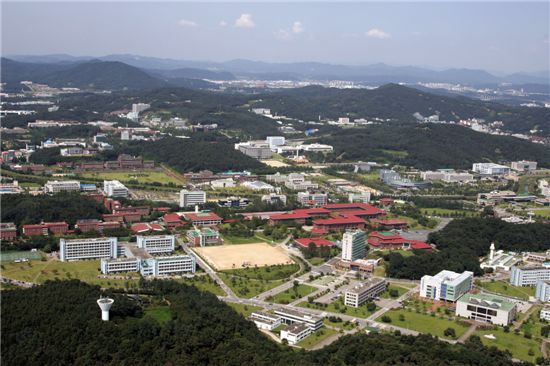 ▲Daedeok Innopolis, home to many government-funded research institutes.
 Photo by Asia Economy DB
The city of Daejeon announced that it has been designated as the nation's first "Global Innovation Zone for Advanced Bio-Manufacturing Based on Synthetic Biology," and will officially begin operations in June.
After being selected as a candidate site for the Ministry of SMEs and Startups' "Global Innovation Zone" project in December last year, the designation was finalized on May 21, following regulatory exemption consultations with relevant ministries, public hearings, deliberations by the Local Era Committee (local and central), and the Regulatory Free Zone Deliberation Committee.
The city has secured a total project budget of 27.2 billion won and will implement the project over four years and seven months, until December 2029. Depending on project performance, the period can be extended by up to two years, allowing operations to continue until as late as 2031.
The "Global Innovation Zone" is an advanced model of the existing regulatory free zones, designed to actively support new product development, verification, and global expansion in advanced fields. Daejeon is the first to be designated as a zone based on synthetic biology.
Synthetic biology is a technology that engineers and constructs biological components such as genes and proteins, enabling mass production and rapid manufacturing that surpass the limitations of conventional biotechnology.
Major countries such as the United States and China are making large-scale investments in the field of synthetic biology. In April this year, Korea also established the world's first "Synthetic Biology Promotion Act," providing a legal framework to accelerate research and development and build a foundation for the field.
The city, together with specialized bio research and support institutions such as the Korea Research Institute of Bioscience and Biotechnology (KRIBB), KAIST, and Daejeon Technopark, will work to establish a full-cycle ecosystem for advanced bio-manufacturing.
KRIBB will use its synthetic biology-based bio foundry beta facility to support the discovery and performance optimization of LMO (Living Modified Organism) candidate substances needed by companies.
KAIST will operate a Grade 1 public LMO production facility using its "mRNA/DNA-based Production Support Center," and will support companies in new product verification and small-scale production.
The Daejeon Technopark Bio Convergence Center will participate in supporting all stages of verification and commercialization operations, leveraging its experience in successfully operating the "Biomedical Regulatory Free Zone" from 2019 to 2024.
The city plans to focus on securing sustainable growth engines for local companies and supporting their entry into global markets by easing regulations for advanced bio-manufacturing, providing R&D centered on corporate demand, and supporting global expansion tracks.
In particular, the city will pursue regulatory easing by utilizing the demonstration exemption system to simplify redundant risk assessments by LMO application, thereby reducing administrative costs and time burdens for companies caused by duplicate reviews. To support the rapid commercialization of technologies by companies, the city will also provide customized R&D support in collaboration with KRIBB.
Strategies for global expansion will be pursued in parallel. The city plans to promote strain development and technology verification through joint research (R&D) with the National University of Singapore, a leading institution in the field of synthetic biology. It also plans to provide tailored consulting for product certification and technology verification in collaboration with domestic and international global certification bodies.
A city official stated, "We expect the operation of the zone to generate an economic ripple effect of about 160 billion won," adding, "We anticipate that advanced bio-manufacturing technology will spread to various industries such as pharmaceuticals, food, agriculture and livestock, and energy, contributing to the creation of new added value and jobs."
Meanwhile, on May 21, at the 15th Regulatory Free Zone Committee hosted by the Ministry of SMEs and Startups, Daejeon was also selected as the "Daejeon Space Technology Research and Utilization Zone" for the 2025 regulatory free zone designation.
The zone will cover approximately 5.15 million square meters in Yuseong-gu and Daedeok-gu, and will operate from June 1, 2025, to December 31, 2029. A total budget of 19.4 billion won will be invested, and 11 space-related companies and research institutions, including the Korea Aerospace Research Institute, Hanwha Aerospace, and KAIST, will participate to conduct full-cycle demonstration of testing, manufacturing, and certification of high-pressure gas-based components for space propulsion.
© The Asia Business Daily(www.asiae.co.kr). All rights reserved.
















