NH Investment & Securities announced on May 21 that it has published a report titled "Analysis of Real Estate Pledges and Post-Election Outlook - A New Era, Familiar Uncertainty."
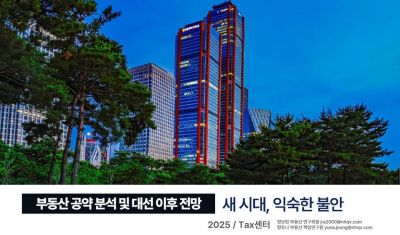
This report forecasts the direction of the real estate market ahead of the early presidential election in June. An analysis of the real estate policies of the three 21st presidential candidates?Lee Jaemyung, Kim Moonsu, and Lee Junseok?found that all three candidates have made expanding housing supply and revitalizing redevelopment projects their key priorities, emphasizing policies centered on actual demand groups such as young people and newlyweds. However, there are differences in their approaches: Lee Jaemyung focuses on public-led urban development and balanced regional growth; Kim Moonsu emphasizes deregulation and strengthening local government authority; and Lee Junseok prioritizes private sector-led supply and pragmatic institutional improvements.
The report also explains the real estate policies and market trends of previous administrations and analyzes the current real estate landscape. It states that the real estate market cannot be explained solely by policy direction, but must also be viewed in the context of structural market characteristics such as domestic and international economic conditions and interest rates. Historically, macroeconomic variables such as the IMF financial crisis, the global financial crisis, and the pandemic?along with interest rates, supply-demand dynamics, and economic cycles?have had as much impact on the market as policy itself.
Jung Ho Hyun, a real estate research fellow at the NH Investment & Securities Tax Center (NH WM Masters Specialist), explained, "Since the direction of real estate pledges among the candidates is similar in this election, in the short term, factors such as the global trade environment, timing of interest rate cuts, the potential lifting of regulations in key areas like Gangnam and Yongsan, and supply-demand conditions are likely to drive market trends." He added that while expectations for policy changes remain valid, market participants inevitably have to consider increasingly complex variables.
Amid these trends, the report sees a high likelihood that, in the mid-to-long term, Seoul and the greater metropolitan area will recover, especially in areas where redevelopment projects are becoming visible. In the provinces, a gradual recovery is expected, centered on metropolitan cities and regions with industrial bases. Structurally, the report forecasts that the concentration of high-value assets in single-home ownership will likely persist.
The report identifies the following as key variables for the future market: ▲whether regulations on land transaction permit zones in areas like Gangnam and Yongsan will continue (with a decision on extension due by September 30); ▲the possibility of a base interest rate cut within the year (with expectations for two to three cuts); ▲the time required to realize the pledges to expand supply and the expected demand for redevelopment projects; and ▲the prospect of selective recovery in local real estate markets.
In particular, despite structural challenges in the provinces such as population decline and aging, the report forecasts that the resolution of unsold housing inventory and a recovery in the construction sector could drive some positive momentum. Jung Yoona, head real estate researcher at NH Investment & Securities, commented, "Rather than vague concerns about uncertainty, now is the time to review asset portfolios and redefine strategies for both end-users and investors."
© The Asia Business Daily(www.asiae.co.kr). All rights reserved.
![Clutching a Stolen Dior Bag, Saying "I Hate Being Poor but Real"... The Grotesque Con of a "Human Knockoff" [Slate]](https://cwcontent.asiae.co.kr/asiaresize/183/2026021902243444107_1771435474.jpg)















