Care and Future Survey
47% Prefer to Receive Care at Their Current Home
Most Rely on Caregivers When Ill, Followed by Spouses, Themselves, and Children
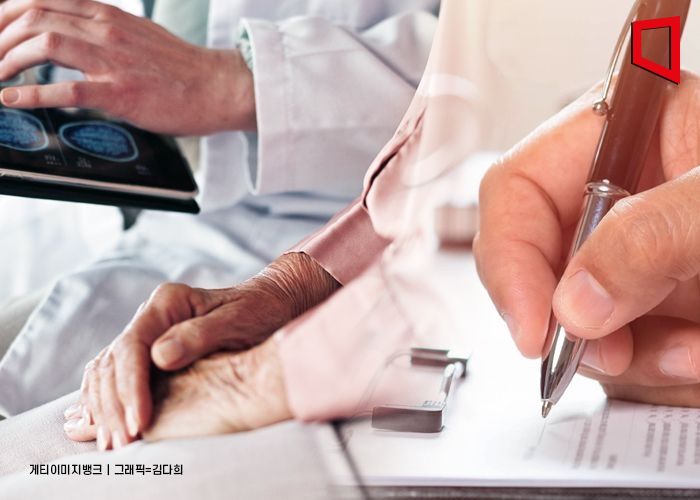
Four out of ten adults in South Korea aged 40 and older say they would rely on a caregiver if they became elderly or fell ill.
The Care and Future Foundation released the results of its "Community Care Perception and Demand Survey" on May 21, which was conducted by Korea Research from April 25 to 30 among 1,000 men and women nationwide aged 40 and older. According to the findings, 39% of respondents said "a caregiver will take care of me," 35% said "my spouse will take care of me," and 21% said "I will have to take care of myself."
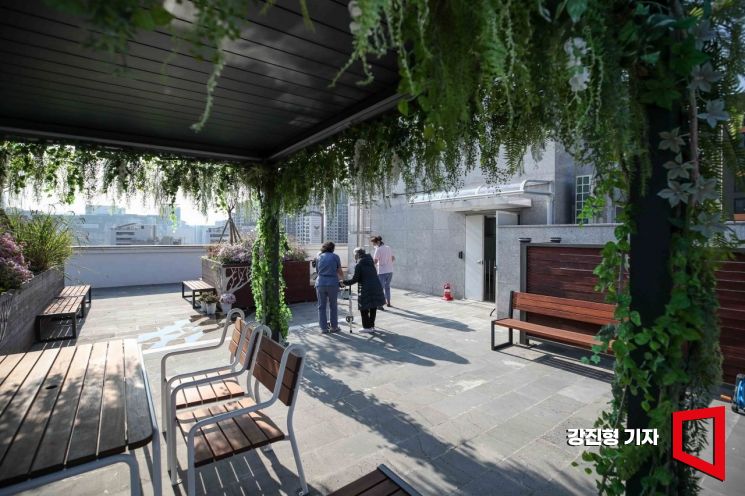 An elderly person is taking a walk with a caregiver on the rooftop garden of the Eunpyeong Senior Care Center in Eunpyeong-gu, Seoul. This photo is provided to help understand the article and is unrelated to the content.
Only 4% of respondents answered that "my children will take care of me."
There was a gender gap in expectations about spousal care. Among men, 49% said "if I become ill, my wife will take care of me," but only 22% of women said "if I become ill, my husband will take care of me," showing a difference of more than double.

More than half of all respondents, 58% (52% of married respondents and 87% of unmarried respondents), said "there is a possibility of dying alone," and 10% said the possibility is "very high."
Only 20% said they "have neighbors with whom they interact frequently." 39% said they "occasionally exchange greetings with neighbors," and 27% said they "do not have special interactions but recognize each other's faces." 40% of respondents said they "have no one to turn to for help outside of family in an emergency."
Regarding preferred care locations, 47% said "the home where I currently live," and 32% said "a suitable home for care within the area where I have lived," meaning nearly 80% want to receive care while living in their own residence. Only 7% each preferred senior welfare housing or nursing homes.
When asked about their preferred place to die, nearly half (48%) answered "at home." This was followed by general hospitals at 31% and long-term care hospitals at 12%. However, when asked where they actually expect to die, the most common answer was general hospitals (29%), followed by long-term care hospitals (25%).

58% of respondents viewed nursing facilities as "positive." Many also expressed expectations such as "making friends" (74%). However, concerns were also raised, such as "abuse is frequent" (53%).
64% of respondents said "care for the elderly and disabled is insufficient," while only 36% said "elderly care services are well provided in my area."
When asked about the most needed services (multiple responses allowed), "health management and medical care" was cited most frequently (61%), and "home visit care" was the top priority service to be provided (71%). The highest-priority task for elderly care policy was "reducing out-of-pocket expenses" (42%).
The majority, 85%, said the "state" should be responsible for elderly care services. Publicness (51%) was cited as the most important value in elderly care policy. 85% supported increasing tax spending for elderly care.
© The Asia Business Daily(www.asiae.co.kr). All rights reserved.
![Clutching a Stolen Dior Bag, Saying "I Hate Being Poor but Real"... The Grotesque Con of a "Human Knockoff" [Slate]](https://cwcontent.asiae.co.kr/asiaresize/183/2026021902243444107_1771435474.jpg)

















