"244 Trillion Won Invested...
Missiles Deployed on Land, Sea, and in Space to Intercept Enemy Weapons"
U.S. President Donald Trump has announced that the American missile defense network, known as the "Golden Dome," will be deployed for operational use during his term in office.
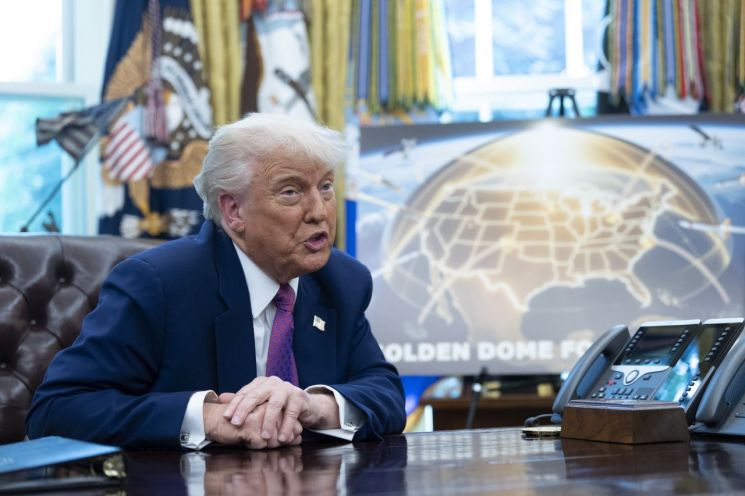
On May 20 (local time), President Trump declared during an announcement event held in the Oval Office at the White House, with Secretary of Defense Pete Hegseth in attendance, that the Golden Dome "must be fully operational before my term ends." He set a goal to make the Golden Dome combat-ready by the end of his term in January 2029.
President Trump explained that the Golden Dome would "deploy next-generation technologies, including space-based sensors and interceptor weapons, on land, at sea, and in space." He added, "Canada has reached out, expressing interest in becoming a part of this. We plan to discuss this with them." He further emphasized, "Once the construction of the Golden Dome is complete, we will be able to intercept missiles launched from the other side of the world and from space. We are building the best system ever."
President Trump also stated that the total cost of constructing the Golden Dome would reach $175 billion, with $25 billion of that amount included in the so-called 'big and beautiful single bill' (a budget and tax cut bill) currently pending in Congress.
The Golden Dome is a next-generation missile defense system similar to Israel's Iron Dome. On January 27, President Trump signed an executive order to establish this system. The order instructs the Department of Defense to develop an implementation plan for a new interceptor system capable of countering ballistic missiles, hypersonic missiles, and new types of cruise missiles within two months.
The most notable feature of the Golden Dome concept is the establishment of a space-based interceptor system. This would involve tracking new types of missiles, which are difficult to detect with ground-based radar, using space sensors mounted on satellites, and intercepting missiles in their boost phase with interceptors deployed in space.
In particular, President Trump's plan is seen as a response to the missile attack capabilities of China, Russia, and North Korea against the U.S. mainland. Previously, in the 1980s, the Ronald Reagan administration also pursued a plan, known as 'Star Wars,' to intercept enemy nuclear missiles using satellites, but the project was halted due to budget constraints and technological limitations.
On this day, President Trump stated, "We will truly complete the work that former President Reagan began 40 years ago."
© The Asia Business Daily(www.asiae.co.kr). All rights reserved.
![Clutching a Stolen Dior Bag, Saying "I Hate Being Poor but Real"... The Grotesque Con of a "Human Knockoff" [Slate]](https://cwcontent.asiae.co.kr/asiaresize/183/2026021902243444107_1771435474.jpg)















