Building an Energy-Centered City Based on Wind and Solar Power
Planning a Virtuous Cycle Model for Income Redistribution
Focusing on the Chain of Job Creation, Economic Growth, and Population Increase
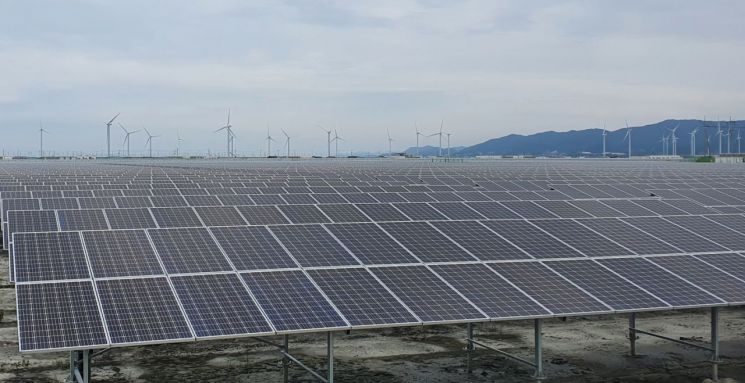
Yeonggwang County in South Jeolla Province is presenting a region-led growth model centered on its abundant renewable energy resources, drawing up a blueprint to leap forward as a “self-sustaining city with a population of 100,000.” The core of this initiative is to link natural resources such as offshore wind and solar power to the energy industry, and to establish a “virtuous cycle system” that connects this foundation to industrial complexes, job creation, and population inflow.
Yeonggwang County is considered one of the best locations for renewable energy nationwide. Its annual solar radiation reaches 4.0?4.2 kWh/㎡, and the average wind speed exceeds 6.0 m/s. These are regarded as optimal conditions for both solar and wind power generation.
Yeonggwang has already attracted the attention of numerous private and public energy companies for several years. The county has announced its plan to transform these natural advantages into “energy for sustainable growth,” and is accelerating its transition into an energy-centered city.
The first step in this strategy is power generation. By ramping up offshore wind and solar power generation, Yeonggwang is securing its own energy production capacity. However, the county has made it clear that it will not remain merely an energy supplier. In addition to producing electricity, the county is pursuing a multifaceted strategy: establishing a base complex with industrial parks, logistics, and maintenance functions in the surrounding area, and actively attracting related companies and institutions.
In particular, the establishment of an “O&M (Operation & Maintenance) base complex” is a key element of this strategy. This base, which will provide offshore wind maintenance functions, will also encompass high value-added industries such as parts maintenance, technical support, and vessel management. The plan is to evolve into a cluster where all stages of the energy industry take place.
 View of the wind farm installed in the coastal area of Yeonggwang, embracing the Chil-san offshore sea. Provided by Yeonggwang County
In addition, the county aims to change the power consumption structure based on the principle of “local production, local consumption (Jisan Jiso).” The plan is to prioritize local consumption of electricity produced in the region and to implement a differential electricity rate system that returns the benefits of being an energy production site to residents and businesses. If this system is introduced, electricity costs will decrease, making Yeonggwang an attractive industrial location for companies.
This will directly lead to designation as a “national energy-specialized industrial complex.” Yeonggwang County is actively seeking national-level industrial complex designation through consultations with the central government, based on a structure where energy production, consumption, and industry are organically connected. The county is targeting the attraction of high value-added, electricity-intensive industries such as advanced technology, hydrogen industry, AI, and data centers.
This step-by-step strategy aims to drive job creation and revitalize the local economy, ultimately bringing about tangible changes such as population growth. The goal of becoming a “self-sustaining city with a population of 100,000” is a comprehensive plan that starts with energy and extends to industry, employment, housing, education, and culture, paving the way toward a sustainable city.
Yeonggwang County stated, “Energy is no longer the property of large-scale operators, but a public asset that must be created together by the region and its residents,” adding, “We will establish a new growth chain based on Yeonggwang’s resources and create a structure in which tangible benefits are returned to local residents.”
© The Asia Business Daily(www.asiae.co.kr). All rights reserved.
![Clutching a Stolen Dior Bag, Saying "I Hate Being Poor but Real"... The Grotesque Con of a "Human Knockoff" [Slate]](https://cwcontent.asiae.co.kr/asiaresize/183/2026021902243444107_1771435474.jpg)
















