On the 20th, Ministry of Education Announces "National Childcare Status Survey"
Childcare and Education Expenses, Including Food and Clothing, Up 140,000 Won Compared to 2021
Difficulties in Raising Children Due to "Early Work Start, Late Work Finish"
Last year, households raising infants and young children spent an average of 1,116,000 won per month on child-rearing expenses, including childcare and education. This amount increased by 140,000 won compared to the survey conducted three years ago in 2021. However, the proportion of these expenses relative to household income slightly decreased from 19.3% to 17.8%.
The childcare center utilization rate among infants and young children was 97.3%. The average age at which children first started attending facilities such as childcare centers or kindergartens was 19.8 months. Compared to the 2009 survey, when the average was 30 months, the age at which children first attend childcare or educational institutions has been steadily decreasing.
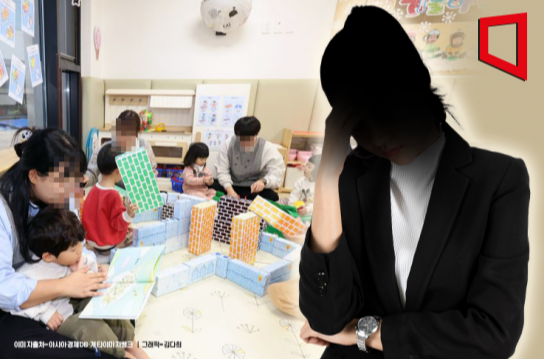
On May 20, the Ministry of Education announced the results of the "2024 National Childcare Status Survey." This is a legally mandated survey conducted every three years under the Infant Care Act, first carried out in 2004, making this the seventh survey. The latest survey was conducted from August to December last year, targeting 2,494 households receiving childcare fees, early childhood education expenses, parental allowances, or child-rearing subsidies, as well as 3,058 childcare centers.
The results showed that the average number of household members in families with infants and young children was 3.5, continuing a downward trend from 3.9 in 2018 and 3.8 in 2021. The average monthly income of these households was 6,254,000 won, which is higher than the average monthly income of all households (5,255,000 won in the third quarter of 2024).
The employment rate among parents was 97% for fathers and 64.2% for mothers, indicating an increase in the proportion of working parents compared to the 2021 survey (95.2% for fathers and 54.1% for mothers).
On the other hand, the amount of time spent with children decreased, with mothers spending 7.1 hours and fathers 3.7 hours per day, down by 0.8 hours and 0.3 hours, respectively.
Regarding parental leave experience, mothers alone accounted for 34.5%, the highest proportion, followed by fathers alone at 3.6%, and both parents at 6.1%. In the 2021 survey, these figures were 32.6%, 2.1%, and 2.4%, respectively.
The main difficulties faced by primary caregivers who are employed were "emergency situations" (3.3 points), "early work start" (3.2 points), and "late work finish" (3.2 points).
In terms of childcare arrangements, 55.2% of households used external institutions such as childcare centers, kindergartens, or part-day academies. Mothers were the main caregivers in 37.3% of cases, followed by grandparents at 4.4%, fathers at 2.1%, and professional childcare workers at 0.2%.
When selecting an institution, childcare center users prioritized "distance from home" (32.8%), while kindergarten users prioritized "programs" (26.8%).
The average usage time was 7 hours and 31 minutes for childcare centers and 7 hours and 20 minutes for kindergartens, an increase of 19 minutes and 16 minutes respectively compared to 2021. When asked about their desired usage time, respondents said they would like to use these institutions for an average of 8 hours and 13 minutes, which is 48 minutes longer than the actual average usage time (7 hours and 25 minutes).
The proportion of households using extended childcare was 33.7%, while those using only basic childcare was 66.3%. The main reason for using extended childcare was "no one to look after the child" (78.8%), while the main reasons for not using it were "no need" (73.8%) and "long hours of care are not good for development" (21.7%).
The average monthly out-of-pocket cost for guardians using childcare or educational institutions was 146,000 won. For childcare centers, the total average monthly cost borne by guardians was 70,000 won, an increase of 14,000 won from 2021. For kindergartens, the cost was 177,000 won, a decrease of 12,000 won.
In the satisfaction survey for childcare and educational institutions, an average of 91.9% of respondents said they were satisfied (very satisfied or satisfied), a significant increase from 77.7% in 2021.
On the other hand, the most frequently cited area for improvement was "diversification of educational content" at 18.3%, followed by "increasing staff" (17%), "renovation of outdated facilities" (14.9%), and "improving staff quality" (10.3%).
According to the survey on the treatment of childcare center teachers, the average monthly salary was 2,873,000 won, up 9.0% from 2021. Lunch and break time for childcare teachers was 60 minutes, an increase of 8 minutes compared to 2021, while the total daily working time, including lunch and break, was 9 hours and 38 minutes, a decrease of 5 minutes. In a survey of 3,000 childcare teachers who participated, 17.7% reported experiencing violations of their rights while at work. The main perpetrators of these violations (multiple responses allowed) were guardians (63.0%), followed by directors (40.8%), fellow staff members (17.3%), childcare center representatives (1.7%), and outsourcing companies (0.8%).
Kang Mingyu, Director of the Department of Early Childhood Policy at the Ministry of Education, stated, "Based on the results of this survey, we will actively pursue various policies to ease the burden of child-rearing on guardians and to help achieve work-life balance, such as measures to promote part-time childcare, expand support for extended childcare, and increase the number of public childcare and educational institutions."
© The Asia Business Daily(www.asiae.co.kr). All rights reserved.
![Clutching a Stolen Dior Bag, Saying "I Hate Being Poor but Real"... The Grotesque Con of a "Human Knockoff" [Slate]](https://cwcontent.asiae.co.kr/asiaresize/183/2026021902243444107_1771435474.jpg)
















