Lai Ching-te Holds First Anniversary Press Conference as President
"We Must Not Rely Solely on Illusions or Dreams in Pursuit of Peace"
China Labels Lai Ching-te a "Separatist"
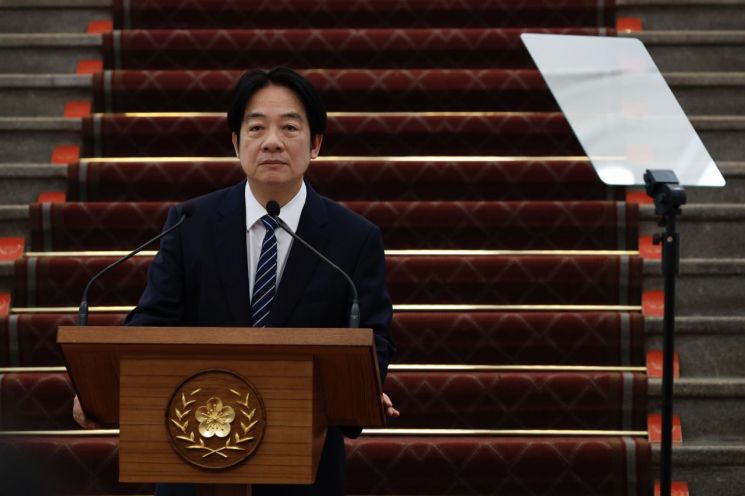 President Tsai Ingwen of Taiwan is holding a press conference on the first anniversary of her inauguration at the Presidential Office in Taipei, Taiwan, on the 20th. Photo by EPA
On the first anniversary of his inauguration, President Lai Ching-te of Taiwan reiterated his willingness to engage in dialogue with China while also expressing his determination to strengthen Taiwan's national defense, according to reports by Reuters and Taiwanese media on the 20th.
At a press conference marking the first anniversary of his inauguration held at the Presidential Office on this day, President Lai stated, "Taiwan desires peace, and there are no winners in war," but also emphasized, "For this reason, we must continue to strengthen our defensive capabilities."
He further stressed, "The people of Taiwan love peace. I do as well. Peace is a precious value that cannot be exchanged for anything, and war brings victory to no one." However, he added, "But as we pursue peace, we must not rely solely on illusions or dreams."
He went on to say, "The best way to prevent war is to be prepared for it," reaffirming the need to strengthen national defense. He also added, "If mutual respect is the foundation, we gladly welcome exchanges and cooperation with China. We must resolve our relationship through exchanges, not encirclement, and through dialogue, not confrontation."
In his inaugural address in May last year, President Lai also expressed to China his hope that "China will replace confrontation with dialogue and encirclement with exchanges, and pursue cooperation with the legitimately elected government of Taiwan under the principles of equality and dignity." At that time, President Lai was elected in the presidential election held last year with 40.05% of the vote, defeating Hou Yu-ih, the Kuomintang (KMT) candidate who is regarded as having a "pro-China" stance.
Reuters pointed out that, in response, the Chinese government has labeled President Lai a "separatist" and has repeatedly rejected proposals for dialogue. Last week, the Chinese Ministry of National Defense also criticized President Lai, stating, "President Lai is an individual who is fueling crisis in the Taiwan Strait, deepening conflict and confrontation across the strait, and undermining peace and stability." The Chinese government maintains the "One China" principle, which regards mainland China, Taiwan, Hong Kong, and Macau as a single country.
President Lai is currently facing a "triple challenge" consisting of heightened tensions with China, a domestic political landscape where the ruling party lacks a majority, and uncertainty over the policies of a second Donald Trump administration in the United States. In particular, Taiwan's long-standing alliance with the United States is in an unstable state. Since President Donald Trump took office as U.S. president in January of this year, uncertainty has grown over whether the United States, Taiwan's main security guarantor, will continue to maintain its commitment to Taiwan's defense.
© The Asia Business Daily(www.asiae.co.kr). All rights reserved.
![Clutching a Stolen Dior Bag, Saying "I Hate Being Poor but Real"... The Grotesque Con of a "Human Knockoff" [Slate]](https://cwcontent.asiae.co.kr/asiaresize/183/2026021902243444107_1771435474.jpg)















