China Criticizes the United States Again on May 19 Following Previous Statement on May 15
The Chinese government once again criticized the United States on May 19 (local time), stating that the recent U.S. targeting of Huawei's artificial intelligence (AI) chips constitutes a violation of the U.S.-China trade agreement.
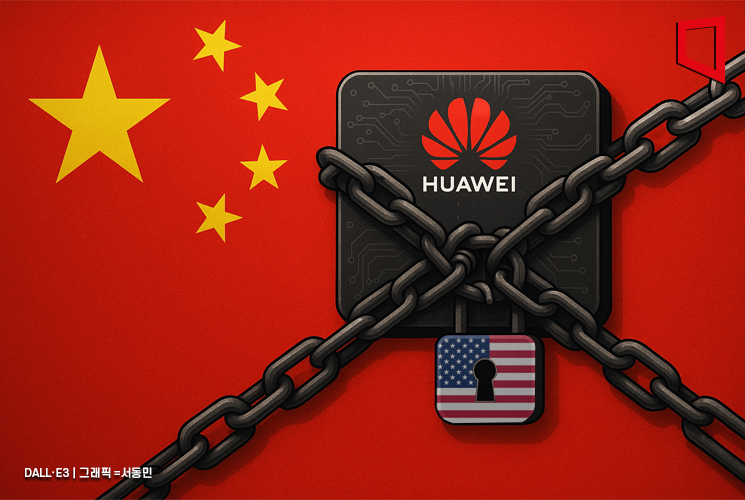
According to Reuters and other media outlets, the U.S. Department of Commerce stated in an official announcement on May 13 that China's advanced semiconductors, including Huawei's AI-dedicated high-performance chip 'Ascend', may have been manufactured using U.S. technology in violation of U.S. semiconductor export controls. The announcement indicated that companies purchasing or using these chips could also be subject to sanctions under the Bureau of Industry and Security's (BIS) General Prohibition 10 (GP10). The Department of Commerce also expressed concern that this technology could be used to train Chinese AI models.
After facing criticism from China and other countries, the U.S. Department of Commerce changed its previous statement that "use anywhere in the world" would violate U.S. export controls to "use carries risks." However, it maintained the phrase that "there are risks associated with the use of advanced computing integrated circuits (ICs) by the People's Republic of China (PRC)."
The Chinese Ministry of Commerce called these measures "discriminatory" and urged the United States to "correct its mistakes." The ministry particularly emphasized that, despite reaching a certain agreement at the high-level meeting in Geneva, Switzerland on May 10, the United States undermined it through unilateral actions. The Wall Street Journal (WSJ) noted that this statement was similar to one issued on May 15.
Bloomberg reported that while the Trump administration's efforts to prevent AI technology from flowing to China have led the Biden administration to ease the 'AI Diffusion Rule', key export controls have actually been strengthened.
The heightened tensions between the U.S. and China eased somewhat following the trade agreement reached on May 10-11. U.S. Secretary Scott Bessent, U.S. Trade Representative (USTR) representative Jamison Greer, Chinese Vice Premier He Lifeng, and Li Chenggang, Vice Minister and International Trade Negotiator of the Ministry of Commerce, held two days of high-level, in-person marathon negotiations in Geneva, Switzerland. Afterwards, both countries announced in official statements that they would temporarily halt the trade war and mutually reduce tariffs by 115 percentage points for 90 days.
© The Asia Business Daily(www.asiae.co.kr). All rights reserved.
![Clutching a Stolen Dior Bag, Saying "I Hate Being Poor but Real"... The Grotesque Con of a "Human Knockoff" [Slate]](https://cwcontent.asiae.co.kr/asiaresize/183/2026021902243444107_1771435474.jpg)















