Starmer, von der Leyen Reset UK-EU Relations After Five Years of Brexit
UK Opposition Criticizes Agreement as "Craven Surrender"
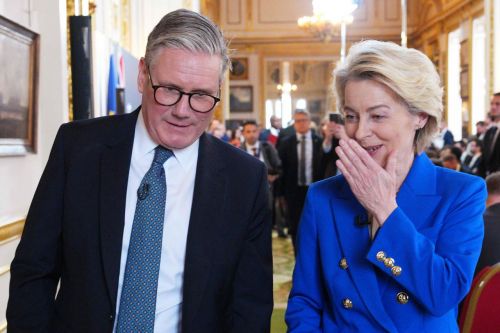 Keir Starmer, UK Prime Minister (left), and Ursula von der Leyen, President of the European Commission, are walking out together after a joint press conference held in London, UK, on the 19th (local time). Photo by AFP Yonhap News
Amid growing skepticism over the effects of Brexit (Brexit·the UK's withdrawal from the EU) in the UK over the past five years, the United Kingdom and the European Union agreed on May 19 (local time) to reset their relationship. Geopolitical concerns triggered by the power struggles among major countries such as the United States, Russia, and China have led to fundamental changes in the relationship between the two sides. In particular, the Financial Times (FT) and others assessed that the breakthrough in dialogue came as the UK conceded on fishing rights.
Summit Agreement Reached in London
UK Prime Minister Keir Starmer, European Commission President Ursula von der Leyen, and European Council President Antonio Costa held a summit in London on this day and reached the agreement.
Prime Minister Starmer stated, "It is time to look forward. We must move beyond old arguments and political strife to find solutions based on common sense and practicality." He also described the agreement as a "win-win" for both the UK and the EU, opening "a new era in our relationship."
President von der Leyen said, "This is a tremendous day as we turn a page and open a new chapter," adding, "It is important at a time of rising geopolitical tensions. We are like-minded and share values."
As a result, the relationship between the two sides has reached a major turning point, nine years after the UK decided to leave the EU in the 2017 Brexit referendum, and five years after Brexit took effect in 2020 following four years of difficult negotiations. The prolonged geopolitical risks caused by Russia's war of invasion against Ukraine and concerns heightened by US President Donald Trump's imposition of tariffs have brought about changes in the relationship between the two sides.
President von der Leyen emphasized, "In a time of global instability, and as our continent faces its greatest threat in generations, we Europeans must stand together. A strong EU-UK relationship is fundamentally important for our security, prosperity, and shared destiny."
Broad Cooperation from Security to Economy
The partnership signed by the UK and the EU on this day includes strengthening cooperation across a wide range of areas, from security and defense to food, fishing rights, energy, and immigration. The agreement also opens the way for the UK to participate in the EU's 150 billion euro (about 240 trillion won) "European rearmament plan," which will be finalized through additional negotiations.
In terms of economy and trade, the UK conceded on fishing rights and secured simplified export procedures for agricultural and food products. The FT pointed out, "The UK has agreed to allow EU fishing vessels to operate in its waters for 12 years, and this concession has enabled broader cooperation."
The UK government explained that the agreement is expected to bring nearly 9 billion pounds (16.7 trillion won) in economic benefits to the UK by 2040. For example, exports of UK food products, which had sharply declined due to complicated procedures after Brexit, are expected to recover.
The two sides agreed to extend the fisheries agreement, which expires next year, until 2038, maintaining mutual fishing rights for an additional 12 years. In addition, for agricultural and livestock products and food, they agreed to significantly simplify quarantine and customs procedures, including exempting many items from quarantine. The UK was initially reluctant to grant EU fishermen long-term fishing rights in its waters and wanted only a four-year extension, but ultimately conceded in exchange for relaxed agricultural quarantine and energy cooperation.
The two sides will also cooperate in energy and environmental sectors. They plan to work closely on carbon emissions and link their carbon emissions trading markets. As a result, UK companies are expected to be exempt from the EU carbon tax, which is scheduled to be introduced next year. The two sides also agreed to consider ways for the UK to participate in the EU's internal trading platforms, including the electricity market.
The two sides also agreed to jointly work on a balanced youth mobility program under mutually agreed conditions to make migration and employment easier for young people under 30. Participation in the EU's student exchange program, Erasmus+, is also under consideration. Youth mobility was a highly contentious issue until the last minute due to sensitive public opinion in the UK regarding immigration. For this reason, the agreement was concluded at the level of committing to working out the details.
However, the UK opposition parties have criticized the agreement, particularly regarding youth mobility and the extension of fishing rights. Conservative Party leader Kemi Badenoch warned, "It started amateurishly and ended in complete betrayal," adding, "We will overturn this terrible agreement as soon as we get the chance." Nigel Farage, leader of the Reform UK party, also denounced the agreement as a "craven surrender" and claimed it signaled "the end of UK fishing."
Public opinion in the UK generally supports strengthening ties with the EU, even if not rejoining the EU itself. According to a YouGov poll in January, 62% assessed Brexit as closer to a failure, while only 11% said it was closer to a success. 64% wanted a closer relationship with the EU or the single market without rejoining. In a YouGov survey published on May 17, 39% said they saw a possibility of the UK rejoining the EU within 20 years, similar to the 40% who said it was unlikely or not at all likely.
© The Asia Business Daily(www.asiae.co.kr). All rights reserved.

















