Upon arriving in Taipei to attend Computex 2025, Jensen Huang, CEO of Nvidia, first met with executives from Taiwan's leading ICT companies, including TSMC, Foxconn, and MediaTek. Huang held a dinner with about 30 key figures from Taiwan's tech sector at a restaurant in downtown Taipei. Local media referred to this gathering as the "trillion-dollar dinner," highlighting it as a major forum for comprehensive discussions on the artificial intelligence (AI) ecosystem. At the event, Jensen Huang explained the AI supercomputer project and shared the roles of each company involved.
The list of participating companies reveals the dense structure of Taiwan's AI ecosystem. TSMC manufactures high-performance chips for artificial intelligence, Foxconn assembles these chips into servers and completes the systems, MediaTek and Siliconware connect and package the chips, and companies such as Pegatron, Wistron, and Compal participate in the production of servers and network equipment. The National Science and Technology Council (NSTC) is responsible for infrastructure support and policy coordination.
Through this project, Nvidia is building a "localized AI ecosystem" that connects the entire Taiwanese industry, from chip design and production to assembly and integration. Jensen Huang made it clear during this visit that he intends to place Taiwan at the center of this strategy. The project aims not simply to build a single computer, but to connect all of Taiwan's industries to create one massive artificial intelligence system.
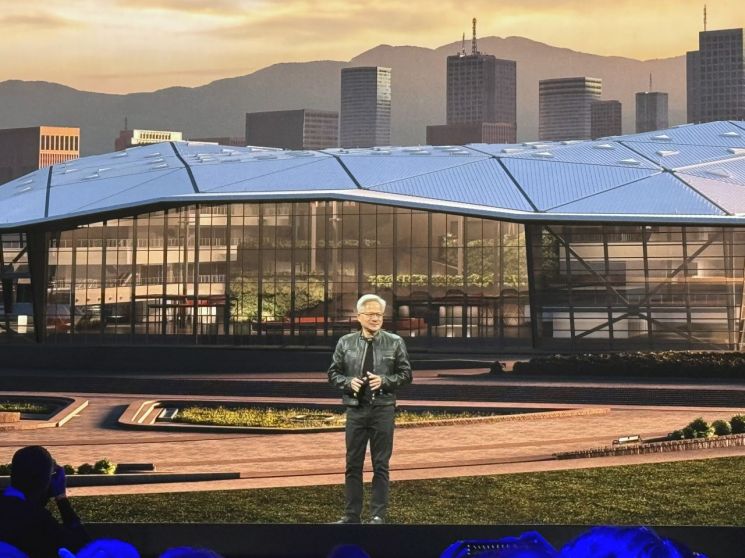 Jensen Huang, CEO of Nvidia, is delivering the keynote speech at Taipei Music Center on the 19th, one day before the opening of Computex 2025, Asia's largest information and communication technology (IT) exhibition held in Taiwan. Photo by Yonhap News
In his keynote speech at Computex 2025, Huang officially announced plans to collaborate with Foxconn, TSMC, and the Taiwanese government to build Taiwan's first large-scale AI supercomputer. This is a major project that will mobilize technological capabilities from across Taiwan, with Nvidia planning to localize every stage from chip design and production to assembly and system integration.
Huang described Taiwan as "the center of cutting-edge industry, the birthplace of AI and robotics technology, and the world's largest electronics manufacturing hub." He added, "This is the home of our valued partners and longtime friends," and emphasized, "We must create new markets from the heart of the computer industry ecosystem."
In his speech, he also outlined his vision to develop Taiwan as the strategic center of the global artificial intelligence industry. His plan is to localize semiconductors, servers, and systems, and to build an Nvidia-centered AI ecosystem on top of this foundation.
In addition to the AI supercomputer, Huang also unveiled plans to build a new Taiwan headquarters called "Constellation." This large research and design headquarters will employ over 1,000 people and will be established on a scale comparable to Nvidia's U.S. headquarters.
The highlight of the keynote was the unveiling of a new chip interconnection technology called "NVLink Coupling Technology." This technology, which allows chips from different companies to operate as a single system, attracted attention as a method for integrating entire AI systems, moving beyond GPU-centric computing architectures. Huang described this as "a new way to build AI factories."
The industry is paying close attention to the fact that Taiwan has been selected as the first site to implement this kind of system integration. Huang announced plans to apply this technology to both the AI supercomputer and the new headquarters to be built in Taiwan. Some analysts suggest that Taiwan's ecosystem, which enables everything from chip production to system assembly and integration, could serve as a proving ground for this technology.
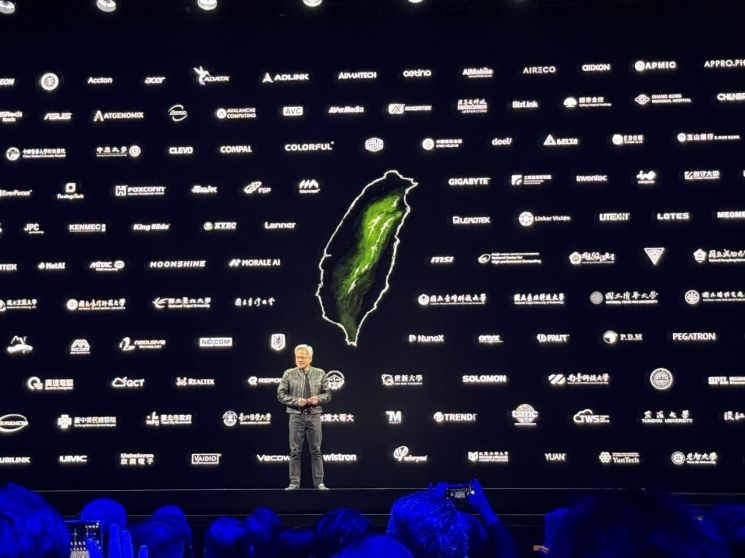 Jensen Huang, CEO of Nvidia, is introducing partnerships with Taiwanese companies while holding a map of Taiwan during his keynote speech at Computex 2025 held at the Taipei Music Center in Taiwan on the 19th. Photo by Yonhap News
Industry analysts say this announcement marks a shift in the "axis of the AI industry" from Silicon Valley in the United States to East Asia, and specifically to Taiwan. Through this year's Computex, Nvidia has made clear its intention to make Taiwan not just a production base, but a strategic hub for designing and operating the artificial intelligence ecosystem.
This shift is expected to have a significant impact on Korean companies as well. Currently, Samsung Electronics and SK Hynix supply high-performance memory for Nvidia's AI servers, but if the ecosystem centered on platforms and systems moves to Taiwan, the risk increases that Korean firms will remain mere suppliers. There are also concerns that if TSMC secures not only chip production but also leadership of the ecosystem, the competitive landscape could become even more challenging for Samsung Electronics.
Kim Yongseok, a distinguished professor at Gachon University’s College of Semiconductor, said, "Integrated device manufacturers (IDMs) are shrinking while foundry companies are inevitably growing, and TSMC has played a decisive role in this shift." He added, "From Nvidia's perspective, it is logical to make Taiwan, where TSMC is located, the center of AI." He continued, "For Korea, the foundry business must thrive; otherwise, Korean companies will be limited to roles such as memory and packaging, and will not be able to lead the rest of the ecosystem."
© The Asia Business Daily(www.asiae.co.kr). All rights reserved.
![Clutching a Stolen Dior Bag, Saying "I Hate Being Poor but Real"... The Grotesque Con of a "Human Knockoff" [Slate]](https://cwcontent.asiae.co.kr/asiaresize/183/2026021902243444107_1771435474.jpg)

















