On May 20, LS Securities projected that the impact of the ban on imports of Brazilian chicken would be limited for the domestic industry.
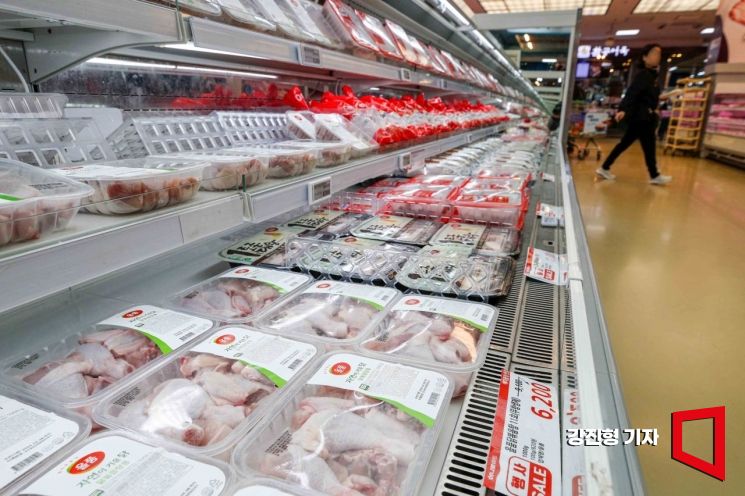 On the 3rd, at Hanaro Mart Yangjae Branch in Seocho-gu, Seoul, chicken is being sold at a discount as part of the government's policy to stabilize prices of agricultural and livestock products. Photo by Kang Jinhyung aymsdream@
According to the Ministry of Agriculture, Food and Rural Affairs, the government decided to impose a complete ban on the import of Brazilian hatching eggs (eggs for chick incubation), table eggs, day-old chicks, poultry meat, and related products starting from May 17. This measure was taken in response to the outbreak of highly pathogenic avian influenza (HPAI) at a Brazilian breeding farm.
As of last year, the total volume of chicken imported into Korea was about 220,000 tons, with Brazilian chicken accounting for approximately 180,000 tons. Park Sungho, a researcher at LS Securities, stated, "Given that domestic chicken consumption last year was about 740,000 tons, a rise in domestic broiler prices due to supply shortages is inevitable," and added, "Even if all of the roughly 60,000 tons of domestically produced chicken currently exported were redirected to the domestic market, some supply gaps would likely remain."
However, the impact on the industry is expected to be limited. Park explained, "Considering that total domestic chicken production is 620,000 tons and the self-sufficiency rate was 83% as of last year, the effect on the domestic industry should be limited," and added, "Any import shortfall could be partially offset by imports from third countries or by using existing stockpiles."
He further stated, "The main demand for Brazilian chicken comes from large supermarkets and convenience stores, and most major chicken franchise chains use domestically produced chicken, so direct damage from the import ban should be minimal. In the case of eggs, the share of Brazilian imports is extremely low, so there is expected to be no impact on domestic food and dining ingredient supplies."
© The Asia Business Daily(www.asiae.co.kr). All rights reserved.

















