Writing in Both Japanese and German: Yoko Tawada
A Journey to Germany in 1979, Learning German for Survival
Experiencing Her Mother Tongue as Unfamiliar Expanded Her Literary Horizons
Classical and Dialectal Language, Not Just Foreign Tongues, as Valuable Mediums
Yoko Tawada, a bilingual author who writes in both German and Japanese, has swept numerous multinational literary awards, including Japan's most prestigious Akutagawa Prize, the Tanizaki Junichiro Prize, the Yomiuri Literary Prize, and Germany's Goethe Medal. She does more than simply write in two languages?she has achieved critical acclaim and widespread popularity in both countries. While many bilingual writers are part of a diaspora due to involuntary migration, Tawada has voluntarily crossed linguistic boundaries, expanding her linguistic world and, based on this expansion, confronting her mother tongue with a sense of unfamiliarity to reveal new modes of expression through what is called 'exophony.'
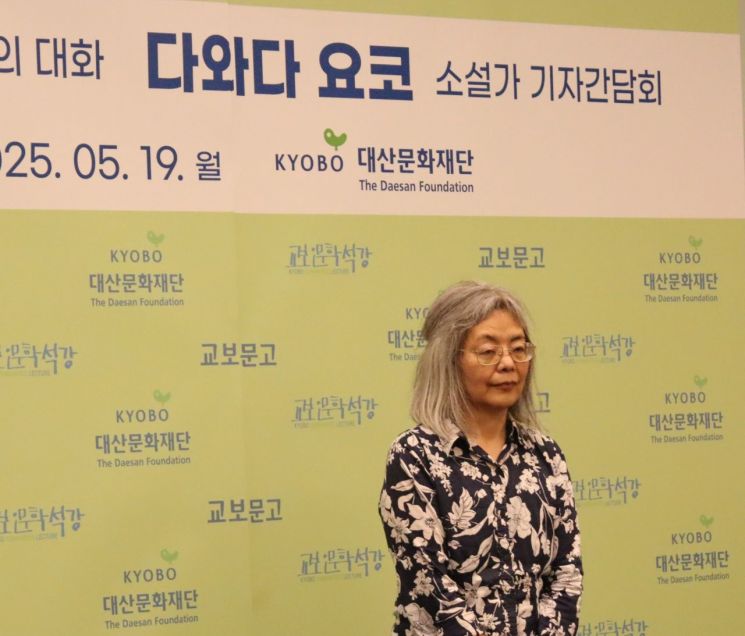 On the afternoon of the 19th, artist Yoko Tawada spoke at a press conference held at the Kyobo Building in Gwanghwamun. Daesan Foundation
The beginning of her exophony dates back to 1979, when she traveled alone to Germany on the Trans-Siberian Railway. She went to Hamburg for a training opportunity and, in order to survive, learned German from scratch. Immersed in learning a foreign language, she temporarily lost her sensitivity to her native language, which led her to experience the world and objects from a completely different perspective. This became a key turning point in the unique literary world that Tawada presents.
The 'Hiruko Trilogy'?comprising "Etched on the Earth" (2018), "Shimmering on the Stars" (2020), and "The Island of the Sun" (2022)?is a representative example of exophony in her work. These novels follow the protagonist, Hiruko, who embarks on a journey to find someone who speaks her language after her country disappears from the earth during her travels in Europe. The trilogy is highly regarded for its deep exploration of language, a hallmark of Tawada's literary world. Hiruko's creation of an artificial language to communicate with various travel companions offers profound insights into the mysteries of human language.
Tawada sometimes chooses the language of her work from the outset, while at other times she changes it at the end of the writing process. She explains that she usually writes in Japanese when she wants to delve deeply into the story itself, and in German when she wishes to explore abstract ideas. There are cases where she starts in Japanese and switches to German after finishing, and vice versa.
There are significant advantages to writing literature in two languages. At a press conference held at the Kyobo Building in Gwanghwamun on the 19th, Tawada said, "When one language reaches its limits, I can develop new ideas in another language. Another advantage is that I can reconsider what I am writing from the perspective of an outsider." She added, "The benefit of exophony is the experience of stepping outside your mother tongue. This does not necessarily have to be a foreign language. Experiences of stepping away from classical, dialectal, or standard literary language all fall under this category."
Although she enjoys translation, Tawada is skeptical about machine translation by artificial intelligence (AI). She believes that as the amount of data increases, the quality of translation deteriorates. She said, "As more and more translation data from unspecified sources is input, the quality continues to decline. I don't think it will succeed in the long run. However, I am curious about the results if the data of a single translator were to be continuously trained."
For an author who enjoys moments of unfamiliarity, travel holds deep meaning. In particular, she recalls that being alone in a foreign country in the days before smartphones allowed for the unique pleasure of encountering others purely as human beings. When in unfamiliar places, she enjoys the freedom of having 'nothing to do,' sometimes simply gazing blankly at the streets. Unfortunately, she said that her schedule in Korea has been so busy that she has not had time to enjoy such leisure.
Tawada's visit to Korea is filled with a busy itinerary. On the 19th at 7 p.m., she will take the stage at the Kyobo Humanities Lecture. On the 20th at 4 p.m., she will participate in a reading hosted by the German Cultural Studies Institute at Seoul National University. On the 21st at 7:30 p.m., she will join a book talk organized by Eunhaengnamu, and on the 22nd at 7:30 p.m., she will attend another book talk hosted by Minumsa.
© The Asia Business Daily(www.asiae.co.kr). All rights reserved.
![Clutching a Stolen Dior Bag, Saying "I Hate Being Poor but Real"... The Grotesque Con of a "Human Knockoff" [Slate]](https://cwcontent.asiae.co.kr/asiaresize/183/2026021902243444107_1771435474.jpg)
















