Moody's Also Downgrades US Credit Rating
US Stock Futures Fall Across the Board
Concerns Rise Over Renewed "Triple Weakness" in Currency, Bonds, and Stocks
Warnings have emerged that the risk of a "triple weakness"?a simultaneous decline in the three major asset classes of currency, bonds, and stocks?could re-emerge in the US financial markets. This concern stems from the possibility that the recent "sell-off of US assets," which had somewhat subsided following progress in US-China trade negotiations, could be reignited by a downgrade in the US credit rating. In fact, when the US credit rating was downgraded in 2011, a large-scale sell-off of US assets occurred. On May 19, the first trading day after Moody's downgraded the US credit rating, major Asian stock markets?including South Korea, Japan, and Australia?opened lower across the board.
According to CNBC on May 18 (local time), after Moody's downgraded the US sovereign credit rating by one notch from 'Aaa' to 'Aa1' for the first time in 108 years, US stock futures fell across the board. Specifically, after 6:00 p.m. Eastern Time that day, Dow Jones Industrial Average futures dropped by 292.9 points (0.7%), while S&P 500 futures and Nasdaq 100 futures fell by 0.7% and 0.8%, respectively. This credit rating downgrade occurred immediately after a temporary tariff-easing agreement between the Donald Trump administration and China, which had led to a rebound in stock prices.
The market is closely monitoring the aftermath of the Moody's announcement, as a downgrade?which signals a decline in credibility?can put downward pressure on the dollar. There is precedent for this as well. When S&P downgraded the US credit rating in 2011, the exchange rate, which had been 79 yen per dollar before the announcement, rose to the 77 yen range within two days. During the same period, the US stock market also experienced a sharp correction, with the Dow Jones index falling by more than 500 points.
Signals of a weakening dollar have also been detected following the credit downgrade. Last week, progress in US-China negotiations eased uncertainties over US tariff policy, causing the dollar to rise and show signs of breaking through resistance. However, due to a lack of decisive upward catalysts, the dollar ultimately reversed into a decline. Even just before Moody's downgrade, the dollar index had been rising as real expected inflation was confirmed, but after the Moody's announcement, it fell back to the 100 range. On the 16th, the dollar index closed at 100.946, up 0.22% from the previous day.

The downgrade of US Treasury credit could also increase selling pressure on US stocks, leading some to expect continued selling of US equities for the time being. Tomoichiro Kubota, chief market analyst at Matsui Securities, said, "With Moody's joining S&P and Fitch in lowering the credit rating, the market will officially assess the US as less credible," adding, "In the short term, the trend of selling US stocks could intensify."
Nobuhide Kiuchi, chief economist at Nomura Research Institute, warned, "Congressional negotiations on extending tax cuts are being delayed, and there is a growing perception that protectionist tariff policies could negatively impact the US economy," adding, "We need to be mindful of the possibility of a repeat of the financial market instability seen in April." In April, a series of tariff hikes by President Donald Trump heightened market uncertainty, prompting a broad sell-off of US assets in global markets. Indeed, after reciprocal tariffs were announced on April 2, the S&P 500 index plunged more than 12% over six days, and the dollar index, which measures the value of the dollar against major currencies, also fell by nearly 9% from January to mid-April this year.
However, some believe the impact of the US credit rating downgrade will be limited. The reasoning is that if risk aversion intensifies, funds could flow into highly liquid US Treasuries. In other words, even if the credit rating is lowered, a volatile market could actually increase demand for US Treasuries.
Keiichi Iguchi, chief strategist at Resona Holdings, explained, "Historically, US Treasuries are sold and yields rise immediately after a downgrade, but as risk aversion strengthens, Treasuries are bought again and yields actually fall." In fact, during the 2011 US credit rating downgrade, US Treasuries saw strong buying.
On Wall Street, many believe that the impact on the market will be limited since the federal government debt problem is already a well-known risk. Kim Forrest, Chief Investment Officer (CIO) at Bokeh Capital Partners, predicted that the market impact of the downgrade would be limited, stating, "Bond investors are already aware of the debt problem."
However, there are also warnings that this move could trigger selling of US Treasuries and undermine the status of dollar assets. Max Gokhman, Vice President and CIO at Franklin Templeton, warned, "The (tax cut) plan currently under discussion in Congress will further accelerate the fiscal deficit," adding, "As investors gradually shift from Treasuries to other safe assets, this will lead to a decline in US Treasury prices, further depreciation of the dollar, and a decrease in the attractiveness of US stocks." He noted that unless the US fiscal deficit issue is fundamentally resolved, the triple weakness phenomenon could reoccur.
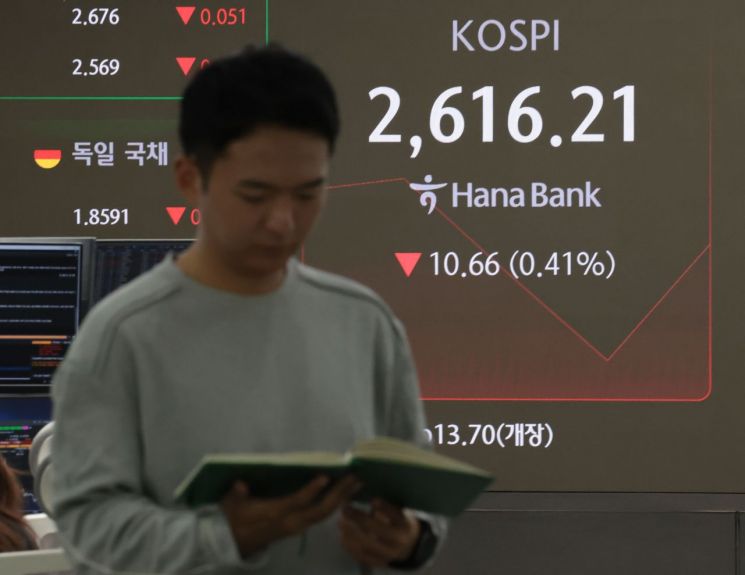
Major Asian stock markets, including South Korea, Japan, and Australia, all opened lower. On May 19, the KOSPI index started at 2,613.70, down 13.17 points (0.50%) from the previous trading day, and by around 10:21 a.m., the decline had widened to over 1%, dropping below the 2,600 mark. The KOSDAQ index also opened down 0.52% at 721.27, and its losses widened to more than 1.8%. The Nikkei index opened at 37,572.36, down 181.36 points (0.48%), and Australia's ASX also started 0.15% lower.
However, analysts noted that US fiscal risks had already been partly priced in, and that recent positive developments, such as the conclusion of US-China tariff negotiations, were supporting investor sentiment to some extent.
Kim Daejun, a researcher at Korea Investment & Securities, analyzed, "The stock market will calculate what kind of trend this issue will bring," adding, "There may be a temporary pause in the process, and in fact, it is a time when the momentum for a global stock market rally is weakening."
© The Asia Business Daily(www.asiae.co.kr). All rights reserved.
![Clutching a Stolen Dior Bag, Saying "I Hate Being Poor but Real"... The Grotesque Con of a "Human Knockoff" [Slate]](https://cwcontent.asiae.co.kr/asiaresize/183/2026021902243444107_1771435474.jpg)

















