Oh Sehoon Presides Over "Seoul Walking with the Vulnerable" Debate
Kim Moonsoo and Lee Junseok Attend... New Welfare Model Draws Interest
Policy Analysis and Achievement Sharing... Seeking Points of Policy Exchange and Application
The Seoul Metropolitan Government is seeking ways to expand its policies for supporting the vulnerable, namely "Didimdol Income" and "Seoul Learn." The goal is to develop advancement strategies for each field, identify areas for collaboration, and generate synergistic effects.
On the morning of the 19th, Seoul Mayor Oh Sehoon presided over the "Seoul Walking with the Vulnerable" debate at Seoul City Hall, expressing his commitment to expanding "Didimdol Income" and "Seoul Learn" nationwide.
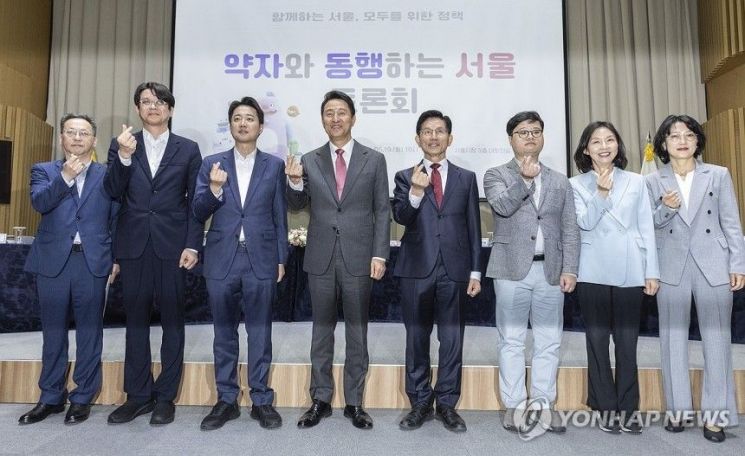 Seoul Mayor Oh Sehun, People Power Party presidential candidate Kim Moonsoo, Reform New Party presidential candidate Lee Junseok, and other guests attended the "Seoul Debate Walking with the Vulnerable" held at Seoul City Hall in Jung-gu, Seoul on the 19th and took a commemorative photo. Photo by Yonhap News
This event was organized to share the operational achievements of "Didimdol Income," now in its third year of policy experimentation, and "Seoul Learn," in its fourth year, as well as to promote their nationwide expansion and establish a new welfare model. The debate drew attention with the attendance of People Power Party presidential candidate Kim Moonsoo and Reform New Party candidate Lee Junseok.
"Didimdol Income" is a system that supplements the household income of families whose income is at or below 85% of the median income, making up the shortfall compared to the standard income. It is a progressive policy that provides more support to those with lower incomes. Because participant households are selected solely based on income and asset criteria, low-income families who fall through the cracks of existing welfare systems can also receive support. In addition, eligibility is maintained even if the income standard is exceeded, so as not to discourage work motivation. Currently, Seoul is providing Didimdol Income to a total of 2,076 households.
"Seoul Learn" offers free access to quality online lectures and one-on-one mentoring services through the Seoul Learn platform to vulnerable students aged 6 to 24 who face difficulties accessing private education due to social or economic reasons, thereby providing fair educational opportunities. As of the end of last month, approximately 34,000 people were using the service.
The debate began with an introduction to the "Didimdol Income" and "Seoul Learn" policies, followed by thematic discussions involving experts and beneficiaries. Experts presented on the role of these policies as representative initiatives for supporting the vulnerable, strategies for sustainable implementation, and ways to elevate them to national policy agendas. Kim Hyuncheol, a professor at the Hong Kong University of Science and Technology and a member of the joint research team for the Didimdol Income pilot project, emphasized, "Didimdol Income brings positive changes to individuals' lives and, in particular, helps stabilize the lives of the vulnerable, thereby contributing to strengthening the social safety net. It is a new welfare model that plays an important role in alleviating social inequality and promoting economic self-reliance."
Lee Bongjoo, a professor at Seoul National University, also stated that Didimdol Income is a representative project that can address many limitations of the current social security system by providing a higher level of guarantee than existing systems and significantly strengthening work incentives. He added that by cooperating with the central government to resolve remaining issues such as securing funding and linking with social services, Didimdol Income is expected to play a crucial role in laying the foundation for a future-oriented social security system in Korea, going beyond the level of an income security system.
Stories were also shared from citizens who experienced positive changes through Seoul Learn. The debate was further enriched by the attendance of a citizen who, after entering university with the help of Seoul Learn, is now serving as a mentor for younger students and spreading positive influence. Kim Sanghyun, a research fellow at the Seoul Institute, said, "A two-year follow-up study on the outcomes of Seoul Learn confirmed effects such as expanded educational opportunities, reduced private education expenses, and improved learning capabilities. In households with high school students, the highest levels of improvement were observed in all areas, including academic performance and classroom behavior."
The Seoul Metropolitan Government plans to actively incorporate the opinions expressed at this debate into policy, and to establish these programs as the city's flagship initiatives for supporting the vulnerable by expanding the programs and their target groups. The city also aims to seek joint development strategies by sharing the two policies. Research to expand "Didimdol Income" began in March last year, and this year, in-depth studies will continue, including research on gradual expansion measures and the development of customized implementation models for local governments.
© The Asia Business Daily(www.asiae.co.kr). All rights reserved.
![Clutching a Stolen Dior Bag, Saying "I Hate Being Poor but Real"... The Grotesque Con of a "Human Knockoff" [Slate]](https://cwcontent.asiae.co.kr/asiaresize/183/2026021902243444107_1771435474.jpg)















