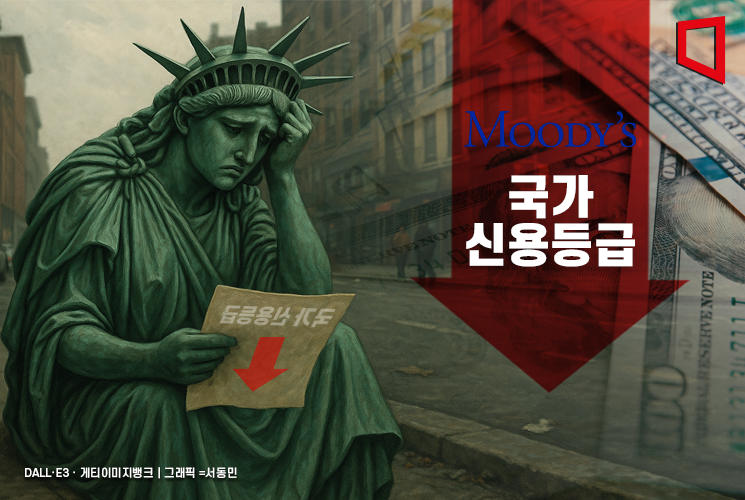
The government assessed that the impact of Moody's downgrade of the US credit rating on Korea's financial and foreign exchange markets would be limited. This is because the risk has already been exposed to the market, and considering the trends following the downgrades by the other two major credit rating agencies, it is unlikely that the ripple effect will be strong enough to change overall market trends.
On May 19, the Ministry of Economy and Finance held a conference call with relevant institutions to assess the market impact of the US credit rating downgrade by Moody's, a global credit rating agency. The Bank of Korea, the Financial Services Commission, the Financial Supervisory Service, and the International Finance Center participated in the call.
Previously, on May 17, Moody's, one of the world's three major credit rating agencies, downgraded the US sovereign credit rating from the highest grade of 'Aaa' to 'Aa1', one notch below, and revised the outlook from 'negative' to 'stable'. As a result, the United States lost its top rating from all three major credit rating agencies, following the downgrades by S&P in 2011 and Fitch in 2023.
Moody's cited chronic increases in national debt, mounting fiscal deficits, and a growing interest burden due to rising interest rates as the reasons for the downgrade. As of the end of last year, the US federal government debt stood at nearly 124% of GDP, putting significant pressure on the country.
The government predicted that the market turbulence caused by Moody's downgrade would not be significant. Participants evaluated, "Moody's downgrade of the US credit rating is a belated move to align with other rating agencies, and considering that Moody's had already maintained a 'negative' outlook on the US rating, this action was largely anticipated. Therefore, its impact on the market is expected to be limited."
In August 2011, when S&P downgraded the US credit rating for the first time in history amid the Eurozone fiscal crisis, it triggered a shock in the US stock market and led to a decline in stock prices. However, when Fitch downgraded the rating in August 2023, the US stock market fell by only 1.4% on the day.
However, there was also attention given to the possibility that the downgrade could weaken confidence in US Treasury bonds and increase market volatility in the short term. There are concerns that, in addition to recent instability in the foreign exchange market due to expectations that the US will use exchange rates as a tool in tariff negotiations, this could serve as an additional negative factor. After news of the downgrade, the won-dollar exchange rate opened at 1,395.1 won in the Seoul foreign exchange market, up 5.5 won from the previous session.
Participants stated, "This downgrade, together with existing external uncertainties such as tariff negotiations between major countries and the United States and the US economic situation, could act as a factor increasing volatility in the financial and foreign exchange markets in the short term. We will closely monitor domestic and international financial and foreign exchange market trends based on close cooperation among relevant agencies, including the Macroeconomic and Financial Issues Meeting (F4 Meeting)."
© The Asia Business Daily(www.asiae.co.kr). All rights reserved.
![Clutching a Stolen Dior Bag, Saying "I Hate Being Poor but Real"... The Grotesque Con of a "Human Knockoff" [Slate]](https://cwcontent.asiae.co.kr/asiaresize/183/2026021902243444107_1771435474.jpg)
















