Pilot Program Extension... Laying the Foundation for Institutionalization
Separate Surveys for Users and Managers... Including Wage Issues
High Cost Burden Remains... Government Says "It Won't Be Easy"
The Seoul Metropolitan Government is set to conduct a fact-finding survey on the pilot project for foreign housekeeping managers. Although the project has struggled to move forward due to lack of demand, the city aims to assess the outcomes of the pilot program and use the findings as a foundation for institutionalizing the system.
According to the Seoul Metropolitan Government and other sources on the 19th, the city has recently begun a survey of users and managers involved in the foreign housekeeping service pilot program, focusing on work conditions and policy needs.
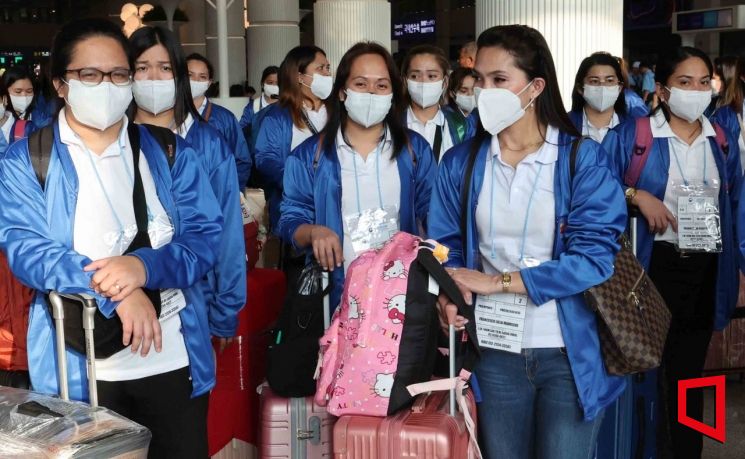 The arrival of Filipino housekeepers participating in the pilot project for foreign housekeeping managers. Photo by Airport Photojournalists Group
The foreign housekeeping manager program was proposed and promoted by Seoul Mayor Oh Se-hoon as part of measures to address low birth rates. The initiative attracted attention as a solution for caregivers who have had to interrupt their careers or forgo childbirth due to soaring care costs, in a context where the number of domestic care workers is decreasing and aging.
The program has been subject to controversy. Since foreign workers are paid the same hourly minimum wage as domestic workers, the high cost burden has raised questions about its effectiveness. For this reason, the main project to expand the service beyond Seoul was canceled, and the pilot program was extended for another year.
In response, the Seoul Metropolitan Government has decided to examine the outcomes of the foreign housekeeping manager pilot project by sector through the fact-finding survey. The survey targets 148 households using the service, 89 Filipino housekeeping managers, and the service providers. For households, the survey will examine changes in childcare activities after using the service and their willingness to continue or expand service use. For the housekeeping managers, the survey will check on working conditions, wage issues, and whether they plan to change jobs or return to their home country after the pilot ends.
The results of the survey will be used as a basis for expanding service use and advancing the main project. After the pilot program ended, the Seoul Metropolitan Government stated that "both the households and the housekeeping managers reported very high satisfaction, indicating that the project achieved its intended results and proved effective as a future alternative to labor shortages in the care sector." During the extension process in March, the number of participating households decreased from 185 to 148, but more than 90%?specifically, 135 households (91.2%)?chose to continue using the service through contract renewal. Thirteen households (8.8%) newly registered as users, and 102 households are currently on the waiting list for the service.
However, the cost burden for users remains a contentious issue. The fee has been adjusted to 16,800 won (compared to 13,940 won during the pilot program) to reflect operating and management costs. For 40 hours of service per week (8 hours per day), the monthly fee (including weekly holiday allowance) has increased by 497,640 won, rising from 2,425,560 won to 2,923,200 won. Furthermore, the government has stated that it does not plan to provide any separate financial support. Kim Minseok, Acting Minister of Employment and Labor, recently commented on the transition of the Filipino housekeeping manager program to a main project this year, saying, "It will not be easy, as the cost issue remains unresolved."
As a result, even if the service is further extended, it is expected that most users will continue to be concentrated in the Gangnam area. At the beginning of the pilot project, more than 30% of users were already concentrated in the "three Gangnam districts." At that time, 33.8% of the 157 households selected as users lived in the three Gangnam districts (Gangnam, Seocho, and Songpa).
© The Asia Business Daily(www.asiae.co.kr). All rights reserved.

















