Restructuring the Wage System and Improving the 52-Hour Workweek Regulation
Investing Over 5% of the National Budget in R&D
Expanding Energy Supply Capacity Through Nuclear Power Utilization
Kim Moonsoo, the presidential candidate of the People Power Party, announced his intention to overhaul the economic landscape through a set of economic pledges focused on dismantling various regulations.
On May 18, at the People Power Party headquarters in Yeouido, Seoul, Kim held a policy announcement event where he stated, "To overcome the crisis of a '0% potential growth rate,' I will decisively overhaul the economy by removing the shackles on businesses."
Kim first proposed the establishment of a Regulatory Innovation Agency. He explained that integrating the regulatory reform functions and regulatory sandbox systems currently scattered across various ministries into the new agency would enhance both operational efficiency and implementation capability.
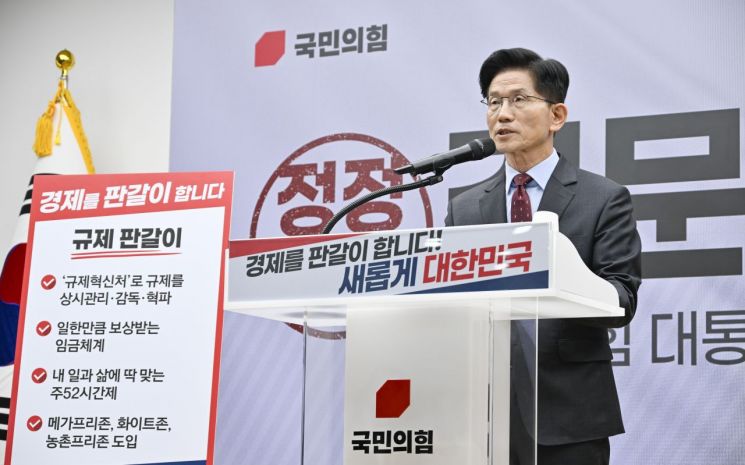
He also put forward labor reforms through wage system restructuring and improvements to the 52-hour workweek regulation. Kim outlined plans to ease the procedures for amending work rules, thereby enabling a wage system that compensates workers according to their performance. Additionally, he pledged to revise the 52-hour workweek regulation so that employees can work and rest according to their preferences. Kim stated, "Since work-life balance is also important, I will expand flexible work arrangements to broaden choices," and promised to extend the minimum unit for flexible and variable work schedules to at least half a year.
For easing regional regulations, Kim said he would enable local governments to make independent decisions and implement reforms. He explained, "When a local government head applies for regulatory exceptions, the central government will adjust the legal framework and introduce a 'Mega Free Zone,' granting local leaders the authority to apply exceptions to policies such as the minimum wage and working hours regulations." He also proposed the introduction of a 'White Zone,' which would grant local governments the authority to establish creative development plans, and the creation of 'Nongchon Free Zones,' which are self-regulatory innovation districts in rural areas.
To foster future industries such as artificial intelligence (AI), Kim pledged an 'infrastructure overhaul.' In particular, he proposed an 'energy mix' strategy to ensure stable power supply, which is key to nurturing advanced industries. Kim emphasized, "With a realistic energy mix strategy that utilizes not only renewable energy but also gas and nuclear power, we will greatly expand our energy supply capacity for the AI era."
He also promised to strengthen research and development (R&D) infrastructure. This includes investing at least 5% of the national budget in R&D and expanding national strategic technology R&D to 10 trillion won within five years. Kim also unveiled plans to increase the number of students in AI graduate programs and to train 200,000 AI professionals through global university partnerships.
Kim announced plans to establish the "Korea Technology 3+1 (AI, Bio, Quantum + Space) Committee," which the president would chair on a regular basis, and to invest over 100 trillion won in initiatives such as the "AI Public-Private Fund" to build an artificial intelligence ecosystem.
As support measures for the venture ecosystem, Kim pledged to expand government-backed fund resources to a total of 20 trillion won by 2030 and to foster 20,000 TIPS (Tech Incubator Program for Startups) companies over the next five years.
© The Asia Business Daily(www.asiae.co.kr). All rights reserved.
![Clutching a Stolen Dior Bag, Saying "I Hate Being Poor but Real"... The Grotesque Con of a "Human Knockoff" [Slate]](https://cwcontent.asiae.co.kr/asiaresize/183/2026021902243444107_1771435474.jpg)
















