Sales Suspended for Product from Former Unification Church Affiliate
Distributor States "Unaware of Affiliation"... Voluntarily Halts Sales
At the 'Osaka·Kansai Expo' (Osaka Expo) held in Osaka, Japan, sales of 'Makcol', Korea's first barley carbonated beverage, have been suspended. This is because the product is made by a company affiliated with the Family Federation for World Peace and Unification (formerly the Unification Church).
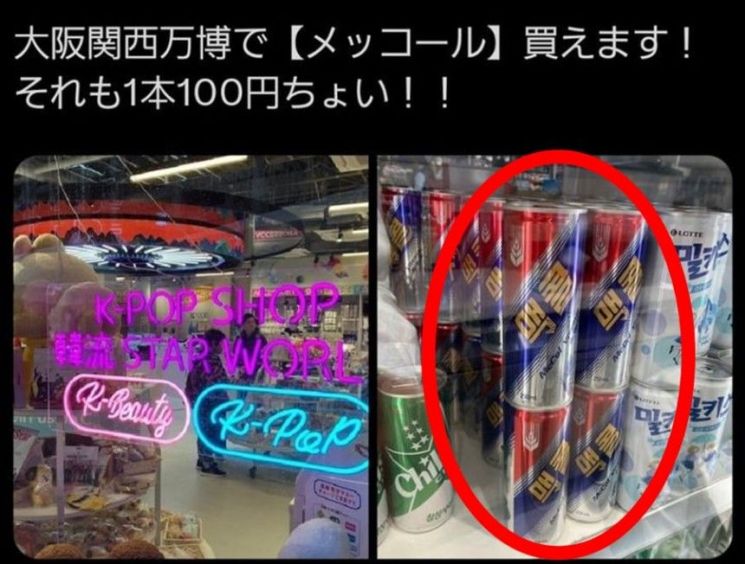 A photo of Makcol displayed in a booth at the Osaka Expo exhibition hall (inside the red circle) is causing controversy on Japanese social networking services (SNS). Screenshot from X (formerly Twitter)
On May 14, the Sankei Shimbun reported that a booth selling K-pop merchandise, Korean cosmetics, and Korean food products at the Osaka Expo exhibition hall, which opened on April 14, recently stopped selling Makcol. The company operating this booth is an importer and distributor of Korean food products, headquartered in Tokyo. However, after posts on social networking services (SNS) sparked controversy over the sale of Makcol at this booth, the media requested confirmation from the company. The company stated, "We did not know that the manufacturer was affiliated with the Unification Church," and voluntarily suspended sales.
Makcol is a product of Ilhwa, a food and beverage company affiliated with the Family Federation for World Peace and Unification. The Family Federation for World Peace and Unification, established in Korea in 1954, has been operating as a religious corporation in Japan since 1964. However, it became a social issue after it was revealed that followers were forced to make large donations or were coerced into purchasing 'spiritual goods.' In particular, in July 2022, the shock in Japanese society intensified after the assassin of former Prime Minister Shinzo Abe revealed that his motive was that his family had been ruined because his mother had made large donations to the Unification Church.
For these reasons, on March 25, the Tokyo District Court accepted the Ministry of Education, Culture, Sports, Science and Technology's request for the dissolution of the Family Federation for World Peace and Unification. At the time, the court stated that "the number of victims who suffered financial losses from donations exceeds at least 1,500, and the total damages amount to 20.4 billion yen (about 200 billion won)," and issued the dissolution order based on the Religious Corporations Act, stating that "the scale of damage is unprecedented."
However, Tokunaga Shinichi, the attorney representing the Family Federation for World Peace and Unification's affiliated organizations, emphasized, "Excluding even foreign products is an excessive reaction, and could be considered hate speech," adding, "Japanese people should calmly reflect on the dangers of social prejudice."
Meanwhile, Makcol, which was launched in 1982, is exported to the United States, Japan, Russia, Australia, South Africa, and other countries, and as of the end of last year, cumulative sales reached 6.4 billion cans. Sankei described Makcol as "having a dedicated fan base, but also nicknamed 'the world's worst-tasting cola' due to its unique flavor," and explained that "in Japan, after incidents of cans bursting, it is now sold only at some Korean supermarkets and similar outlets."
© The Asia Business Daily(www.asiae.co.kr). All rights reserved.
![Clutching a Stolen Dior Bag, Saying "I Hate Being Poor but Real"... The Grotesque Con of a "Human Knockoff" [Slate]](https://cwcontent.asiae.co.kr/asiaresize/183/2026021902243444107_1771435474.jpg)
















