Future Energy Policy Institute Power Forum
"New Business Models Needed, Such as VPP and Sector Coupling...
Discussion Required on Regional Reorganization of Public Power Generation Companies"
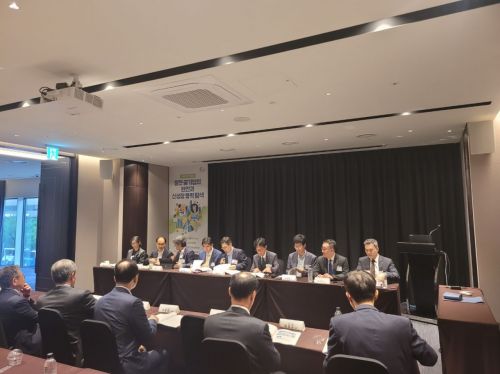 The 48th Power Forum hosted by the Future Energy Policy Institute is taking place on the 16th at EL Tower in Yangjae, Seoul. Photo by Heejong Kang
The operating rates of the five power generation subsidiaries of Korea Electric Power Corporation (KEPCO) have dropped sharply, with all falling below 50%. As the closure of coal-fired power plants becomes a foregone conclusion and renewable energy expands, there are growing calls to restructure the roles and business models of these five power generation companies.
At the 48th Power Forum hosted by the Future Energy Policy Institute under the theme "Current Issues and Exploration of New Growth Engines for Power Generation Public Enterprises," held on the 16th at EL Tower in Yangjae, Seoul, Yoonseong Kim, CEO of Energy and Space, stated as the keynote speaker, "None of the five power generation public enterprises had an operating rate exceeding 50% in 2024," and added, "The current system of power generation public enterprises is failing to lead the energy transition in the domestic power sector."
From January to October last year, the utilization rates of generators were as follows: Korea South-East Power 48.8%, Korea Southern Power 37.3%, Korea East-West Power 41.6%, Korea Western Power 36.1%, and Korea Midland Power 49.6%?all below 50%. The share of these five companies in total power transactions also fell sharply from 61.9% in 2010 to 34% in 2024. Yoonseong Kim emphasized, "This situation inevitably leads to a serious management crisis and reduced investment," and stressed the need for analysis and evaluation of the causes.
The sharp decline in the operating rates of the five power generation companies is attributed to a combination of factors: the gradual closure of coal-fired power plants, the emergence of private power producers, and the expansion of renewable energy. As the share of renewable energy increases in the future, the role of public power generation companies is expected to become even more limited.
According to the 11th Basic Plan for Long-term Electricity Supply and Demand, the share of coal power generation will decrease from 31.4% in 2023 to 10.1% in 2038, while the share of renewable energy will rise from 8.4% to 29.2% over the same period. The share of LNG power generation will also fall from 26.8% to 10.6%.
Yoonseong Kim pointed out, "Currently, public power generation companies do not possess sufficient scale for large-scale renewable energy development," and added, "Most of the increasing renewable energy capacity will be handled by the private sector going forward." Even in specialized businesses such as offshore wind power, some public enterprises' articles of incorporation only specify "construction project management" and do not explicitly mention "operation management." Yoonseong Kim emphasized, "As we enter a major energy transition, it is time for a vision and detailed plan regarding the changing roles of public institutions responsible for energy supply."
Taeui Lee, director at the Korea Energy Economics Institute, noted, "Although the five power generation companies are market-oriented public enterprises, they have not been able to operate autonomously due to involuntary power mix, restrictions on investment areas, a rigid labor market, and a lack of incentives for profit-seeking." According to the Korea Energy Economics Institute, the power generation of the five companies decreased by about 30%, from 280 GWh in 2014 to 197 GWh in 2024. Taeui Lee suggested, "The five power generation companies need to redefine their roles by introducing new business models such as virtual power plants (VPP) and sector coupling (converting surplus renewable energy into heat, gas, etc.)."
Sungyong Son, a professor at Gachon University who participated as a panelist, said, "There needs to be a discussion on what roles public power generation companies should play in the new power industry," and suggested, "To provide integrated energy services such as VPP, it is necessary to reorganize the five power generation companies, which are currently dispersed nationwide, into regional units."
However, there were also opinions that it is inevitable to run existing business models in parallel. Seungshin Choi, CEO of C2S, stated, "For the sustainable growth of public power generation companies, it is necessary to balance existing businesses with new growth engines and to actively pursue overseas projects." Seungshin Choi argued, "After the European energy crisis, Siemens Energy has thrived by offsetting sluggish renewable energy business with its traditional power generation business, while Orsted, which went all-in on renewables, suffered losses due to high interest rates, structural flaws, and rising supply chain costs."
Taekdong Kim, director at Korea Hydro & Nuclear Power, said, "Overseas, feasibility studies have already been conducted on converting sites of decommissioned coal power plants into small modular reactor (SMR) facilities," and suggested that South Korea should also consider promoting SMR projects utilizing coal power plant sites. According to the U.S. Department of Energy (DOE), about 80% of the 370 coal power plants in the United States that are closed or still operating are considered suitable for conversion to SMRs. In fact, in Wyoming, Pacificorp, in partnership with TerraPower founded by Bill Gates, is pursuing the construction of an SMR on the site of a decommissioned coal power plant.
© The Asia Business Daily(www.asiae.co.kr). All rights reserved.
![Clutching a Stolen Dior Bag, Saying "I Hate Being Poor but Real"... The Grotesque Con of a "Human Knockoff" [Slate]](https://cwcontent.asiae.co.kr/asiaresize/183/2026021902243444107_1771435474.jpg)















